
Santa Ana Gas Line installs, repairs and replaces gas piping throughout Yorba Linda, California. A great deal of the work here is buried, and it is buried in ground that is rarely flat — graded parcels, cut-and-fill pads and slopes that change what a trench has to do.
A trench on level ground is a straightforward piece of work. The same trench on a grade behaves differently: cover depth varies along its length, water uses it as a path, and backfill that would settle harmlessly on the flat can migrate downhill instead. None of that is exotic, but all of it has to be planned rather than discovered.
So the excavation is usually the part of the job that deserves the most thought here, not the pipework. Where the trench runs, how deep it sits at each point, and how the ground is put back afterwards determine whether the installation is still sound after several wet winters have passed over it.
What Slope Does to a Trench
Depth of Cover on a Grade
Cover is measured from the surface directly above the pipe, and on a slope that surface is moving relative to the pipe the whole way along. A trench dug at a consistent depth from the machine’s point of view can end up shallow partway down and needlessly deep at the bottom. The machine reads its own depth honestly; it simply is not measuring the thing the code cares about.
We set the depth against the finished grade at each point rather than against the start of the run. Getting that wrong in the shallow direction is the one that matters, because it puts the line within reach of future landscaping and anyone digging in it.
Water Follows the Trench
A backfilled trench is looser than the ground around it, which makes it the easiest path available to any water arriving from above. On a slope that turns a trench into a drain, and a drain that runs alongside a gas line is not what anybody intended to build. Water moving along a run also moves the bedding that supports it, which is the slower half of the problem.
We compact in layers rather than filling in one pass, and where a run crosses a slope we take that drainage path into account when choosing the route. It costs a little more time at backfill and it prevents a channel forming where the trench was.
Working Down the Slope Rather Than Across It
Running straight across a face is often the shortest route and rarely the best one. A run angled down the slope generally gives more consistent cover, keeps the spoil manageable and gives a machine somewhere sensible to stand. It is usually a longer trench and a better installation, and we would rather explain that than quietly take the short line.
Route selection here is worth more than speed of excavation. We would rather walk the ground with the customer and agree a route that is stable than take the direct line and rely on the backfill to hold it. Ground that has been cut and filled once will move again, and the route is what decides whether that matters.
Looking for gas line closer to Hawaiian Gardens? See Gas Line in Hawaiian Gardens.
Materials and Fittings for Buried Work
Polyethylene and the Transition
Buried gas line is polyethylene — PE 2708 or PE 4710 — rather than steel, because it does not corrode in the ground and it tolerates ground movement far better than a rigid material does. On a graded parcel that flexibility is doing real work every season rather than only in an earthquake.
It comes back above ground through an anodeless riser, and that transition is the point the whole run depends on. It is also the point most exposed to damage from a mower, a vehicle or a landscaper, so where it surfaces is a decision rather than an accident. We put it somewhere protected and we point it out at handover.
Tracer Wire and Finding It Later
Polyethylene is invisible to a locator, which is why tracer wire is run over the top of it. Without that wire the line cannot be found later by anyone, including us, and the next person to dig on the property is working blind, which on a parcel this size means a long afternoon and a reasonable chance of hitting it.
We run the wire, we terminate it where it can be accessed, and we photograph the route and depth before anything is covered. Those photographs go to the customer so the next trade on site inherits the information rather than guessing at it.
Backfill and Compaction
Bedding matters as much as depth. The pipe sits on material that supports it evenly along its length rather than on rubble that concentrates load onto single points, and the first layer over it is selected rather than whatever came out of the trench. Rock bearing directly on polyethylene is a slow failure rather than an immediate one, which is why it survives the test and surfaces years later.
We backfill and compact properly, and hardscape, turf and planting go back the way they were found. On a slope, settlement is not merely cosmetic — a depression that collects water above a gas line is the start of the next problem.
Standby Generators and Detached Structures
Sizing the Run to the Generator
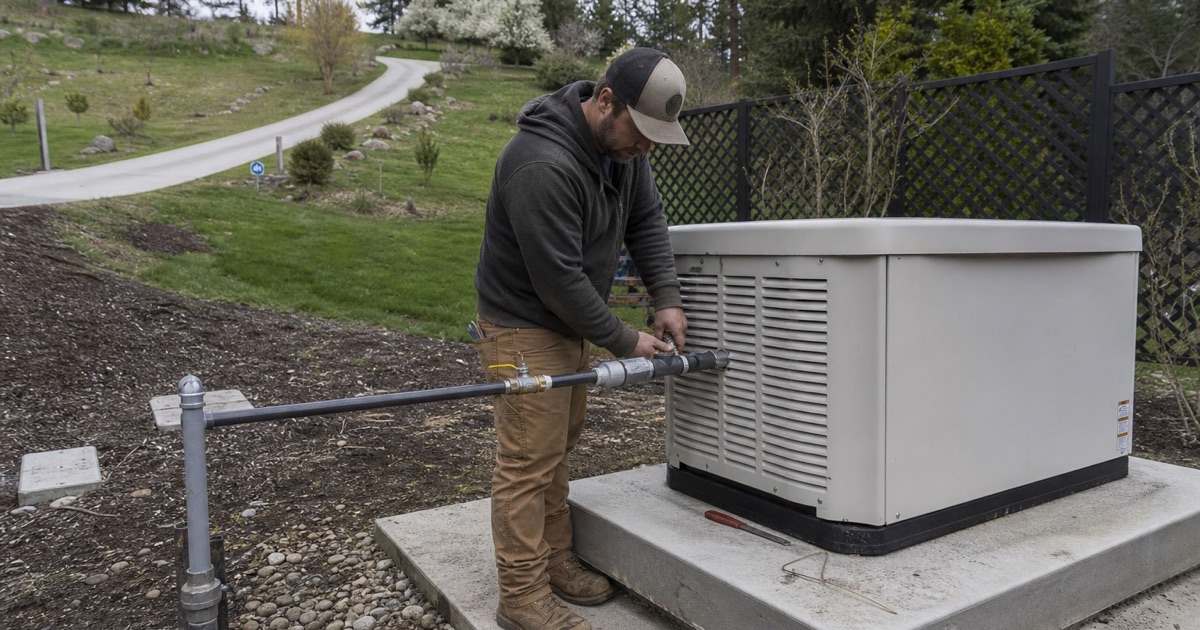
A standby generator is a substantial and abrupt load. It asks for a large volume of gas the moment it starts, and a run sized on average consumption rather than on starting demand will not satisfy it when it matters.
We size on the manufacturer’s stated requirement and calculate the developed length of the actual route, then read both against a pipe sizing table. A generator that starts fine in a test and struggles under load in an outage is usually a supply problem rather than a machine problem, and it is discovered at the worst possible moment for finding out.
Where the Pad Sits Relative to the Meter
Generators end up wherever noise, setbacks and the electrical work put them, which is frequently a long way from the meter. That distance is a gas design constraint and it is rarely considered until the pad is already poured.
Getting involved before the pad is sited saves money often enough that it is worth a phone call. Yorba Linda is a suburban city in northeastern Orange County, with its city hall about 27 miles southeast of downtown Los Angeles, and the parcels here give equipment plenty of room to end up far from the house.
Outbuildings Added Over Time
Workshops, casitas, barns and pool houses tend to arrive one at a time across decades, each one connected to whatever was convenient at the time. The result is a system nobody designed as a whole, carrying more than the original run was ever asked to.
We total what everything on the property draws together rather than treating each structure separately. Where the original run has been overtaken by what has been hung off it, we say so plainly and price the correction rather than adding one more branch to it. There is no sense running a new line to a casita off a main that is already at its limit.
Digging Safely and Signing Off
Locating Before Any Excavation
Every excavation is preceded by a locate, and that goes considerably further than an 811 DigAlert ticket. The utility marks its own assets and stops there, which leaves every customer-owned line — irrigation, lighting, pool, the feed to an earlier outbuilding — unmarked and directly in the way.
We locate and mark the private runs as well before a machine moves. On properties that have been developed in stages over many years, what is already in the ground is genuinely unknown until somebody goes looking for it.
Restoring the Ground
Backfill is compacted in layers, and the surface is reinstated to match what was there. Slope restoration takes longer than flat ground because the material wants to move and the planting holding it in place has just been disturbed.
That work is part of the quote rather than an extra that appears afterwards. The fixed-price written quote agreed at the walkthrough is the number on the invoice, and reinstatement is inside it.
Permits, Testing and the Record
We pull the permit and meet the inspector rather than leaving that with the customer. Fuel gas piping falls under Chapter 12 of the California Plumbing Code, Title 24 Part 5, and the work is done under a CSLB C-36 plumbing classification.
A written pressure test result is handed over at the end of every job whether or not an inspector asks for it, along with the route and depth photographs. On a buried run crossing a graded property, that record is the only thing standing between the next contractor and a shovel.
- Licensed & Insured
- Same-Day Leak Response
- Free Written Quotes









