
Santa Ana Gas Line installs, repairs and replaces gas piping throughout Villa Park, California. The recurring problem on lots this size is not the pipe itself but the distance it has to cover — a pool heater, a standby generator or an outdoor kitchen sited a long way from the meter, and a supply that arrives thinner than the equipment expected.
Gas does not lose pressure because a run is long in a straight line. It loses pressure because of everything the gas has to pass through on the way, and on a large parcel there is a great deal more of that than on a tract lot. Every fitting, every elbow and every change of direction adds to the total.
That is why a system here can be entirely sound, correctly installed and still disappoint the equipment at the end of it. Nothing is broken. The line was simply sized for the length somebody paced out rather than for the length the gas actually experiences, and the difference between those two numbers is where the fault lives.
What Distance Does to Delivered Pressure
Developed Length Is Not Run Length
The figure that matters in a sizing calculation is developed length, and it is not the distance across the yard. It is the straight run plus an allowance for every fitting on it, each one converted into the equivalent length of pipe that would cause the same resistance. On a long run with several direction changes the two numbers diverge sharply. A run that measures ninety feet across the grass can behave like a hundred and thirty.
We measure the developed length of each run rather than estimating from a site plan, then read it against a pipe sizing table alongside the total connected load. A calculation done from the actual route is the only one worth doing, and it is the step most often skipped on a property where the run looks simple.
Where the Pressure Actually Goes
Pressure is lost gradually along the run and abruptly at restrictions, which is why the last appliance on a long line is always the one that suffers first. A heater at the far end can behave perfectly when nothing else is running and poorly the moment the house calls for gas at the same time. Two appliances that each work alone and fail together are describing a supply problem, not a coincidence.
Intermittent faults of that kind get blamed on the equipment for a long time before anyone measures the supply. We put a manometer on the system under real load rather than at rest, because a reading taken on a quiet system describes a condition the equipment never actually operates in.
Sizing for the Far End
The correct size for a long run is the size that still delivers at the furthest point with everything running, not the size that satisfies the first appliance. That usually means a larger diameter than a short-run rule of thumb would suggest, and it is cheaper to install once than to discover later, when the discovery involves reopening a trench across finished ground.
Where a customer is planning to add equipment in a year or two, we would rather size for that now while the trench is open. Villa Park is a small city in northern Orange County founded in 1962, and the properties here tend to gain amenities gradually rather than all at once.
Looking for gas line closer to Huntington Beach? See Gas Line in Huntington Beach.
Two-Stage Regulation on a Long Run
Carrying Higher Pressure Further
One answer to a long run is to carry the gas at a higher pressure and step it down near the equipment, because higher pressure loses proportionally less over distance. It lets a smaller pipe do the work of a much larger one, which matters when the alternative is trenching for something substantial.
That approach is a design decision rather than a default, and it brings a second regulator and its own requirements with it. We will tell you when it is the better answer and when a larger single-stage run is simpler to live with. Fewer components to service is a real advantage on equipment that sits outdoors.
Where the Second Stage Sits
A line pressure regulator such as a Maxitrol 325 series unit needs to sit where it can be reached, inspected and serviced, not buried behind planting because it was inconvenient elsewhere. Its position also has to suit the equipment it is feeding rather than the route the pipe happened to take.
We place it deliberately and we show the customer where it is at handover. A regulator nobody can find is a regulator nobody will ever check, and on a system that only runs seasonally that can be a long time between one look and the next.
Vent Piping and Its One Restriction
A regulator needs a vent limiter or vent piping, and there is one rule that catches people out repeatedly: corrugated stainless steel tubing is not permitted in regulator vent piping, even though the same material is allowed almost everywhere else on the system. It is an easy thing to get wrong and an easy thing to check.
We check vent runs specifically rather than assuming a recent installation was done correctly. Where we find CSST used in a vent we say so, price the correction and explain why it matters rather than leaving it as a note on a report.
Pool Heaters, Spa Heaters and Equipment Pads
The Load at the Pad
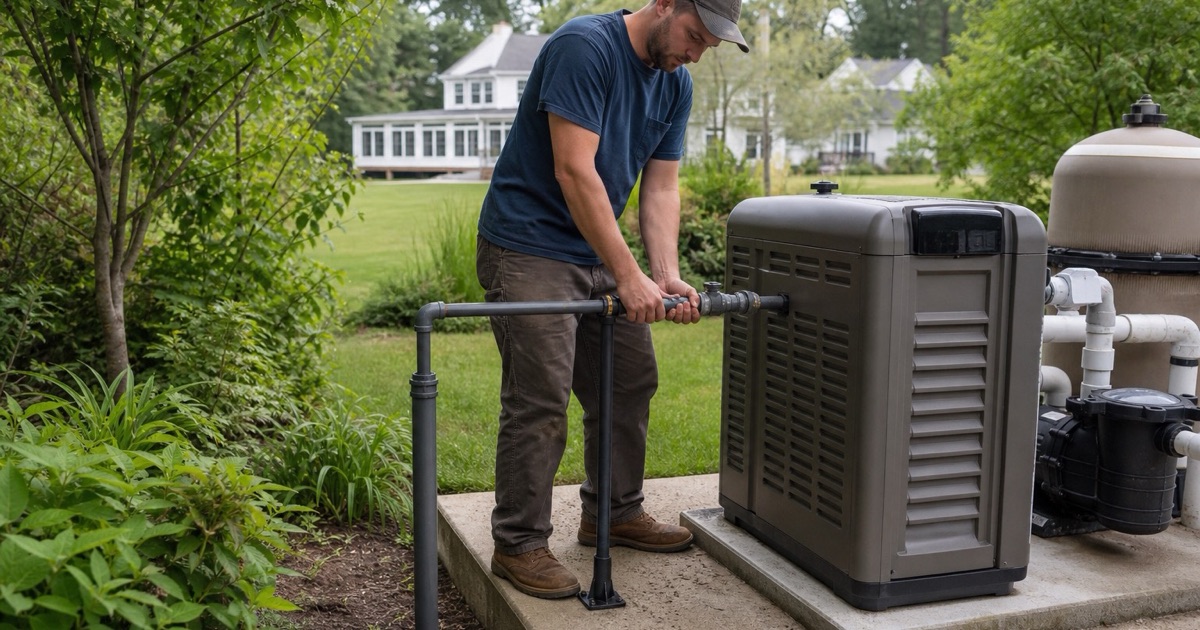
An equipment pad often carries more gas load than the rest of the property put together. A pool heater alone can exceed the combined demand of a range, a dryer and a water heater, and a spa heater beside it adds more on top of that.
We total what the pad genuinely draws rather than working from the assumption that outdoor equipment is a small addition. That number, set against the developed length back to the meter, is what decides whether the existing run can serve it at all.
Adding to a Pad Already Fed
The most common request here is another appliance on a line that already works. The question is never whether the line can carry the new item on its own; it is whether it can carry everything at once on the worst day of the year.
We measure and calculate before quoting rather than connecting and hoping. Where the existing run will not take the addition, upsizing the run is usually a better investment than accepting an installation that underperforms from the first week.
Isolation at the Equipment
Every appliance wants its own shutoff within reach and a sediment trap ahead of it, and on outdoor equipment that becomes more important rather than less. Debris travels further down a long run, and the equipment at the end of it is where the debris arrives, usually in the first cold week of the season.
We fit the trap and place the shutoff so a single item can be isolated for service without shutting down the pad. Where an outdoor kitchen is involved, a quick-disconnect outlet is often the right answer for anything that moves.
Getting the Line There and Proving It
Trenching Across a Finished Property
A long run on a developed lot crosses lawn, hardscape and planting that somebody has paid for. Route selection is largely a question of what can be put back convincingly, and that is worth discussing before a trench is cut rather than afterwards.
We locate and mark existing lines before any excavation, including customer-owned runs that an 811 DigAlert ticket does not cover, because the utility marks only as far as its own asset. On a property with irrigation, low-voltage lighting and a pool circuit already in the ground, that private locate is what prevents a second repair.
Testing a Long Run
A long run holds more volume, and more volume means temperature has more influence on the gauge. A test has to be held long enough to distinguish a genuine loss from the sun moving along a shallow section of the trench during the afternoon.
We use a pressure test gauge rated to no more than twice the test pressure and graduated in increments of a tenth of a psi, and we hold the test properly rather than glancing at it. Inches of water column and psi are both in use on a system like this, and mixing the scales is a reliable way to misread the result.
Permits and What You Are Handed
We take the permit and the inspection appointment on ourselves instead of handing them over as a to-do. Fuel gas piping is covered by Chapter 12 of the California Plumbing Code, Title 24 Part 5, and the work is done under a CSLB C-36 plumbing classification.
At the end you get a written pressure test result whether or not the inspector asked for one, plus photographs of the route and the depth taken before the line was covered. On a property where the run crosses half an acre, knowing exactly where it went is worth as much as the pipe.
- Licensed & Insured
- Same-Day Leak Response
- Free Written Quotes









