
Santa Ana Gas Line installs, repairs and replaces gas line systems throughout Tustin, California. We cover leak detection, repipes on original steel, buried yard runs, appliance and amenity connections, and the permit and inspection that legally belong to the work.
Tustin is a market of two halves, and the halves sit next to each other. Post-war tract housing with original steel piping shares streets with much newer construction built to a different standard, and the gas problems each produces have almost nothing in common.
That matters because the wrong assumption costs money in both directions. Treating a newer house like an old one sells work nobody needs, and treating an old one like a new one misses a system that is at the end of its life.
So the first visit here is diagnostic rather than promotional. We would rather spend an hour establishing which of the two situations you are actually in than arrive with a recommendation already decided by the year the house was built.
Two Building Eras, Two Sets of Problems
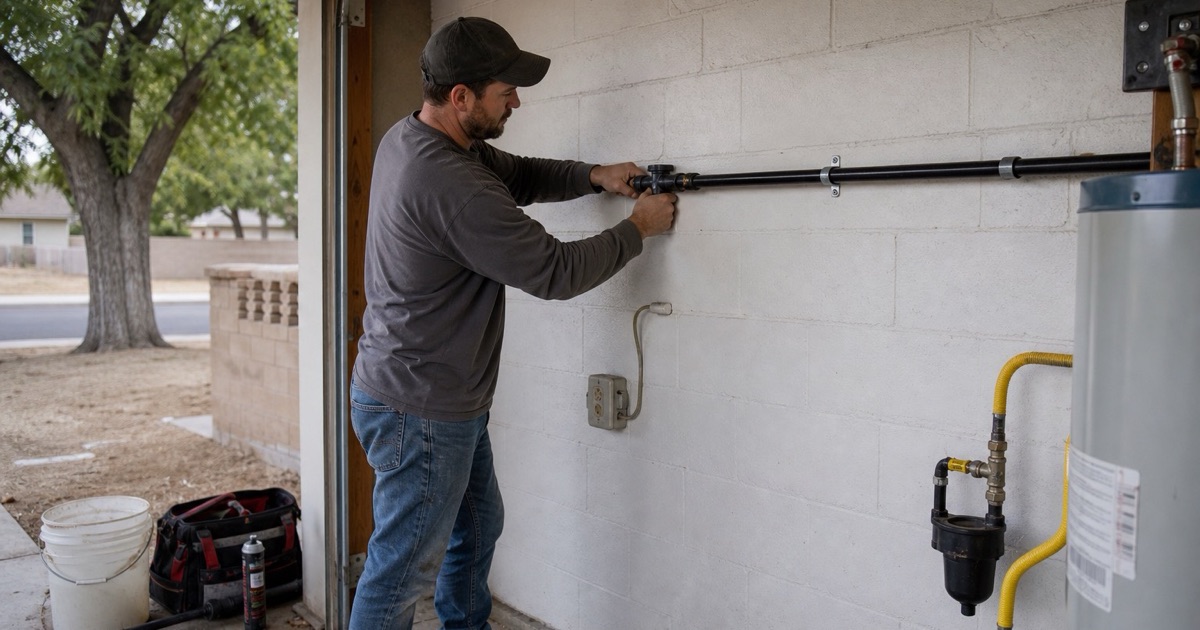
Original Steel on the Older Tracts
On the post-war stock the story is corrosion. Threaded Schedule 40 black steel fails from the inside out, at joints and at low points where moisture has sat against it, which means faults arrive in groups rather than singly across decades.
The practical signal is repetition. A second leak within a year of the first is a pattern rather than bad luck, and at that point each individual repair buys a few months. We survey the whole system so that decision is made against what is there rather than against the one fault that prompted the call.
Where the finding does point to replacement, the work can be staged so a household is not left without gas overnight. That takes more planning and occasionally more days on site, and it is the difference between a repipe that is disruptive and one that is genuinely unlivable.
Newer Construction and Different Failure Modes
Newer houses rarely have corroded pipe, and their problems are different: bonding on corrugated stainless steel tubing, terminations, and capacity that was correct on the day and is not any more. A system sized for the original appliance schedule does not stretch to a tankless heater and a standby generator added later.
Corrugated stainless steel tubing listed to ANSI LC-1 and CSA 6.26 needs a 6 AWG copper bonding conductor, and it is not permitted in regulator vent piping. These are the findings that come up on newer stock, and they are as real as corrosion.
They are also the findings most often missed, because a system with no leak and no corrosion reads as healthy to anybody who is only looking for those two things. Bonding in particular is easy to check and easy to overlook, and it sits in the gap between the plumbing trade and the electrical one.
Telling Them Apart Before Quoting
The first thing we do is establish which system we are looking at, because it decides everything after. That is a pressure test, a look at the material and the terminations, and a delivered pressure reading at each appliance while it is running. It takes an hour or so and it is the difference between an accurate quote and an optimistic one.
It is also the step that protects you from being sold the wrong job. A contractor who quotes a repipe without testing is guessing, and on newer stock that guess is expensive and unnecessary. We would rather spend the hour and tell you the system is sound.
Looking for gas line closer to Fountain Valley? See Fountain Valley Gas Line.
Where Additions Meet Original Pipe
The Extension Nobody Recalculated
Tustin’s tract housing has been added onto steadily, and the most common defect we find is a new appliance teed off a branch that had no capacity left. Nothing dramatic happens. The system simply runs short whenever two things fire together.
Adding an outlet to a line already at its limit does not fail visibly, which is why it persists for years and gets blamed on the appliances. We add up the connected load and read it against the developed length before agreeing that any existing pipe can carry more.
Where the numbers do not work, the answer is upsizing the trunk rather than replacing appliance parts that were never faulty. That is a larger job than the customer expected and a smaller one than repeatedly replacing thermocouples and water heaters that keep failing for a reason nobody addressed.
Kitchen and Laundry Conversions
Putting gas into a kitchen that has only ever been electric means a new branch, a shutoff behind the appliance that can be reached, a sediment trap to catch debris before it reaches the burner orifices, and a connector rated for the duty. The pipe is rarely the hard part; the route into a finished kitchen is.
A dryer connection has its own version of the same problem: enough clearance behind the appliance that the connector is not crushed against the wall when the dryer is pushed back. It sounds trivial and it is the most common defect we find on laundry connections.
We plan that route before quoting, because the cheapest path through a house and the one you want to live with are not always the same line, and on a tract house with a known layout there are usually options worth discussing.
Tract construction helps here. When the framing and the original service layout repeat across a neighborhood, the shortest sensible route is usually predictable before anything is opened, which keeps both the disruption and the quote honest.
Water Heater Upgrades
A tankless unit fires at several times the input of the tank it replaces, and the branch that fed the old heater almost never carries it. This is the single most common reason a tankless installation stops on the day, with the appliance on the driveway and the pipe two sizes short.
We size and run the supply ahead of the changeover so the pipe and the appliance meet the same standard rather than the installer improvising on the morning. Where a pool heater or a standby generator is also planned, that load goes into the same calculation now rather than later.
Where a pool heater or a standby generator is also planned, that load goes into the calculation now rather than later. Upsizing a trunk once the walls are closed is a materially different job from sizing it correctly while the route is still open.
Permits, Testing and Handover in Tustin
The Permit Side
Work that installs, extends, alters or replaces gas piping is permitted work, and we pull the permit and schedule the inspection rather than handing you a form. The fee appears on the quote rather than arriving afterwards as an extra.
Unpermitted gas work is one of the reliable ways a straightforward sale turns complicated, because it surfaces during escrow with a deadline attached and very little negotiating room. It is also entirely avoidable, since the permit fee on residential gas work is small against the job itself.
It is also entirely avoidable. The permit fee on residential gas work is small against the job, and the inspection is not adversarial — it is a second pair of eyes on something that will sit inside your walls for decades.
Proving the System
A finished line is isolated, charged to test pressure and held while the gauge is watched, read in inches of water column for low-pressure work and psi above that. The gauge range has to be no more than twice the test pressure and graduated in tenths of a psi, because a coarser instrument reads a slow drop as no drop at all.
You keep that written result on every job, whether or not an inspector asked for it. It is the only evidence that the system held on the day it was closed up.
Where we have buried a run we also photograph the route and the depth before it is covered. That record is what stops the next contractor, or a landscaper with a trencher, from finding your gas line the hard way.
Getting Everything Back On
Where the supply was interrupted, every appliance in the building has to be relit and checked in turn and the lines purged of air. We verify the pressure each appliance actually receives while it is firing and check for spillage at the draft hood.
Where more than one appliance shares a branch we run them together, because a supply that is marginal only reveals itself under simultaneous load. Testing appliances one at a time on a system that is genuinely undersized returns a clean result and tells you nothing.
Tustin had a population of 80,276 in 2020, and a good share of that lives in housing where more than one appliance shares a branch. A building handed back with three of four appliances working is not a finished job, and we do not leave one that way.
Documentation That Outlives the Job
Gas piping is the part of a house nobody sees and everybody inherits. The written pressure test result, the permit paperwork and the photographs of any buried route are what turn an invisible system into one the next owner, the next contractor or an insurer can actually reason about. We hand all three over as a matter of course rather than on request, because the alternative is a system whose history restarts every time the property changes hands.
- Licensed & Insured
- Same-Day Leak Response
- Free Written Quotes









