
Santa Ana Gas Line installs, repairs and replaces gas piping throughout Stanton, California, across single-family houses, apartment buildings and mobile home communities. We handle leak detection, repipes, buried runs, appliance connections, meter work and the permits, inspections and pressure testing that go with them. Stanton is small and dense, with a housing mix weighted more toward multifamily and manufactured housing than most of the cities around it.
That mix is the thing that shapes the work. A single-family repipe, an apartment building’s shared system and a mobile home in a master-metered park are three genuinely different jobs, with different owners, different authorities and different boundaries. Getting those straight before anything is quoted is not administrative fussiness; it decides who can authorize the work at all.
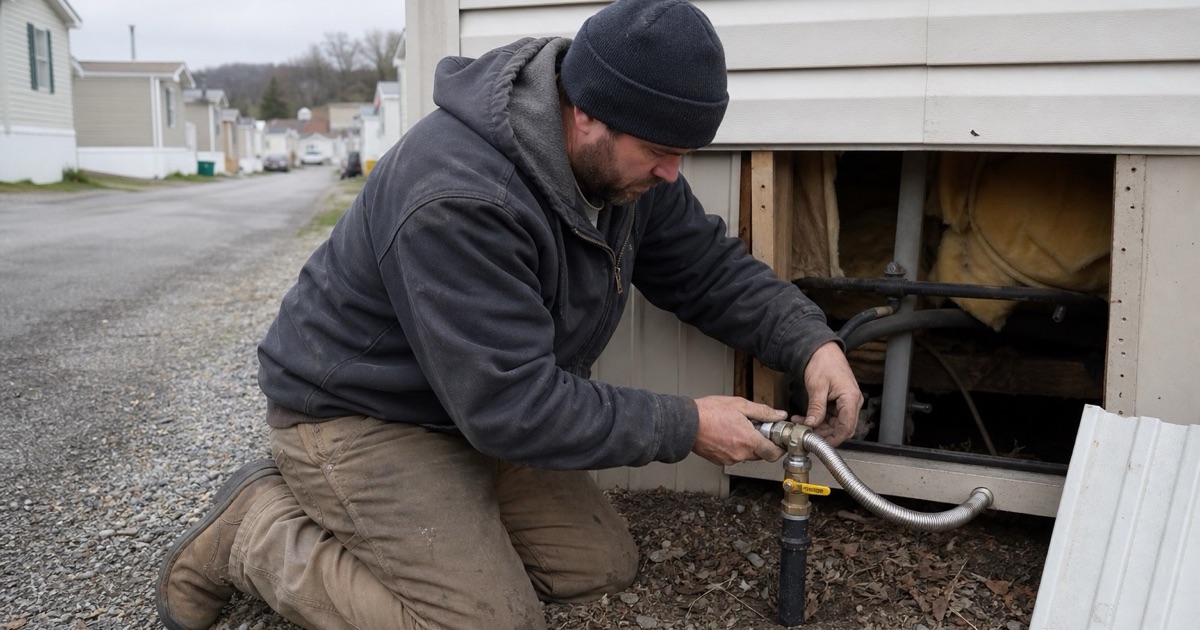
The mobile home case is the one most often got wrong, and it is worth stating plainly up front. In a master-metered park the park owner owns the distribution system feeding the individual meters, the resident owns the piping from their meter into the coach, and the system is overseen by the CPUC’s Safety and Enforcement Division rather than by the city.
Mobile Home Parks and Master-Metered Systems
Two Owners, One System
In a master-metered park a single utility service feeds a distribution system that the park owner owns and maintains, running to individual meters serving each space. Downstream of a resident’s meter, the piping into the coach is the resident’s. That produces two check-signers on what looks from the outside like one system.
Establishing which side of that line a fault sits on is the first thing we do, because it decides who authorizes the repair and who pays for it. A quote sent to the wrong party sits unanswered while somebody has no hot water, and on a fixed income that delay matters more than it does elsewhere. Establishing ownership first is the single most useful thing a contractor can do on a park job, and it costs nothing but a conversation.
A Different Authority
Because the park’s distribution system is regulated as a utility operation rather than as building work, oversight sits with the CPUC’s Safety and Enforcement Division rather than with the city’s building department. That is not a technicality — it changes who inspects, what is required, and how a finding gets closed out.
Contractors who work only on conventional housing routinely assume the city has jurisdiction over everything inside the park. We establish the correct authority before quoting a process or a timeline, because getting that wrong wastes weeks. It also affects what documentation closes a finding out, which is not the same paperwork a city inspection would produce.
Work on the Coach Side
The piping from a resident’s meter into the coach is conventional customer-owned gas work, and it has its own characteristics: connections designed for a structure that was transported, terminations at appliances in confined spaces, and flexible connections at the service point where a rigid connection would be inappropriate.
We work on that side routinely and coordinate with park management where access or shutdown affects anybody else. Where a fault turns out to be on the park’s distribution rather than the resident’s line, we say so plainly and in writing, which is usually what the resident needs in order to get it dealt with. Without that document the conversation tends to go in circles, with each party pointing at the other.
Looking for gas line closer to Newport Beach? See Gas Line in Newport Beach.
Apartment Buildings and Shared Piping
Where One System Serves Several Homes
Duplexes, fourplexes and larger buildings raise the same boundary question in a different form: where the landlord’s piping ends and each tenancy’s begins. Systems in older multifamily buildings frequently grew by addition rather than by design, and the boundaries are not obvious from the pipe.
Establishing which meter feeds which unit, and where the isolation points actually are, comes before anything is opened up. On buildings that have been altered several times, that map frequently does not match anybody’s assumption about it. It decides who authorizes the work and whose supply has to be interrupted, and getting it wrong is expensive in ways unrelated to pipework.
Isolating Without Shutting Everyone Down
Work on an occupied building has to be sectioned, and what makes that possible is isolation valves in sensible places. Older buildings frequently lack them, which turns a repair to one unit into a shutdown for the whole building — disruptive, complaint-generating, and a reason owners defer maintenance until it becomes urgent.
Where a system cannot be sectioned properly we will say so and quote the valves that would fix it. It is a small addition during work that is already happening, and it changes the economics of every future job on the building. Owners who have done it once do not go back to shutting down the whole building for a single unit.
Inspection Exposure on Rental Property
Rental housing meets an inspection regime owner-occupied property does not, and the findings are predictable: unpermitted alterations, missing or inaccessible appliance shutoffs, unsupported or corroded pipe, and connectors reused past their service life.
We survey ahead of a visit and give the findings in writing with a fixed price against each. Correcting them on your own schedule costs materially less than correcting them under a notice with a date attached, and it avoids displacing a tenant over something that could have been handled quietly.
Single-Family Work and Original Steel
The Familiar Repipe Question
On the conventional housing the question is the usual one. Threaded Schedule 40 black steel corrodes from the inside out and fails at joints and low points, so faults arrive in groups rather than singly. A second leak within a year of the first is a pattern rather than bad luck.
We survey the whole system with an electronic combustible gas detector, isolate sections under test pressure, and give you the finding in writing with a fixed price against repair and against replacement. Where the evidence supports a repair we say so. A repipe sold on a system that tests clean is the kind of job that produces a bad review five years later, and rightly so.
Buried Runs and Meter Position
Where a meter sits at the curb rather than against the building, the whole run back to the house is customer-owned pipe rather than the utility’s, and it is usually the oldest section nobody has examined. We isolate the underground portion and test it separately before anybody excavates.
Every dig is preceded by a locate that goes further than an 811 ticket, because the utility marks only as far as the meter. On dense lots there is very little margin between where the pipe runs and where somebody wants to dig. The customer-owned yard line is not on that ticket unless a private locate is arranged, and we carry that out ourselves.
Testing, Permits and Handover
Every altered system is isolated, charged to test pressure and held while the gauge is watched, on an instrument whose range is no more than twice the test pressure and graduated in tenths of a psi. You keep the written result on every job.
Where a permit is required we pull it and meet the inspector rather than leaving that with an owner, a tenant or a park manager. Where the supply was interrupted, we arrange the utility’s re-light and check every appliance back into service, verifying the pressure each receives while it is firing.
Sizing and Added Load
Appliances Added to an Older Branch
Small houses and apartments get the same appliance upgrades as larger properties, and the piping rarely gets revisited when they do. A replacement water heater at higher input, a second cooktop, or a dryer moved to a different wall each draw on a branch that nobody has recalculated since it went in.
Adding an outlet to a line already at its limit does not fail visibly. The furnace and the water heater simply run short whenever the range is on, which gets blamed on the appliances rather than on the pipe feeding them.
Tankless Conversions
A tankless water heater fires at several times the input of the tank it replaces, and the branch that fed the old heater almost never carries it. This is the most frequent reason a tankless installation stops on the day of the swap, with the unit sitting on the driveway and the pipe one or two sizes short.
We size and run the supply ahead of the changeover so the pipe and the appliance meet the same standard. In a rental context that also avoids the situation where a unit is out of service for longer than anybody budgeted.
Measuring Rather Than Estimating
Before an appliance goes onto an existing line we total what that line already feeds, measure the developed length of the run including its fittings, and read both against a sizing table for the material and the delivered pressure. Where something further is planned, that load goes into the calculation now.
Reading the delivered pressure at each appliance with a manometer while it is actually firing settles the question in minutes, and it stops perfectly serviceable appliances being replaced for a fault that was never theirs.
- Licensed & Insured
- Same-Day Leak Response
- Free Written Quotes









