
Santa Ana Gas Line installs, repairs and replaces gas piping throughout South El Monte, California, on industrial, commercial and residential property. That covers process gas and plant heating, commercial kitchen supply, tenant improvements and building systems on the working side, and leak detection, repipes and appliance connections on the domestic side.
This is a city weighted heavily toward manufacturing and industry with a comparatively small residential core, which means we are frequently working both sides of that divide within the same week. The two demand different planning even where the pipe specification is identical, and the mistake worth avoiding is treating one like the other.
The other characteristic worth stating is mixed-use adjacency. Manufacturing premises and housing sit closer together here than they do in a purely industrial city, so work on one frequently has to account for the other — access, noise, timing, and the fact that a fault on an industrial site does not respect a property boundary any more than a residential one does.
Manufacturing and Commercial Systems
Equipment With a Specified Requirement
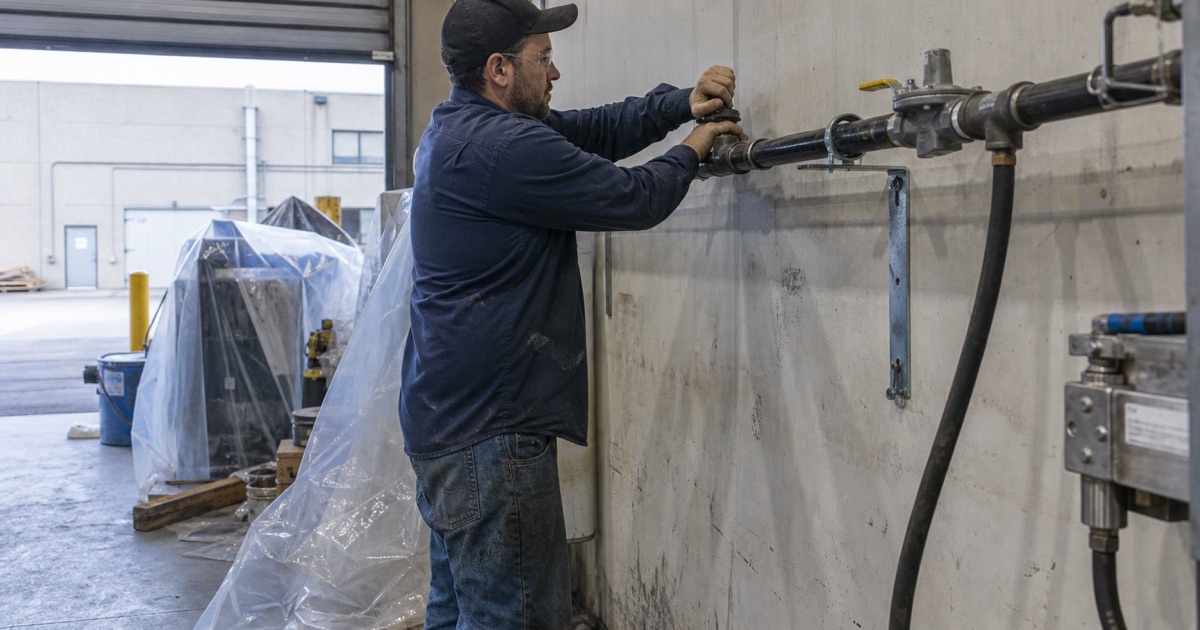
Process equipment usually requires a steady supply at a defined pressure rather than simply enough gas to burn. A system sized only for space heating and hot water will not deliver what a process burner, an oven or a finishing line expects, and the shortfall shows up as inconsistent output rather than as an obvious fault. Nobody logs that as a gas problem. It survives several equipment service visits before anyone thinks to measure the supply feeding it.
We take the requirement from the equipment’s data plate rather than an assumption, then size and regulate to it. A line pressure regulator and its vent piping are part of that design, and corrugated stainless steel tubing is not permitted in regulator vent piping even though it is permitted almost everywhere else on the same system. We check vent runs specifically rather than assuming a recently built system was built correctly throughout.
Sizing for Simultaneous Load
An industrial building may run process equipment, make-up air units, unit heaters and water heating at once, and the supply has to carry the genuine simultaneous total rather than a diversified average. Sizing on an average is how a plant finds out on the coldest morning of the year that heating and process cannot both have what they need.
We total the connected load, measure the developed length of each run including its fittings, and read both against a sizing table for the material and delivered pressure. On a large building the length term does much of the work and is routinely underestimated from a drawing rather than measured on site. Every elbow and change of direction adds to it, and there are always more of them than the plan suggests.
Isolation and Scheduling
Work on an operating building has to be sectioned, and what makes that possible is isolation valves in sensible positions. Older industrial premises frequently lack them, which turns a repair affecting one line into a shutdown for the whole site — a cost with nothing to do with pipework that dwarfs it entirely.
Where a system cannot be sectioned we say so and quote the valves that would fix it. Gas work on a working site is scheduled around production rather than the contractor, and we plan backwards from the moment production has to resume rather than forwards from the start date. A window that was never realistic is worse than none at all, because everything downstream has already been scheduled around it.
Looking for gas line closer to Lomita? See Gas Line in Lomita.
The Residential Core
Older Housing and Original Steel
The housing here follows the familiar regional pattern. Threaded Schedule 40 black steel corrodes from the inside out and gives way at threaded joints and at low points where moisture has been sitting against it, so faults arrive in groups rather than singly across decades. A second leak within a year of the first is a pattern rather than misfortune.
We survey the whole system with an electronic combustible gas detector and isolate sections under test pressure rather than attending only to the fault that prompted the call, then give the finding in writing with a fixed price against repair and against replacement. If the measurements support a repair we will say so. A repipe sold on a system that tests clean earns a justified complaint a few years later, and rightly so.
Added Appliances on an Old Trunk
Housing of this vintage was piped for the appliance schedule of its era, and the same systems have since taken on replacement water heaters at higher input, second cooktops, patio heaters and increasingly tankless units. The load rose in increments each small enough to look harmless, and almost none of them prompted a look at the trunk.
Pipe does not stretch, so a branch ends up running at its limit and starving everything on it whenever two appliances fire together. We total the connected load and read it against the developed length before agreeing that any existing pipe can carry more, and read delivered pressure with a manometer while the appliance fires. That measurement settles in minutes an argument that otherwise runs for years and costs several appliances.
Rental and Multi-Unit Property
A share of the housing here is rented, which puts gas piping in front of an inspection regime owner-occupied property never meets. An inspector looks for unpermitted alterations, missing or inaccessible appliance shutoffs, unsupported or corroded pipe, and connectors reused past their service life.
We survey ahead of a visit and give the findings in writing with a fixed price against each item, so they can be corrected on your own schedule rather than under a notice with a date attached. Because that list is largely predictable, the survey works well as a forecast of what a visit will produce. Correcting a finding early also avoids displacing a tenant over something that could have been handled quietly.
Buried Runs and Locating
Ground That Carries Traffic
Buried gas runs on industrial property cross yards carrying loaded vehicles, which is a different protection requirement from a residential lawn. Depth, bedding, and sleeving where a line passes beneath a traffic route all have to suit the loading the ground genuinely takes rather than a nominal figure.
New underground work is polyethylene laid at depth with tracer wire above so the line can be located again, transitioning to steel at an anodeless riser where it surfaces. On a site where loaded vehicles turn, that protection is not a matter of preference. A line crushed beneath a loaded trailer is not a maintenance item; it is an evacuation.
Locating Before Anyone Digs
Every excavation is preceded by a locate that goes further than an 811 ticket does. The utility marks only as far as the meter, so the customer-owned yard line — frequently the one crossing exactly where work is planned — appears on nobody’s ticket unless a private locate is arranged.
We carry that out ourselves with our own equipment. On an industrial site with vehicle movements and several buried services, that hour is the difference between a routine job and an incident that stops the operation for the day.
Testing Before Backfill
A buried run is pressure tested while the trench is still open, because a line that fails after backfill is a second excavation rather than an adjustment. On an operating site that means a second disruption to traffic and production as well as a second dig.
The section is brought up to pressure and held on an appropriately ranged gauge — within twice the test pressure, reading in tenths of a psi — and only then do we call the inspector. Keeping that order is what prevents an underground job being excavated a second time.
Permits, Testing and Handover
Permits and Inspection
Residential, commercial and industrial gas work are all permitted, and we pull the permit and meet the inspector rather than leaving that with an owner, a tenant or a general contractor. The fee appears on the quote rather than arriving afterwards as an extra.
Where piping is altered as part of a remodel or fit-out, the piping test is taken after lath or gypsum board is in place, which catches damage from the drywall screws themselves. On a job running several trades in parallel that sequencing is the step most often missed.
Proving the System
A completed system gets isolated, charged to test pressure and held while somebody watches the gauge, read in inches of water column for low-pressure work and in psi above it. The instrument is specified as part of the test: no more than twice the test pressure across its range, in tenths of a psi.
A coarser instrument reads a slow loss as no loss at all, which is precisely how a leaking system passes a test. You keep the written result on every job, and on commercial and industrial property it is what an insurer and an auditor will want to see.
Documentation and Getting Back On
Along with the test result you keep photographs of the route and depth of anything buried before it was covered, and a clear note of where the isolation points sit. On premises maintained by people who were not present for the installation, that record is the whole value of the documentation.
Where the supply was interrupted, we relight and check every appliance back into service, verifying the delivered pressure at each while it is firing and checking for spillage at the draft hood on anything that vents.
- Licensed & Insured
- Same-Day Leak Response
- Free Written Quotes









