
Santa Ana Gas Line installs, repairs and replaces gas piping throughout Signal Hill, California, on residential, commercial and light industrial property. We handle leak detection, repipes, buried runs, appliance connections, meter work and the permits, inspections and pressure testing that go with them. One characteristic of this city dominates the planning of almost every job, and it is what is already in the ground.
Signal Hill has active oil production within its boundaries, and it has had for a very long time. That means the subsurface here carries a density and variety of infrastructure that most cities simply do not have — production and gathering lines, abandoned and idle wells, service piping, and decades of utility work laid around all of it. Excavating without knowing what is down there is not an acceptable risk anywhere, and here it is a substantially larger one.
The second characteristic is topography. This is a hill, and a sloped parcel changes how a trench is cut, how a line is supported, and how the ground behaves afterwards. Machine access is frequently limited, and what reads as a simple run on a plan can be hand excavation in practice. We walk the route before quoting so the number reflects the real method.
Knowing What Is Already Underground
Why Locating Matters More Here
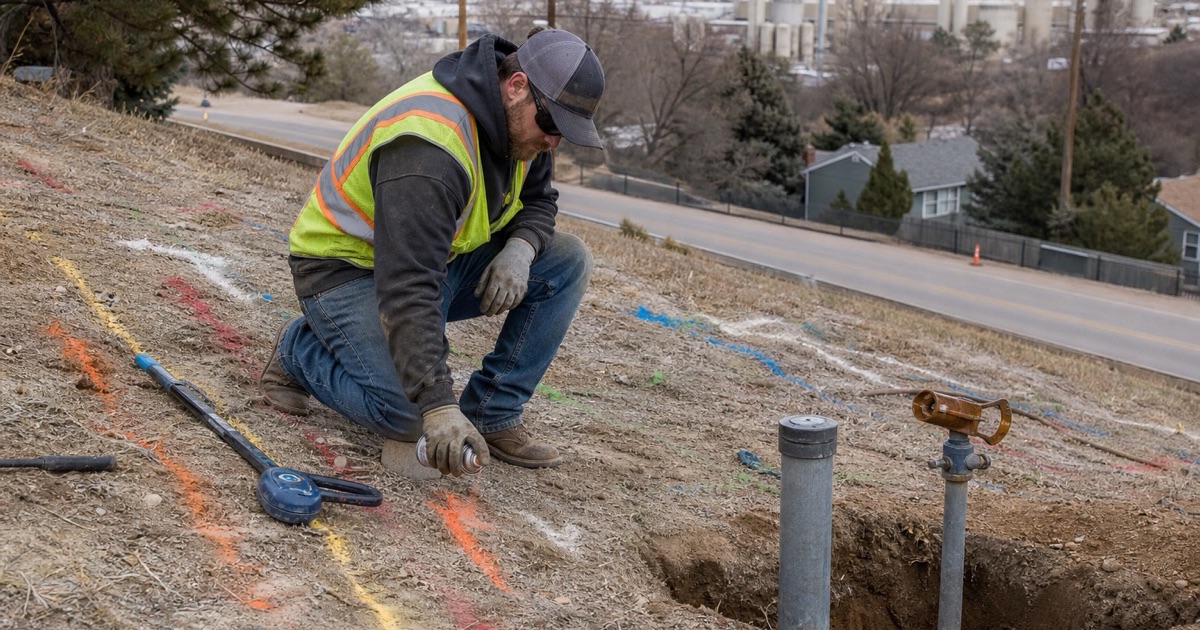
An 811 DigAlert ticket brings the utilities out to mark their own facilities, which is a necessary step and not a sufficient one anywhere. Here it is a long way from sufficient. The gas utility marks only as far as the meter, so the customer-owned yard line is on nobody’s ticket, and oil field infrastructure is a separate question again.
We carry out a private locate ourselves before any excavation, with our own equipment, and we treat original drawings as a starting point rather than an authority. Almost nothing stays exactly where it was first drawn, and on ground that has been worked for over a century that is more true than usual. Records get filed, superseded and lost, and the ground keeps whatever was put in it regardless of the paperwork.
Working Around Existing Infrastructure
Routing a new run on a congested site is a design problem before it is a digging problem. Where the ground is crowded, the shortest path is frequently not the safest one, and a route that adds distance but keeps clear of known infrastructure is the better engineering decision even though it costs more pipe.
We plan the route with what the locate actually found rather than with what the plan showed, and we say plainly where a proposed position is not workable. Adding length to a run changes the sizing calculation, which is one more reason the two decisions are made together rather than in sequence. Routing first and sizing afterwards is how a compliant route ends up on an undersized pipe.
Depth, Protection and Reinstatement
New underground work is polyethylene in PE 2708 or PE 4710 laid at depth on proper bedding, with tracer wire above so the line can be located again, transitioning to steel at an anodeless riser where it surfaces. The tracer wire matters more on ground this congested than almost anywhere.
It is the element most often omitted and the one most missed later, because the next person needing to find that line has very little else to work with. A few dollars of wire laid in an open trench is the cheapest insurance available on a site like this. We backfill and compact in layers so a trench on a slope does not settle or channel water somewhere nobody intended.
Looking for gas line closer to Commerce? See Gas Line Services in Commerce.
Hillside Routing
Trenching on a Slope
A sloped trench behaves differently from a flat one. Bedding has to hold the pipe where it was laid, backfill has to be compacted so the ground does not creep, and surface water has to be considered because a trench line becomes a path of least resistance the first time it rains properly.
We compact in layers rather than simply refilling, and pay particular attention to reinstatement where a run crosses a slope. A trench that settles on a hillside does not merely look poor; it moves water, and that is a landscaping and drainage problem arriving months after the gas work was signed off. By then nobody connects the two, and the cost of putting it right falls on whoever owns the slope.
Access and Method
Machine access on a hillside parcel is frequently limited or impossible, which means hand excavation for part or all of a run. That changes the method, the duration and the price, and it is far better established at the quote than discovered on the first morning with a crew standing idle.
We walk the whole route before quoting and say plainly where machine access is not available. Where a run has to negotiate a retaining structure, a slope or a narrow side yard, the pipe specification does not change but how it is installed, supported and protected certainly does. Hand excavation is slower and more expensive, and quoting it honestly at the outset is better than absorbing it as a surprise.
Sizing Across Distance and Grade
Longer routes mean more developed length, and developed length is what drives pressure drop. A diameter that is generous near the meter can be inadequate by the time it reaches a detached structure or an equipment pad at the far end of a sloped parcel.
We total the connected load, measure the route as it will genuinely be run including its fittings, and read both against a sizing table for the material and delivered pressure. Where an added length forced by a routing constraint pushes the calculation, the pipe size changes with it. That is not an upsell; it is the arithmetic following the route the ground actually allows.
Mixed Property Types
Residential Work
The housing here follows the familiar regional pattern. Threaded Schedule 40 black steel corrodes from the inside out and gives way at joints and at low points, so faults arrive in groups rather than singly across decades. A second leak within a year of the first is a pattern rather than misfortune.
We survey the whole system with an electronic combustible gas detector and isolate sections under test pressure rather than attending only to the reported fault, then give the finding in writing with a fixed price against repair and against replacement. If the measurements support a repair we will say so, including when the larger job would have been easier to sell.
Commercial and Light Industrial
Commercial and light industrial buildings here need supply sized for genuine simultaneous load rather than a diversified estimate, and process equipment frequently requires a steady supply at a specified pressure rather than simply enough gas to burn.
We take the requirement from the equipment’s data plate rather than an assumption. A line pressure regulator and its vent piping are part of that design, and corrugated stainless steel tubing is not permitted in regulator vent piping even though it is permitted almost everywhere else on the same system.
Isolation on Occupied Buildings
Work on an occupied commercial building has to be sectioned, and what makes that possible is isolation valves in sensible places. Older buildings frequently lack them, which turns a repair affecting one line into a shutdown for everybody in the building.
Where a system cannot be sectioned properly we say so and quote the valves that would fix it. It is a small addition during work already happening and it changes the economics of every future job on that building. A tenant who can keep operating during a repair elsewhere in the building is worth the valve several times over.
Permits, Testing and the Record
Permits and Inspection
Installing, extending, altering or replacing gas piping is permitted work, and we pull the permit and meet the inspector rather than leaving that with an owner or a contractor. The fee is shown on the quote rather than arriving afterwards as an extra.
Where piping is altered as part of a remodel or fit-out, the piping test is taken after lath or gypsum board is in place, which catches damage caused by the drywall screws themselves. That sequence has to be planned with the other trades.
Testing Before Backfill
A buried run is pressure tested while the trench is still open, because a line that fails after backfill is a second excavation rather than an adjustment — and on ground this congested, a second excavation carries the same risk as the first one did.
We charge the section and hold it on a gauge whose range is no more than twice the test pressure and graduated in tenths of a psi, then call for the inspection. A coarser instrument reads a slow loss as no loss at all.
The Route Record
Before any trench is closed we photograph the route and the depth, and you keep those images with the written test result. On ground where a great deal is already buried and very little of it is documented, adding one more undocumented line is exactly what should not happen.
That record protects the next contractor as much as it protects you. Anybody excavating on this property afterwards benefits from knowing where the gas went, and here that benefit is considerably larger than it would be elsewhere.
- Licensed & Insured
- Same-Day Leak Response
- Free Written Quotes









