
Santa Ana Gas Line installs, repairs and replaces gas piping throughout Santa Fe Springs, California. In a warehouse city most of that pipe is over your head rather than under your feet — unit heaters hung from the structure, make-up air on the roof, and the runs that feed them.
Distribution and logistics buildings are the stock here, and they are heated as volume rather than as floor area. A building with high clear height has a heating problem a house does not have, and the gas system that answers it looks nothing like a residential one.
That puts most of our work at height, on a roof or in the structure, in a building that is usually still operating. Access, racking and traffic shape the schedule as much as the pipework does, and we plan around them before we quote rather than after.
Heating Volume, Not Floor Area
Unit Heaters and Where They Hang
High-bay space is heated by units suspended in the structure, and each one needs supply, a shutoff within reach and a sediment trap ahead of it. The trap, sometimes called a drip leg, matters more here than in a house because the runs are longer and there is more line for debris to travel down. A trap left off a high-bay unit is invisible until the burner starts short-cycling, and by then it has been running rough for a season.
We set the branch and the shutoff so a unit can be isolated and dropped without taking the rest of the building’s heat with it. That is a maintenance decision more than an installation one, and it is far cheaper to make now than to retrofit later. Anyone who has tried to isolate one heater in a building with a single shutoff already knows why.
Make-Up Air and What It Has to Balance
A building that exhausts air has to replace it, and a make-up air unit carries a substantial gas load of its own. Sized against the exhaust rather than against the floor plan, it is frequently the largest single draw on the system. It is also the load most often left out when somebody totals up what a building is using.
Where an operation changes — a new spray booth, a new line, a tenant with different equipment — the exhaust changes and the make-up air should change with it. We total the connected load again rather than assuming the original sizing still holds. A building that was right for its first tenant is not automatically right for its third.
Load That Only Runs Part of the Year
Warehouse heating is seasonal, so a fault often sits undiscovered from spring until the first cold week, and then the whole building wants attention at once. A system that has not run for months is not proof of a system that works. It is only proof that nobody has asked it for anything.
We would rather survey and test in the quiet part of the year than take an emergency call in December. A pre-season check on a system of this size costs a fraction of what a shutdown does. It is also the one time of year an inspector and a lift are both easy to book.
Looking for gas line closer to Signal Hill? See Gas Line in Signal Hill.
Gas on the Roof
Getting Through the Deck
Every rooftop unit means a penetration, and a penetration is a roofing detail as much as a gas one. The pipe passes through a curb, and how it is sleeved and sealed decides whether the building has a leak of a different kind next winter. The gas work will be tested and signed off; the roof detail around it usually is not.
We coordinate with whoever holds the roof warranty rather than cutting first and telling them afterwards. A gas job that voids a roof warranty has not saved anybody anything. On a leased distribution building that warranty frequently belongs to somebody who is not in the room.
Supports, Sleepers and Movement
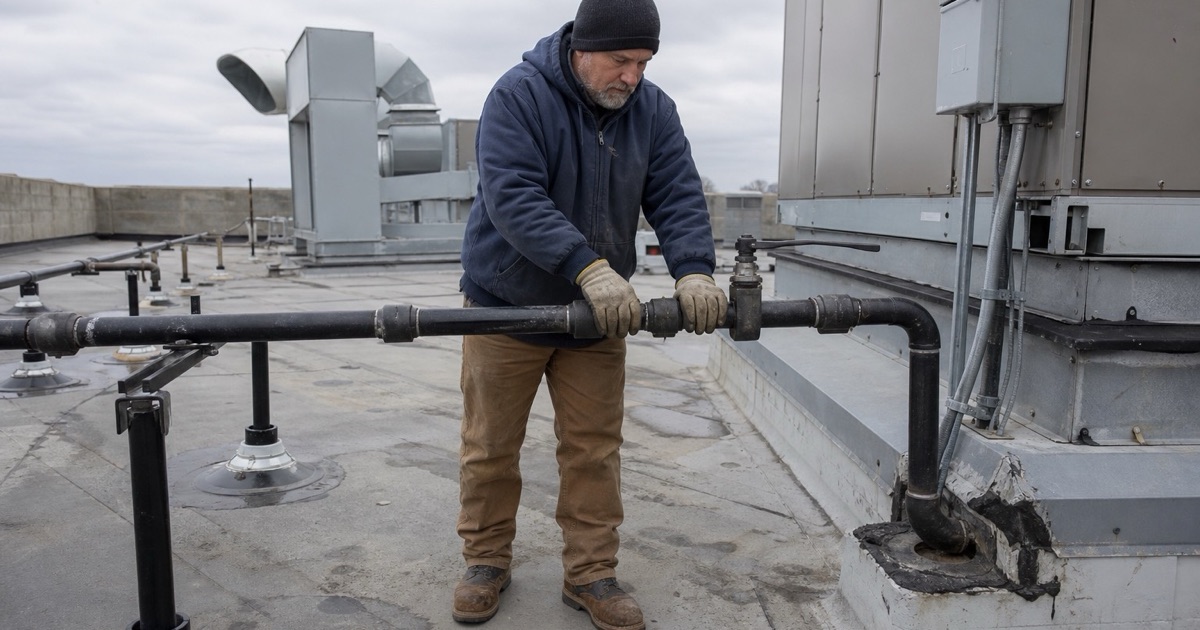
A run across a roof deck sits on supports rather than on the membrane, and it has to be free to move as the deck heats and cools through the day. Pipe pinned rigidly at both ends of a long roof run will find somewhere to relieve the stress, and it will be a joint. Roof steel in Southern California sees a wide daily swing even in a mild week, and the run moves every one of those days.
We space supports for the diameter and let the run move where it needs to. Schedule 40 black steel to ASTM A53 is the material, and at roof lengths its expansion is not a rounding error. A hundred-foot run does not stay a hundred feet, and the supports are what accommodate the difference.
Weather and Corrosion at Height
Rooftop steel takes weather that concealed pipe never sees, and it does so where nobody looks at it. Coating condition at the supports, where water sits longest, is usually the first thing to go. Nothing about that is visible from the roof hatch, which is as far as most people ever get.
We check the contact points and the low spots rather than the easy lengths in between. A run that looks sound from the hatch can be well advanced at the four places it touches something.
Working Around a Running Building
Racking, Traffic and Access
The pipe may be accessible in an empty building and completely blocked in a working one. Racking, stacked product and forklift traffic decide where a lift can stand, and that decides what can be reached on any given day. A run that is twenty feet from the wall on the drawing can be behind six rows of pallet racking in practice.
We walk the route with the site before pricing so the quote reflects the building as it actually operates. A price built on an empty warehouse is not a price, it is an opening position. We would rather price the building we will actually be working in.
Shutdown Windows
Distribution buildings run to schedules that have very little slack, and the cost of stopping one is rarely the cost of the labor standing idle. A missed outbound window costs the operation something we cannot put on an invoice, and it is not ours to spend. The isolation plan is what keeps the work inside a window the operation can absorb.
We agree the window before the work rather than negotiating it from a ladder. Where a section can be capped and left live-adjacent so the rest keeps running, that is usually the better answer. Most buildings can absorb losing one zone for a morning; very few can absorb losing all of them for a day.
One Crew, Start to Finish
We do not subcontract. The people who walked the building and priced the work are the people on the lift, which matters on a site where knowing what is behind the racking is half the job. Handing that knowledge to a subcontracted crew on the morning of the work does not transfer it.
If it needs attention later, the same people answer the phone. On a building that only runs its heating for part of the year, that continuity is worth more than it sounds. The person who remembers why a run was routed the way it was is the person who installed it.
Permits, Testing and Handover
Inspection on an Occupied Warehouse
We pull the permit and schedule the inspection ourselves rather than leaving it with the tenant. Fuel gas piping sits under Chapter 12 of the California Plumbing Code, Title 24 Part 5, and the work is done under a CSLB C-36 plumbing classification. Santa Fe Springs sits in southeast Los Angeles County, and the county’s adoption governs the inspection.
Fitting an inspector into an operating building takes some arranging, and it goes better when the person booking the appointment is the person who knows what state the work will be in that morning. We book it, we meet the inspector, and we do not leave either to the tenant.
Proving It at Height
A rooftop system is tested the same way as any other, but the practicalities are harder — the gauge is on the roof and so is everybody reading it. We use a gauge rated to no more than twice the test pressure and graduated in increments of a tenth of a psi. Inches of water column and psi are both in use on a system like this, and confusing the two scales is a reliable way to misread a result.
Where a leak is suspected we survey with an electronic combustible gas detector and confirm at the joint with a soap bubble test, then repair and retest rather than repairing and assuming. One leak found is a repair; a second within the year on the same run is a pattern, and it changes what we recommend.
What You Get at the End
A written pressure test result is handed over on every job whether or not an inspector asks for it, along with photographs of the runs and the penetrations. Santa Fe Springs is a compact city in southeast Los Angeles County with far more industrial floor space than housing, and buildings here change tenants regularly.
That record is what the next tenant’s contractor will want, and it is the difference between a system somebody can work on and a system somebody has to survey from scratch.
- Licensed & Insured
- Same-Day Leak Response
- Free Written Quotes









