
Santa Ana Gas Line installs, repairs and replaces gas piping throughout San Marino, California. We handle leak detection, whole-house repipes, long buried yard runs, pool and spa heater supplies, standby generator connections, outdoor kitchens and the permits, inspections and pressure testing that go with all of it. The housing here is among the oldest and the largest in this ring, and both of those facts change the work.
Age is the first factor. Substantial pre-war homes carry gas systems that have been altered repeatedly across a century rather than installed once, and what you inherit is a system nobody holds a complete picture of. Original threaded steel, sections replaced at various dates, and branches capped rather than removed when an appliance came out all sit in the same building.
The second factor is what the routing has to pass through. These houses carry plaster, hardwood, panelling, tile and joinery that are expensive to disturb and in many cases impossible to match. The shortest path for a gas line is frequently straight through the most irreplaceable thing in the building, which makes route planning a larger part of the job than the pipework itself.
A Century of Alterations
What Repeated Alteration Leaves Behind
Successive owners have added, capped, rerouted and abandoned sections of these systems, each time reasonably and each time without recalculating the whole. The characteristic finding is a trunk sized for the original kitchen still feeding appliances specified eighty years later, which presents as pilots dropping out and a water heater going cold when something else fires.
We survey the entire system with an electronic combustible gas detector and isolate sections under test pressure rather than attending only to the reported fault. On a house of this age that survey frequently turns up more than one response, and it is the only way to know what is actually there. Quoting a repipe on a house of this age without testing first is pricing an assumption, and assumptions here are wrong more often than right.
Live, Dead and Dead but Connected
Older properties routinely contain gas piping that was capped rather than removed when a fireplace, a wall heater or a laundry was taken out. Those runs sit in walls and under floors holding nothing, and they surface during remodels as a pressure test that will not hold for a reason nobody can locate.
Part of a survey here is establishing what is live, what is dead, and what is dead but still connected. That map is worth having before a remodel rather than during one, and it frequently reduces the cost of a replacement because a meaningful share of the existing pipe turns out to be feeding nothing. The replacement system is then smaller than the original rather than a duplicate of it, and the price follows.
Repair or Replace, With Evidence
One failure on a system that otherwise tests clean is a repair. The answer changes when the same line has been repaired before, when the failure is corrosion at a threaded joint rather than an impact, or when the survey found several faults on one original run. Each repair then buys a few months.
You get both options in writing with a fixed price against each and the finding that produced the recommendation. If the measurements support a repair we will say so, including when the larger job would have been easier to sell. A replacement sold on a sound system earns a justified complaint later. The pressure test is what makes that promise checkable rather than a matter of trusting the person making it.
Looking for gas line closer to Orange? See Gas Line in Orange.
Routing Through Irreplaceable Finishes
Planning the Route Before the Price
The route determines the cost, the disruption and how much of the building has to be opened. On a house where original plaster, panelling and hardwood are most of what makes it valuable, the cheapest path through and the one you can live with are rarely the same line.
We walk the route with you before quoting and identify anything that would have to be disturbed. That conversation happens before work is agreed rather than during it, because the alternative is discovering the cost of making good after somebody has already opened a wall. On finishes that cannot be matched, that discovery is not a variation but a permanent loss.
Choosing Materials for the Route
Corrugated stainless steel tubing listed to ANSI LC-1 and CSA 6.26 threads through existing framing far more readily than rigid pipe, which reduces the number of openings needed considerably. It requires a 6 AWG copper bonding conductor and is not permitted in regulator vent piping.
Schedule 40 black steel to ASTM A53 remains correct where a rigid exposed run is practical, and below grade the material is polyethylene transitioning to steel at an anodeless riser. A good installation in a house like this mixes all three deliberately rather than forcing one everywhere, and we set out on the quote which goes where. Seeing the reasoning laid out is what lets an owner question it, which is the point of writing it down.
Rerouting Rather Than Replacing in Place
Where a concealed run has failed inside a finished wall, replacing it along its original path means opening that wall and making it good afterwards in materials that may no longer exist. Rerouting through an accessible path is frequently cheaper and far less destructive even though it uses more pipe.
We put that option in front of you rather than defaulting to like-for-like replacement. On a property where a plaster repair is a specialist trade in itself, the calculation usually favors the longer route by a wide margin. More pipe is cheap; original plaster is not, and it does not come back.
Grounds, Amenities and Long Runs
Distance and Sizing
Large parcels mean long gas runs, and pressure drop accumulates over the developed length of a pipe including every fitting on it. A diameter that is generous close to the meter can be genuinely inadequate by the time it reaches an equipment pad or a detached structure at the far end of the grounds.
We measure the route as it will actually be run rather than as it appears on a plan, then total the connected load and read both against a sizing table. Where you tell us something further is planned, that load goes into the calculation now rather than after the trench has been closed. Opening the same trench twice across established grounds is the most avoidable expense on a property like this.
Pool Heaters, Generators and Outdoor Kitchens
The heaviest loads on properties like these sit furthest from the meter, which is exactly the combination that produces an undersized supply. A pool or spa heater is among the largest single loads a residential property carries, and a standby generator has to deliver full output while everything else is drawing.
We calculate the total before equipment is ordered and say plainly whether the answer is a larger line, a larger meter, or both. Where an outdoor kitchen or fire feature is being built, we coordinate with the hardscape trades so the stub arrives before the stone rather than being chased in afterwards.
Trenching Across Established Grounds
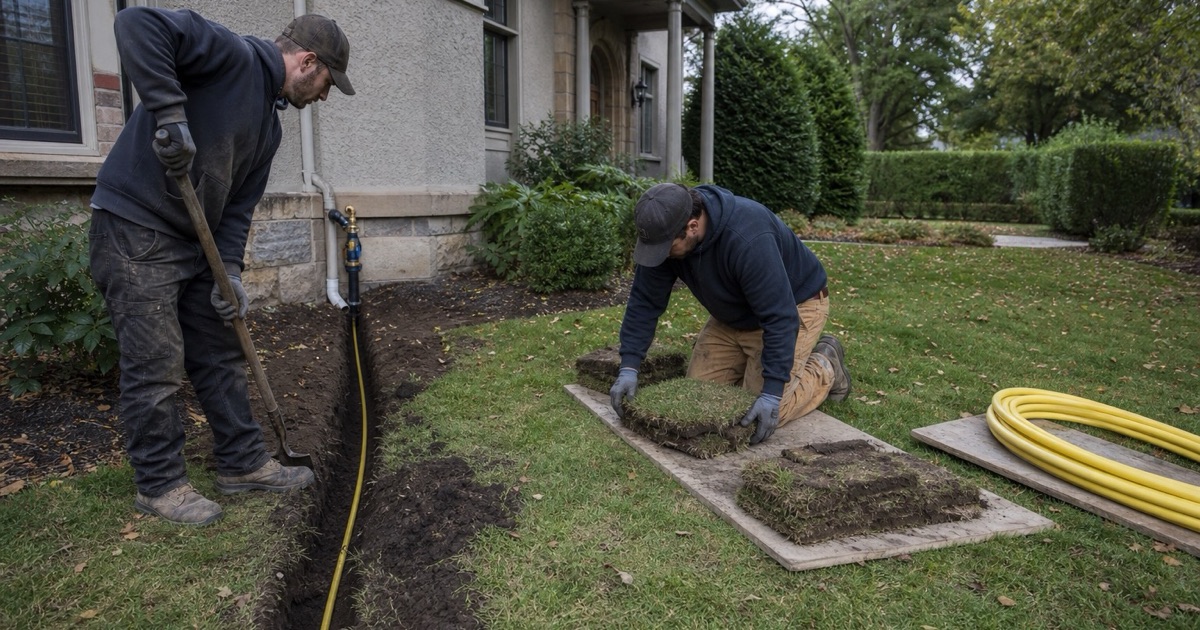
Long runs mean long trenches, and on grounds with mature planting, hardscape, irrigation and lighting the restoration is frequently a larger part of the job than the pipework. It should be quoted rather than treated as goodwill.
We backfill and compact in layers so the trench does not settle into a visible depression over the following winter, and put hardscape, turf and planting back the way we found them. On grounds that have taken decades to establish, that is what the work gets judged on. Nobody remembers the pipe once it is buried; everybody remembers the lawn.
Permits, Testing and the Record
Permits and Sequencing
Installing, extending, altering or replacing gas piping is permitted work, and we pull the permit and meet the inspector rather than leaving either with you. The fee is shown on the quote rather than arriving afterwards as an extra.
Where the work forms part of a wider remodel, the piping test is taken after lath or gypsum board is in place, which catches damage from the drywall screws themselves. On a project running several trades that sequencing has to be planned so nobody closes a wall ahead of the stage that must be witnessed.
Legalizing Work Nobody Permitted
A property that has changed hands several times across a century has usually had gas work done at some point without a permit. It surfaces at a sale or a refinance with a deadline attached and very little negotiating room.
The route through is an inspection of what is there, correction of anything that fails current code, and a permit that closes properly. We survey first and set out the scope in writing, and on houses like these the original workmanship is frequently sound and it is the record that is missing.
Testing and Documentation
The completed system is sectioned off, taken up to test pressure and held under observation, using a gauge whose range stays within twice that pressure and which reads in tenths of a psi. A blunter instrument simply cannot show a slow loss.
You keep the written result along with photographs of the route and depth of anything buried before it was covered. On a house that has already absorbed a century of undocumented alterations, not adding one more is the point.
- Licensed & Insured
- Same-Day Leak Response
- Free Written Quotes









