
Santa Ana Gas Line installs, repairs and replaces gas piping throughout Placentia, California. We handle leak detection, repipes on original steel, buried yard runs, appliance and amenity connections, meter work, and the permits, inspections and pressure testing that go with them. Much of the housing here is mid-century tract construction that has been added to steadily since it was built. That layering is the defining characteristic of the gas work.
A tract house is piped once, to a specification, for the appliances of its era. What happens afterwards is that owners add things — a dryer on a different wall, a replacement water heater at higher input, a second cooktop, a patio heater, a pool heater, eventually a tankless unit. Each addition is small enough to seem harmless, and almost none of them prompts anybody to look at the trunk they all hang off.
The result is a system that works until two things run at once. It does not leak and it does not fail an inspection, so nothing forces the issue. It simply underperforms in ways that get attributed to the appliances, and perfectly serviceable equipment gets replaced for a fault that was never in it.
Additions on an Original Trunk
The Extension Nobody Recalculated
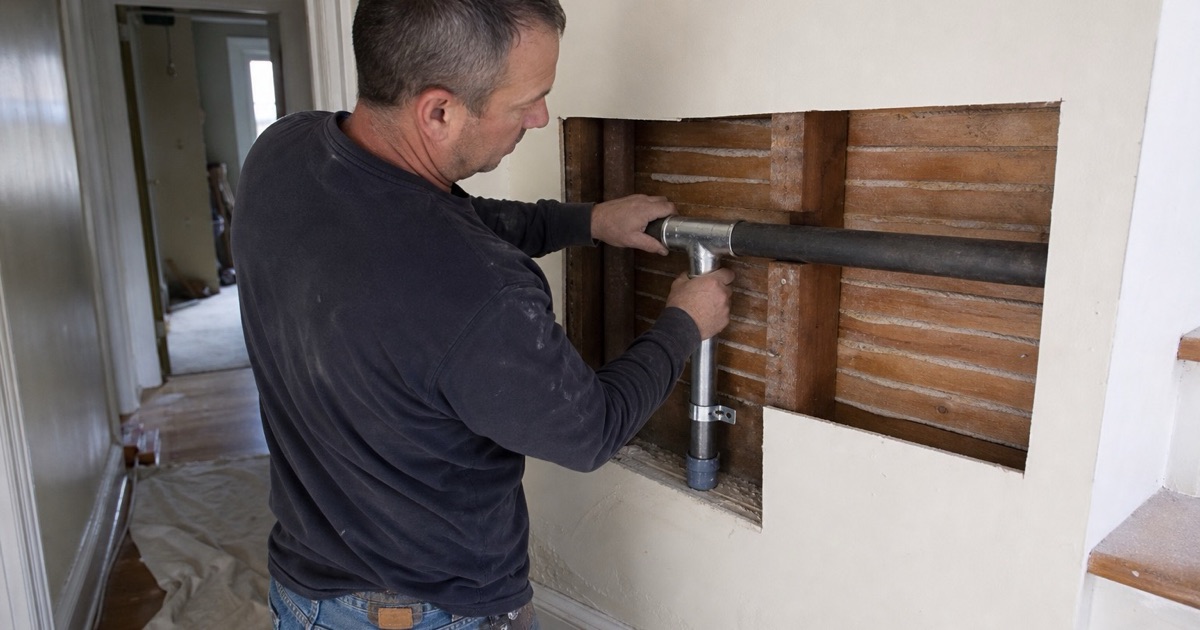
The single most common defect we find in this city is a new appliance teed off a branch that had no capacity left to give. Adding an outlet to a line already at its limit does not produce a visible failure. It means the furnace and the water heater both run short whenever the range is on, and the pilot on the appliance furthest from the meter drops out first. That gets blamed on the pilot assembly.
We total the connected load, measure the developed length of the run including its fittings, and read both against a sizing table for the material and the delivered pressure before agreeing that any existing pipe can carry more. Where the numbers do not work, the fix is upsizing the trunk rather than replacing appliance parts that were never faulty.
Reading Pressure at the Appliance
The measurement that settles almost every one of these arguments is the delivered pressure at the appliance, read on a manometer while the appliance is actually firing rather than at rest. A starved branch looks entirely healthy under no load. Run two appliances together and the number moves immediately. It takes minutes and it costs nothing beyond the time.
It is also the measurement most often skipped, because replacing a thermocouple is quicker than investigating why the old one kept failing. We would rather spend the time and tell you the pipe is the problem, even though the resulting job is larger and harder to sell than a part.
Sizing for What Is Coming
Where an owner tells us something further is planned — a pool heater, a generator, an outdoor kitchen, a second water heater — that load goes into the calculation now rather than at the point it is installed. Upsizing a trunk while a route is still open is a marginal cost. Doing it after the walls are closed and the hardscape is finished is a materially different job.
This is the single piece of advice that saves the most money on tract housing, and it costs nothing to act on. We ask the question at the survey rather than assuming that today’s appliance list is the final one.
Looking for gas line closer to Cypress? See Cypress Gas Line.
Original Steel and Its Failure Pattern
How Threaded Steel Gives Way
Schedule 40 black steel to ASTM A53 corrodes from the inside out, and it fails at threaded joints and at low points where moisture has been sitting against it. That is a predictable pattern rather than a random one, which is what makes diagnosis on this stock informative. Faults arrive in groups over a short period rather than singly across decades.
The practical signal is repetition. A second leak within a year of the first, at a joint rather than from an impact, is the system reporting on the rest of itself. At that point each individual repair buys a few months and the next call is already forming.
Surveying Rather Than Chasing
We survey the whole system with an electronic combustible gas detector and isolate sections under test pressure rather than attending only to the fault that prompted the call. On a house that has been altered repeatedly, that survey frequently turns up more than one response, and it also identifies runs that were capped rather than removed when an appliance came out.
Those abandoned runs matter more than they sound. They are the reason a pressure test will not hold for a cause nobody can locate, and resolving them is far better done before a remodel than during one.
Repair or Replace, in Writing
One failure on a system that otherwise tests clean is a repair, and so is impact damage to a buried line. The answer changes when the same line has been repaired before, when the failure is corrosion at a threaded joint, or when the survey found several faults on the same original run. We set that out plainly rather than leading with a recommendation.
You get both options with a fixed price against each and the finding that produced the advice. If you would rather repair a system we believe is finished, we will do it and note the reasoning on the paperwork. It is your property and your decision to make.
Buried Runs and the Meter
The Section Nobody Has Examined
Tract lots of this vintage frequently carry a buried run to a heater, a detached garage or the house itself, installed when everything else was and never looked at since. Buried steel in wet ground corrodes on a different schedule from interior pipe, and it is the section least likely to have been considered because nothing about it is visible.
We isolate the underground portion and test it separately, which establishes whether a loss is above or below ground before anybody excavates. That single measurement regularly reduces the scope of a job rather than expanding it.
Where the Meter Sits
Where a meter sits at the curb rather than against the building, the entire run from the sidewalk back to the house is customer-owned pipe rather than the utility’s. On older lots that is routinely both the longest and the oldest section of the whole system, and most owners assume the gas company owns it.
Establishing which side of that boundary a fault falls on is part of the survey rather than an afterthought. It decides who carries out the work and who pays, and getting it right early avoids both paying for the utility’s pipe and waiting on a utility that was never coming.
Locating Before Anyone Digs
Every excavation is preceded by a locate, and it goes further than an 811 ticket does. The utility marks only as far as the meter, which means the customer-owned yard line — frequently the one running straight across where the work is planned — is not on that ticket and is not marked by anybody unless a private locate is arranged.
We carry that out ourselves with our own equipment before a shovel goes in. On a lot with a pool, a patio and established planting, knowing where the pipe runs is the difference between a contained repair and a landscaping project.
Permits, Testing and Handover
Permits and the Inspection
Installing, extending, altering or replacing gas piping is permitted work, and we pull the permit and schedule the inspection ourselves rather than handing you a form and a phone number. The fee shows on the quote rather than arriving afterwards. Unpermitted gas work is one of the reliable ways a straightforward sale turns complicated.
Where the work forms part of a wider remodel, the piping test is taken after lath or gypsum board is in place, which catches damage caused by the drywall screws themselves. That has to be planned with the other trades so nobody closes a wall ahead of the stage that must be witnessed.
Proving the Finished System
A finished system is isolated, charged to test pressure and held while the gauge is watched, read in inches of water column for low-pressure work and in psi above that. The gauge range must be no more than twice the test pressure and graduated in tenths of a psi, because a coarser instrument reads a slow loss as no loss at all.
You keep that written result on every job, whether or not an inspector asked for it. It is the only evidence that the system held on the day it was closed up, and it is what a buyer’s surveyor or an insurer will ask to see.
Getting Everything Back On
Where the supply was interrupted, every appliance in the building has to be relit and checked in turn and the lines purged of air. We verify the delivered pressure at each appliance while it is firing and check for spillage at the draft hood on anything that vents.
Where more than one appliance shares a branch we run them together, because a marginal supply only reveals itself under simultaneous load. Testing appliances one at a time on an undersized system returns a clean result and tells you nothing useful.
- Licensed & Insured
- Same-Day Leak Response
- Free Written Quotes









