
Santa Ana Gas Line installs, repairs and replaces gas line systems throughout Orange, California, and has worked on piping in this city for more than 20 years. We handle leak detection, repipes, buried yard lines, appliance connections and the permits and inspections that go with them.
Orange asks more of a gas contractor than most of the cities around it, and the reason is age. This is a market where a single street can hold a house whose piping was installed before the Second World War and one whose piping went in during the 1970s, and the two need entirely different conversations.
What that means in practice is that nothing here should be quoted from a photograph or a phone call. We survey the system, test it, and tell you what is actually in the walls before anyone talks about price.
Working on Orange’s Older Gas Piping
The Oldest Systems in the County
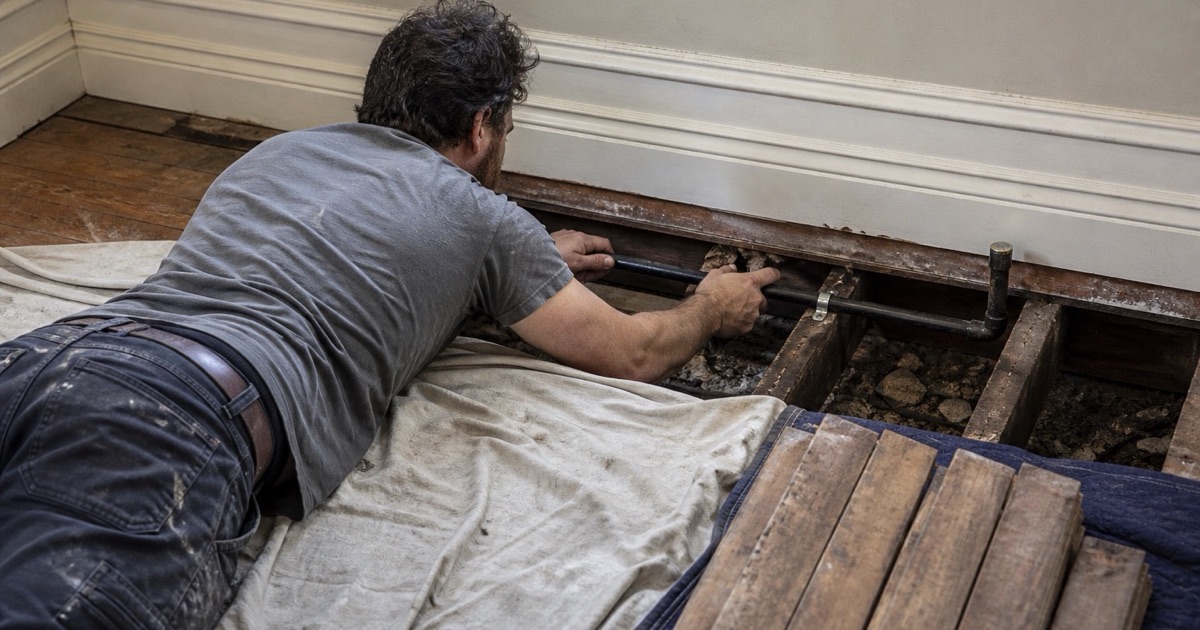
Orange is unusual in this region because many of the homes in its Old Town District were built before 1920, and while other cities demolished such houses in the 1960s, Orange decided to preserve them. That decision produced a housing stock unlike anything else in the ring, and it produced gas systems that have been altered repeatedly across a century rather than installed once.
On a house of that age the original piping is rarely all original. Successive owners have added, capped, rerouted and abandoned sections, and what you inherit is a system nobody has a complete picture of. Surveying the whole run rather than the reported fault is not thoroughness here; it is the only way to know what you have.
That survey is also what makes an accurate quote possible. A contractor who prices a repipe on a preserved house without first establishing which runs are live, which are abandoned and where the trunk actually goes is pricing an assumption, and assumptions on this housing stock are wrong more often than they are right.
What a Century of Alterations Leaves Behind
The characteristic finding on these systems is a line that has been extended more than once, each time by somebody who did not recalculate the load. The result is a trunk sized for a 1920s kitchen feeding appliances specified in the 2010s, and it presents as pilots dropping out and a water heater going cold whenever something else fires.
We add up the connected load and measure the developed length before recommending anything. Where the arithmetic says the trunk cannot carry the house, upsizing it is the repair, and replacing individual branches simply moves the problem.
This is the finding customers most often push back on, because the symptom appears at the appliance and the cause is fifty feet away. Reading the delivered pressure at the appliance with a manometer while it is actually firing settles it in a few minutes and saves buying parts that were never faulty.
Abandoned and Capped Runs
Older properties frequently contain gas piping that was capped rather than removed when a fireplace, a wall heater or a laundry was taken out. Those runs sit in walls and under floors holding nothing, and they turn up during remodels as a surprise, sometimes as a pressure test that will not hold for reasons nobody can locate.
Part of a survey on a house of this age is establishing what is live, what is dead, and what is dead but still connected. That map is worth having before a remodel rather than during one.
It also changes what a repipe costs. Where a substantial share of the existing pipe turns out to be feeding nothing, the replacement system is smaller than the original and the price reflects that rather than duplicating runs nobody needs.
Looking for gas line closer to Tustin? See Gas Line Services in Tustin.
Permits and the Historic District
Why the Express Permit Route Does Not Always Apply
Gas work in this region is permitted through the local building authority, and some jurisdictions offer a same-day express route for straightforward alterations. Those express routes commonly exclude properties in historic districts, which in a city that has deliberately preserved its pre-1920 housing is a meaningful share of the market.
We establish which route a property falls under before quoting the timeline, because a job planned around a same-day permit that turns out to need a full plan check is a job that has already gone wrong.
That check costs us a phone call and saves a customer several weeks of assumption. Where a plan check is required we build it into the schedule at the start rather than discovering it once the trades are booked and the appliance has been delivered.
Testing Sequence on a Remodel
Where gas piping is being altered as part of a wider remodel, the piping test is taken after lath or gypsum board is in place rather than before. That catches damage done by the drywall screws themselves, which is exactly the failure an earlier test would miss.
On an older house that sequencing matters more, because there are usually more trades involved and more opportunity for somebody to close a wall ahead of the stage that has to be witnessed. We plan that with whoever is running the job.
Legalizing Work Nobody Permitted
A property that has changed hands several times over a century has usually had gas work done at some point without a permit. It surfaces at a sale or a refinance with a deadline attached. The route through is an inspection of what is there, correction of anything that fails the current code, and a permit that closes properly.
We survey first and give you the scope in writing before you commit to anything. On a preserved house the correction is frequently smaller than the owner fears, because the original workmanship was sound and what fails is the paperwork rather than the pipe.
Materials and Routing in a Preserved House
Getting a Line Through Without Damage
The hardest part of running gas in a preserved house is not the pipe, it is the route. Original plaster, lath, hardwood and trim are the reason the house is worth what it is, and opening them is expensive to put right. Corrugated stainless steel tubing threads through existing framing far more easily than rigid pipe, which reduces the openings needed.
Where a concealed run has failed, rerouting through an accessible path is frequently cheaper and far less destructive than replacing it in place. We plan the route before quoting so the number reflects the real job.
What Still Has to Be Rigid
Not everything can be flexible. Corrugated stainless steel tubing needs a 6 AWG copper bonding conductor and is not permitted in regulator vent piping, and Schedule 40 black steel remains the right answer where a rigid run is practical and exposed. Below grade the material is polyethylene, transitioning to steel at an anodeless riser.
A good replacement on a house like this mixes all three deliberately rather than choosing one and forcing it everywhere. Which material goes where is decided by the route, the exposure and the code, and we set that out on the quote so you can see why each section costs what it does.
Buried Runs Under Mature Landscaping
Old houses have old gardens, and a trench across established planting is a real cost rather than an afterthought. We locate the existing run before excavating, open a short section rather than the whole route where the work allows it, and backfill and compact in layers so the ground does not settle into a scar over the following winter.
Tracer wire goes in above any new polyethylene so the next person who needs to find that line is not guessing, which on a property that will outlive several more owners is worth the few dollars it costs.
What You Get at the End
A Written Record for a House That Will Change Hands Again
Every line we install or repair is pressure tested before it is closed up, on a gauge whose range is no more than twice the test pressure, and you keep the written result. On a property of this age that document has a second life: it is what a buyer’s surveyor, an insurer or the next contractor asks for.
We also photograph the route and the depth of anything buried before it is covered, and hand those over. On a house that has already absorbed a century of undocumented alterations, adding one more is the thing worth avoiding.
Those photographs cost nothing on the day and repeatedly save the next trade from finding a line the hard way. On a property in a preserved district, where excavation and wall openings are both expensive to put right, that record is worth more than it is anywhere else in the county.
The Permit, the Inspection and the Re-light
Where a job needs a permit we pull it and meet the inspector rather than leaving either with you. If the meter was shut off or tagged during the work, we arrange the utility’s re-light appointment and check every appliance back into service, verifying the pressure each one receives while it is firing.
- Licensed & Insured
- Same-Day Leak Response
- Free Written Quotes









