
Santa Ana Gas Line installs, repairs and replaces gas piping throughout North Tustin, California. We handle leak detection, repipes, long buried yard runs, pool and generator supplies, appliance connections and the permit and inspection process that goes with them. The work here leans toward larger properties and longer runs than the cities around it. That changes both the engineering and the paperwork.
The paperwork point comes first because it catches people out. North Tustin is unincorporated, which means there is no city hall here and gas permits are issued by Orange County rather than by a municipality.
That distinction is not academic. It changes which counter the application goes to, which fee schedule applies, and which inspector attends. A contractor who works mainly inside city limits and assumes the process is the same will find out at the worst possible moment. We establish jurisdiction before quoting a timeline.
Working Under County Jurisdiction
Why the Permitting Route Is Different Here
For statistical purposes the Census Bureau defines North Tustin as a census-designated place. It is both the largest CDP and the largest unincorporated community in Orange County, with a population of 25,718 at the 2020 census, up from 24,917 in 2010.
An incorporated city permits work within its own boundaries under its own adopted code and fee schedule. An unincorporated area does not have that machinery, so the county building authority takes the role. The physical requirements for gas piping do not change, but the process around them does — the application, the fee, the inspection scheduling and the sign-off all run through a different office. Knowing that in advance is the difference between a job that runs to plan and one that stalls in week one.
The area’s ZIP codes overlap with neighboring incorporated cities, which is precisely why the confusion persists. An address that shares a postal code with a city is not thereby inside that city for permitting purposes. We check the actual jurisdiction rather than inferring it from the mailing address. That check costs a phone call and has saved more than one project a wasted fortnight.
Planning the Inspection Sequence
Where gas piping is altered as part of a wider project, the piping test is taken after lath or gypsum board is in place rather than before, which catches damage caused by the drywall screws themselves. That sequencing has to be coordinated with the other trades so nobody closes a wall ahead of the stage that has to be witnessed. On a larger remodel with several trades running in parallel, this is the step most often missed. Rework at that point is expensive and entirely avoidable.
We plan the sequence with whoever is running the project and pull the permit early rather than at the point it becomes urgent. Where the scope needs a plan check rather than a straightforward over-the-counter approval, that is much better established at the start. It affects the schedule far more than the pipework does.
Legalizing Work That Was Never Permitted
Larger properties tend to accumulate alterations, and on a house that has been extended, remodeled or re-landscaped several times some of that gas work will have been done without a permit. It surfaces at a sale, a refinance or an insurance claim with a deadline attached. The route through is an inspection of what is there, correction of anything that fails current code, and a permit that closes properly. On county-permitted property that process runs through the county, which is one more reason to establish jurisdiction early.
We survey first and set out the scope in writing before you commit. The physical correction is frequently smaller than an owner fears, because the original workmanship was often sound and it is the record that is missing. Knowing which of the two you are dealing with changes the budget considerably.
Looking for gas line closer to Midway City? See Gas Line in Midway City.
Large Lots and Long Runs
The Distance Problem
Bigger parcels mean longer gas runs, and length matters as much as diameter in a sizing calculation. Pressure drop accumulates over the developed length of a run including its fittings, so a pipe size that is generous close to the meter can be inadequate by the time it reaches a detached structure or an equipment pad at the far end. This is the most common engineering error we correct on properties of this kind. It presents as equipment that never quite performs rather than as an obvious fault.
We total the connected load and measure the real developed length rather than the straight-line distance, then read both against a sizing table for the material and delivered pressure. Where a run genuinely cannot carry what is on it, the answer is upsizing the trunk. Replacing appliances or their parts on an undersized line changes nothing.
Pool Heaters, Outdoor Kitchens and Generators
The heaviest loads on properties like these sit at the far end of the longest runs, which is exactly the combination that produces an undersized supply. A pool or spa heater is one of the largest single gas loads on any residential property. A standby generator is more demanding still, because it has to deliver full output at the same time as everything else in the building is running. Outdoor kitchens and fire features add load in the same direction.
We calculate the total before you order equipment, so the question of whether you need a larger line, a larger meter, or both is a planning decision rather than a problem discovered on installation day. Where several of these are planned over time, sizing for all of them at once while a trench is open is dramatically cheaper than doing it in stages.
Trenching Across Established Grounds
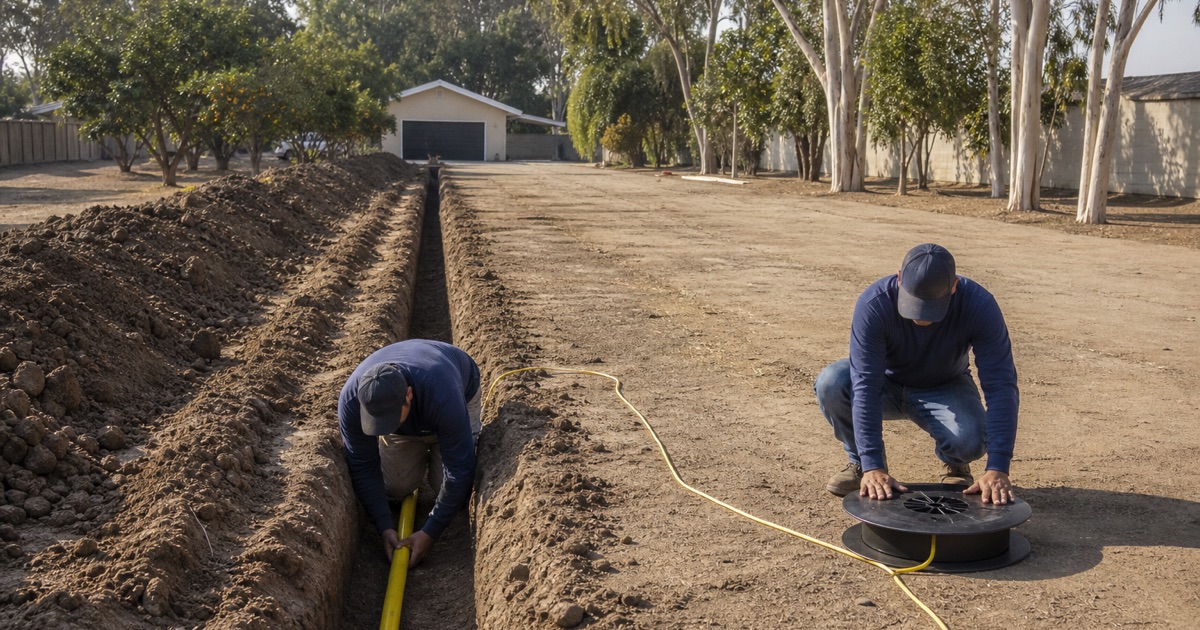
Long runs mean long trenches, and on properties with mature landscaping, hardscape and irrigation that is a real cost rather than an afterthought. New buried work is polyethylene at depth, bedded properly, with tracer wire laid above it so the line can be located again, transitioning to steel at an anodeless riser where it surfaces. Getting that transition right is where a lot of older underground work went wrong. The tracer wire is the part most often omitted and most missed later.
We backfill and compact in layers so the trench does not settle into a visible depression over the following winter, and put hardscape, turf and planting back the way we found them. On grounds that have taken decades to establish, that restoration is a significant part of what the job is judged on. We quote it rather than treating it as goodwill.
Locating, Testing and Handover
Marking Before Anyone Digs
Every excavation is preceded by a locate, and it goes further than an 811 ticket does. The utility marks only as far as the meter, so the customer-owned yard line — frequently the one running straight across where the work is planned — is not on that ticket and is not marked by anybody unless a private locate is arranged. On a large parcel with several buried services, that gap is the most likely cause of a strike. We carry out the locate ourselves with our own equipment.
This matters more here than on a small lot simply because there is more buried infrastructure to hit and longer distances over which nobody has a clear memory of what went where. Irrigation, electrical, and previous gas runs all share the ground. A locate is an hour that regularly prevents a much worse day. It is also the only way to know whether an old run was ever laid where the drawings said it was.
Testing Before It Is Covered
A buried run is pressure tested while the trench is still open, because a line that fails its test after backfill is a second excavation rather than an adjustment. We charge the section and hold it on a gauge whose range is no more than twice the test pressure and graduated in tenths of a psi, then call for the inspection. Doing the test and the inspection in the right order is what stops an underground job being dug twice. A failed test on a closed trench can cost more to reopen than the original excavation did.
You keep the written result. On property where the gas system extends well beyond the house, that document is the only durable record that the whole system held on the day it was closed up.
The Route Record
Before any trench is closed we photograph the route and the depth, and you keep those images. It costs nothing on the day and it repeatedly saves the next trade — a landscaper, a pool contractor, an electrician trenching for a subpanel — from finding the line the hard way. On a large parcel where runs cross open ground with no visible reference, this record is worth considerably more than it is on a small lot.
Where the meter sits away from the house, we note that too. The run from the meter to the building is customer-owned pipe, and on a property of this size that can be a substantial length of line that nobody has ever documented.
- Licensed & Insured
- Same-Day Leak Response
- Free Written Quotes









