
Santa Ana Gas Line installs, repairs and replaces gas piping throughout Newport Beach, California. We handle outdoor kitchen and fire feature supplies, pool and spa heater runs, standby generator connections, leak detection, repipes and the permits, inspections and pressure testing that go with all of it. The work here concentrates on amenity load and on coastal exposure more than on anything else. Both are demanding in ways that ordinary suburban gas work is not.
The amenity side is straightforward to describe and easy to underestimate. Properties here carry a density of gas-fired outdoor equipment that most housing never approaches — built-in barbecue islands, linear fire tables, fire bowls, patio heaters, gas lanterns, pool and spa heaters, and increasingly standby generators. Each of those is a real load rather than a token one. Added together they frequently exceed what the original system was ever sized to deliver.
The coastal side acts on everything exposed. Salt-laden air attacks the meter set, the riser, exterior runs, their supports and the terminations at outdoor appliances, and it does so progressively rather than suddenly. Interior piping ages much as it would anywhere. Everything outside ages faster, and it is the part most often overlooked because it is in plain sight.
Amenity Load and Sizing
Adding Up What the Outdoor Space Draws
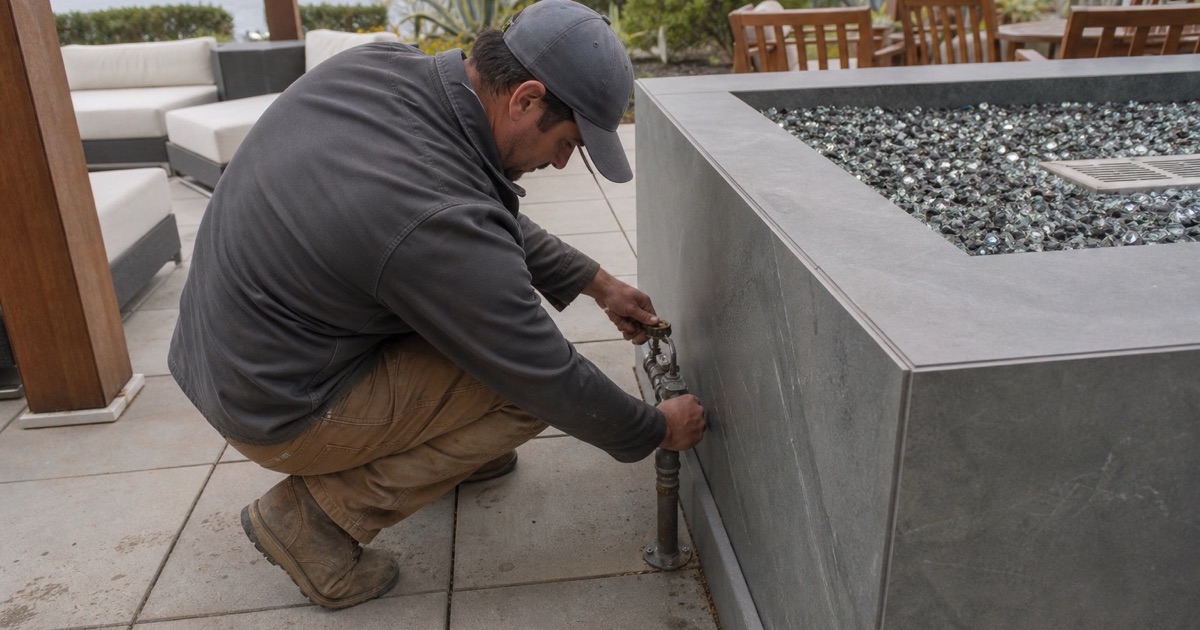
A finished outdoor living space can carry more connected gas load than the entire interior of the house it belongs to. A built-in grill, a side burner, a fire table, two patio heaters and a pool heater together represent a substantial demand, and they are frequently expected to run at the same time on the one evening a year everybody is outside. Sizing for a diversified average rather than the real simultaneous load is how that evening goes wrong. We total what is actually there.
The calculation takes the connected load, the developed length of the run including every fitting, and the delivered pressure, read against a sizing table for the material. On a property where the equipment pad and the outdoor kitchen sit at opposite ends of a long site, the length term does a great deal of the work. We measure the route as it will be run rather than as it appears on a plan.
Pool and Spa Heaters
A pool or spa heater is one of the largest single gas loads on any residential property, and it almost always sits at the far end of the longest run on the site. That combination is precisely what produces an undersized supply, and the symptom is not a failure but a heater that never quite reaches temperature. Owners generally blame the equipment, and frequently replace it. The supply is rarely the first thing anybody measures.
We size the line for the heater’s rated input over the real distance to the pad, and we read the delivered pressure at the unit with a manometer while it is firing before recommending anything. That measurement takes minutes and settles an argument that otherwise runs for years. It has saved more than one perfectly serviceable heater from being condemned twice over.
Standby Generators
A whole-house standby generator is the most demanding load most residential properties will ever carry, because it has to deliver full output at the same moment everything else in the building is drawing. That combination frequently exceeds the existing line and sometimes the meter set itself. On a large or long site the distance compounds the problem further. It is not a load that can be estimated by eye.
We calculate the total connected demand before equipment is ordered and tell you plainly whether the answer is a larger line, a larger meter, or both. That is a far better conversation while the generator is still a quotation than after it has been delivered and set. A unit that cannot carry the house it was bought for is a problem no amount of servicing resolves.
Looking for gas line closer to Placentia? See Gas Line Services in Placentia.
Coastal Exposure
Meter Sets, Risers and Exterior Runs
The meter set assembly and the riser serving it sit permanently outdoors and take the full load of the marine environment. Corrosion appears first at fittings, at supports, and anywhere a coating has been damaged or dissimilar metals are in contact. It advances quietly, which is why it is usually well established before anybody remarks on it. By the time it is obvious from the street it has often been progressing for a decade.
The meter itself belongs to the utility, but everything downstream of it is customer-owned, and that boundary runs directly through the most exposed part of the system. We identify which side of it a problem sits on before anybody is billed for anything. Replacing a failed support or restoring a coating is a fraction of the cost of replacing the run it was carrying.
Outdoor Terminations and Shutoffs
Quick-disconnect outlets, shutoffs serving outdoor appliances, and the terminations feeding fire features and patio heaters all live outside permanently. A shutoff that has corroded to the point where it no longer operates is worse than absent, because it creates the belief that an isolation point exists where none functionally does. Nobody discovers a seized valve at a convenient moment. The only reason to reach for one is that something has already gone wrong.
We check that every outdoor termination actually operates rather than assuming it does, and replace whatever has seized. On a property with several exterior appliances that check takes very little time. Specifying valves and fittings for the exposure rather than for the price is what determines whether the same check passes in five years.
Buried Runs Near the Coast
Buried steel corrodes in wet ground everywhere, and proximity to the coast does nothing to help. Original underground runs on older property here are among the most likely sections to have failed, and they are simultaneously the least likely to have been examined, because nothing about them is visible from the surface. Where a meter sits away from the building, that run is customer-owned pipe. Most owners assume it belongs to the gas company.
We isolate the underground portion and test it on its own, which establishes whether a loss is above or below ground before anybody excavates. New buried work is polyethylene laid at depth with tracer wire above it, transitioning to steel at an anodeless riser. That single test regularly changes the scope of a job in the customer’s favor.
Routing on Difficult Sites
Slopes, Bulkheads and Constrained Access
Sites here are frequently anything but flat, and a run may have to negotiate a slope, a bulkhead, a retaining structure or a narrow side yard with no machine access at all. Those conditions change the method rather than the specification — the pipe requirement is unchanged, but how it gets installed, supported and protected is not. Hand excavation is common. So is working around structures nobody wants disturbed.
We walk the route before quoting so the number reflects the real method rather than an optimistic one. Where machine access genuinely is not available, saying so at the quote stage is considerably better than discovering it on the first morning with a crew standing idle.
Working Around Finished Surfaces
Established properties carry finished surfaces that are expensive to disturb and frequently impossible to match — stone, specialist plaster, hardwood, custom joinery. The shortest route for a gas line is often straight through the most expensive thing on the site. Corrugated stainless steel tubing threads through existing framing far more readily than rigid pipe, which reduces the openings needed considerably.
Where a concealed run has failed, rerouting through an accessible path is frequently cheaper and far less destructive than replacing it in place. We identify anything that would have to be disturbed at the survey and put the options in front of you before work is agreed rather than during it.
Coordinating With Other Trades
Outdoor kitchens, fire features and pool equipment are built by other contractors, and the gas has to arrive at the right point in their sequence. A stub positioned before the stone or stucco goes on costs nothing extra; the same stub chased in through finished cladding afterwards is expensive and never looks correct. That is a scheduling matter rather than a technical one.
We coordinate directly with whoever is building the feature so the trench and the stub happen when the ground and the structure are still open. The trades that follow us are the ones who pay for it when this is left late, which is why we raise it early.
Permits, Testing and the Record
Permits and Inspection
Installing, extending, altering or replacing gas piping is permitted work, and we pull the permit and schedule the inspection ourselves rather than handing over a form and a counter phone number. The fee appears on the quote rather than arriving later as an extra. Where the work forms part of a wider remodel, the piping test is taken after lath or gypsum board is in place.
That sequencing has to be planned with the other trades so nobody closes a wall ahead of the stage that must be witnessed. On a project running several contractors in parallel it is the step most frequently missed, and rework at that point is expensive and entirely avoidable.
Testing Before Anything Is Covered
A finished system is isolated, charged to test pressure and held while the gauge is watched, read in inches of water column for low-pressure work and in psi above that. The gauge range has to be no more than twice the test pressure and graduated in tenths of a psi, because a coarser instrument reads a slow loss as no loss at all. That is how a leaking system passes a test.
A buried run is tested while the trench is still open, because a line that fails after backfill is a second excavation rather than an adjustment. Doing the test and the inspection in the right order is what prevents an underground job being dug twice.
Documentation Worth Keeping
You keep the written pressure test result on every job, whether or not an inspector asked for it, along with photographs of the route and depth of anything we buried before it was covered. On a property where gas runs cross open ground to several pieces of equipment, that record is the only durable account of where anything went.
It protects the trades who come after us as much as it protects you. A landscaper with a trencher, a pool contractor or an electrician running a subpanel all benefit from knowing where the gas is, and in an environment actively working on everything exposed, a documented baseline is worth more than it would be inland.
- Licensed & Insured
- Same-Day Leak Response
- Free Written Quotes









