
Santa Ana Gas Line installs, repairs and replaces gas piping throughout Midway City, California. We cover leak detection, repipes on original steel, buried yard lines, appliance connections, meter work and the permit and inspection process that goes with them. The lots here are small and densely built, which makes routing and access the defining constraints rather than distance. It also means neighboring properties are close enough that a gas incident is never confined to one household.
The first thing worth establishing on any job here is jurisdiction. Midway City is unincorporated, forming part of the county land controlled by Orange County, and it is mostly surrounded by Westminster with Huntington Beach bordering it on the southwest.
That arrangement means there is no city building department here. Gas permits are issued by the county, not by a municipality, and a contractor who assumes otherwise because the address sits inside a familiar postal area will discover the problem at the counter. We confirm jurisdiction before quoting any timeline.
Permits Under County Jurisdiction
No City Hall Means a Different Counter
The Census Bureau defines Midway City as a census-designated place. It is also the only area in Orange County that incorporates its chamber of commerce and homeowners association to act in concert like a city council, which gives it a coordinating structure most unincorporated areas lack.
An incorporated city permits work inside its boundaries under its own adopted code and fee schedule. An unincorporated county island has no such machinery, so the county building authority takes that role instead. The physical requirements for gas piping are unchanged, but the application, the fee schedule, the inspection scheduling and the sign-off all run through a different office than they would two streets away. Knowing that at the start is the difference between a job that runs to plan and one that stalls before it begins.
The confusion here is structural rather than careless. Being surrounded by an incorporated city means the mailing address, the postal code and the everyday sense of where you are all point one way while the permitting authority points another. We check the actual jurisdiction rather than inferring it, and we do that before anything is scheduled.
Sequencing the Inspection
Where gas piping is altered as part of a remodel, the piping test is taken after lath or gypsum board is in place rather than before, which catches damage caused by the drywall screws themselves. On a small house with several trades working in a confined space, that sequencing is easy to lose track of. Somebody closes a wall, and the stage that had to be witnessed is now behind it. Rework at that point is expensive and entirely avoidable with a conversation at the start.
We plan the order with whoever is running the job and pull the permit early rather than when it becomes urgent. Where a plan check is required rather than an over-the-counter approval, that is far better established in week one than in week six.
Work Nobody Permitted
Small older properties accumulate alterations, and a good deal of the gas work on them was done without a permit at some point. It surfaces at a sale, a refinance or an insurance claim with a deadline attached and very little room to negotiate. The route through is an inspection of what is actually there, correction of anything failing current code, and a permit that closes properly. Because this is county-permitted land, that process runs through the county too.
We survey first and put the scope in writing before you commit to anything. On a good number of these the physical correction turns out to be modest and the missing paperwork is the real job.
Looking for gas line closer to Westminster? See Gas Line Services in Westminster.
Small Lots, Dense Building
Routing Where There Is No Slack
Compact properties leave very little room for a gas run to take an easy path. Wall cavities are shallow, crawl space access is often restricted, and there is rarely a convenient route that avoids finished surfaces entirely. Corrugated stainless steel tubing listed to ANSI LC-1 and CSA 6.26 threads through existing framing far more easily than rigid pipe, which reduces the openings needed, and it requires a 6 AWG copper bonding conductor.
Not everything can be flexible, though. Schedule 40 black steel remains the right answer where a rigid exposed run is practical, and corrugated tubing is not permitted in regulator vent piping. A good installation here mixes materials deliberately rather than forcing one everywhere.
Yards That Are Mostly Building
Where lot coverage is high, a buried run has fewer possible routes and more obstacles crossing it. Irrigation, electrical, drainage and previous gas work all share a narrow strip of ground, and on a property that has been built out over decades nobody has a reliable memory of what went where. That congestion is the main risk on any excavation here.
Every dig is preceded by a locate that goes further than an 811 ticket, because the utility marks only as far as the meter. The customer-owned yard line is not on that ticket and is not marked by anybody unless a private locate is arranged. We carry that out ourselves before a shovel goes in.
Meter Position and What You Own
Where the meter sits at the curb rather than against the building, the entire run back to the house is customer-owned pipe rather than the utility’s. On older small lots that section is short but frequently original, and it is the part least likely to have been examined because nothing about it is visible. Most owners assume the gas company owns it, and that assumption costs money in both directions.
We isolate the underground portion and test it separately, which establishes whether a loss is above or below ground before anybody excavates. That single measurement regularly changes the scope of a job in the customer’s favor.
Older Systems and Added Load
Original Steel Reaching Its Limit
Threaded Schedule 40 black steel corrodes from the inside out and gives way at joints and low points, so faults arrive in groups rather than singly across decades. A second leak within a year of the first is a pattern rather than bad luck. At that point each repair buys a few months and the next call is already on its way. The 2020 census listed the population as 8,825, in housing old enough for this to be a live question on many properties.
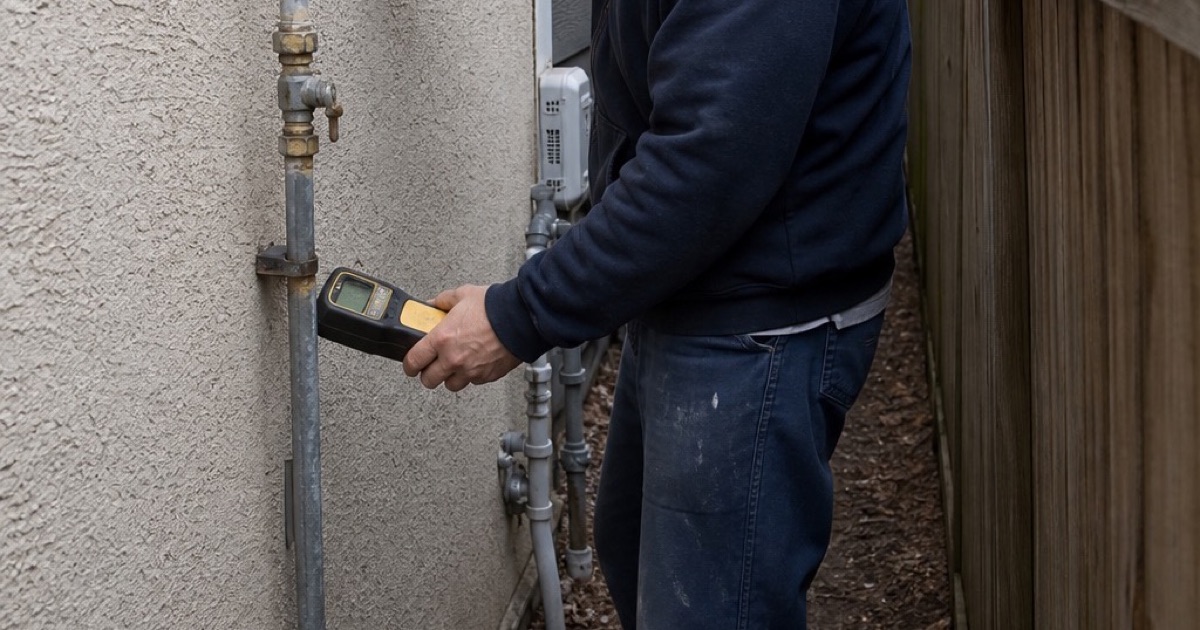
We survey the whole system with an electronic combustible gas detector, isolate sections under test pressure, and give you the finding in writing with a fixed price against repair and against replacement. If the evidence supports the repair we will say so.
Appliances Added to a Line With No Headroom
Small houses get the same appliance upgrades as large ones, and the pipe rarely gets revisited. A tankless water heater fires at several times the input of the tank it replaces, and the branch that fed the old heater almost never carries it. Adding an outlet to a line already at its limit does not fail visibly — the furnace and the water heater simply run short whenever the range is on.
We total the connected load and read it against the developed length before agreeing that any existing pipe can carry more. Reading the delivered pressure at each appliance while it is actually firing settles the question in minutes.
Testing and What You Keep
Every altered system is isolated, charged to test pressure and held while the gauge is watched, on an instrument whose range is no more than twice the test pressure and graduated in tenths of a psi. A coarser gauge reads a slow loss as no loss at all, which is how a leaking system passes a test. You keep the written result on every job, along with photographs of the route and depth of anything buried.
Where the supply was interrupted, we arrange the utility’s re-light and check every appliance back into service, verifying the pressure each one receives while it is firing and checking for spillage at the draft hood.
Living Close to Your Neighbors
Why Density Changes the Risk
On a compact street the consequences of a gas fault do not stop at the property line. A leak that would ventilate harmlessly on a large parcel behaves differently between closely spaced buildings, and an excavation that strikes a line affects more than one household immediately. That is not a reason for alarm, but it is a reason the work here is treated with a shorter fuse than it might be elsewhere.
We take suspected leaks and shut-off meters as same-day calls. Where a strike or a serious fault does occur, the priority is isolating it and making the area safe before anything else is considered, and the density here is precisely why that ordering matters.
Access and Shared Boundaries
Small lots mean equipment, meters and buried runs sit close to boundaries, and work on one property frequently needs access from or coordination with the neighboring one. That is a practical scheduling matter rather than a technical one, and it is far easier arranged in advance than negotiated on the morning with a trench half open.
We identify any access requirement at the survey and raise it before the work is scheduled. Where a run genuinely has to cross or approach a boundary, establishing the arrangement in writing beforehand protects everybody involved.
Community Coordination
This is the only area in the county that incorporates its chamber of commerce and homeowners association to act in concert like a city council, which gives it a coordinating structure most unincorporated areas lack. For work affecting more than one property, or where several neighbors are dealing with the same aging systems, that structure is genuinely useful.
Where several properties on a street are facing the same question, we are happy to survey and quote them together. It reduces mobilization cost and it gives owners the ability to compare like with like.
- Licensed & Insured
- Same-Day Leak Response
- Free Written Quotes









