
Santa Ana Gas Line installs, repairs and replaces gas piping throughout Los Alamitos, California. A specific problem turns up here more than anywhere else in the ring: the meter set is exactly where somebody now wants to build, and on a compact lot there is nowhere obvious for it to go instead.
Lots here are small and the houses sit close to their boundaries, so the side yard doing duty as a utility corridor is frequently the only clear ground on the property. The moment an addition, a wider driveway or an accessory unit is proposed, that corridor is the first thing in the way, and the meter set is the least movable object in it.
Relocating a meter set is not a job that belongs entirely to us or entirely to the gas company, which is why it stalls so often. It sits across the boundary between the two, and the sequence matters more than the pipework does. Getting that sequence right at the planning stage is the difference between a straightforward move and a project that waits months on somebody else’s calendar.
Moving a Meter Set
Which Side of the Boundary Each Part Sits On
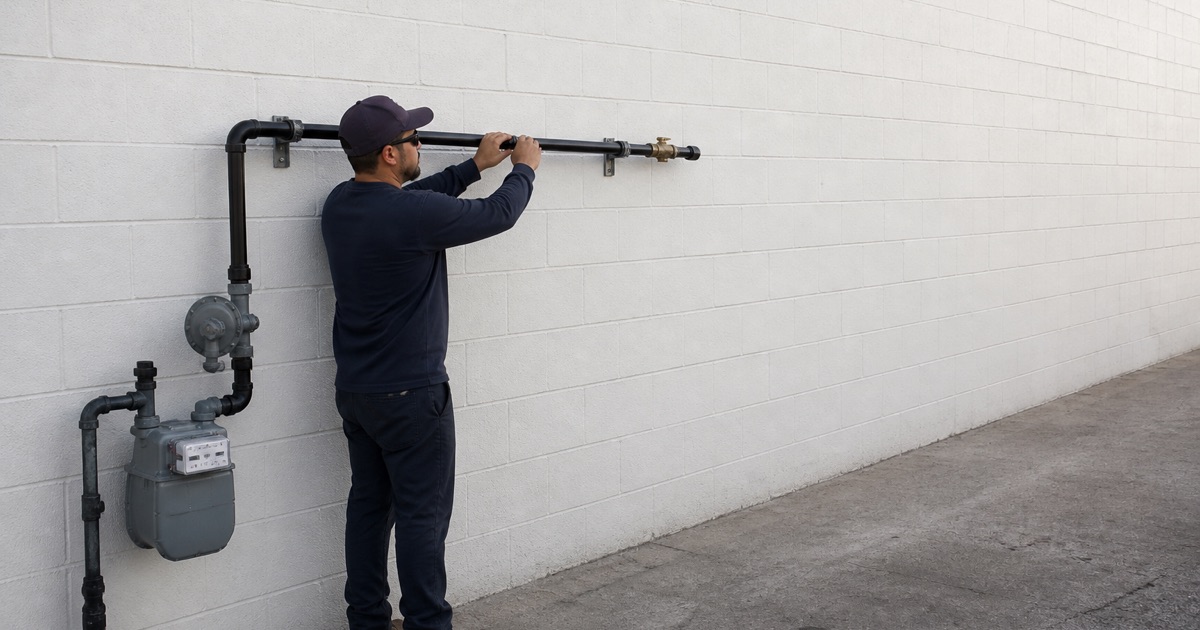
The meter set assembly and the service feeding it belong to the utility. Everything downstream of the SoCalGas service delivery point is houseline and belongs to the property. A relocation involves both, which means it involves two organizations, two schedules and two definitions of when the work is finished.
We establish that split at the walkthrough and explain who does what before anything is committed to a drawing. It is a short conversation and it prevents the common failure here, which is a customer discovering halfway through a build that the piece holding everything up was never ours to move. By then the framing is up and the only remaining options are expensive ones.
The Sequence That Actually Works
The order runs one way: agree the new location, get the utility’s part scheduled, prepare the houseline to meet it, then move. Attempting it in a different order produces a house with its gas off waiting for an appointment nobody booked early enough, which is the single most common way this job goes wrong. The pipework itself is rarely what causes the delay.
We handle our side and we make sure the customer knows the utility’s timeline rather than discovering it. Where a build program depends on the move, that date needs to be in the schedule from the beginning rather than added once framing is up and the trades behind it are already committed to dates.
Choosing Somewhere It Can Stay
A meter needs access, clearance and protection from vehicles, and on a small lot those three requirements compete with each other and with everything else wanting the same strip of ground. The temptation is to put it wherever it fits today, which is how a meter ends up boxed in by the next project.
We would rather find a position that survives the next change to the property. Los Alamitos was incorporated in March 1960 and a significant part of the city is occupied by the Joint Forces Training Base, which concentrates the housing into a compact area where lots get reworked rather than replaced. Second and third alterations to the same parcel are the norm here rather than the exception.
Looking for gas line closer to Rossmoor? See Rossmoor Gas Line.
Routing Gas on a Tight Lot
Working in a Narrow Side Yard
Much of the exposed pipe here runs through a side yard barely wide enough to stand in, shared with the electrical service, the hose bib, the air conditioning condenser and the fence. Access for the work is genuinely constrained, and so is access for whoever has to inspect or service it later.
We route with servicing in mind rather than purely for the shortest run. A shutoff that cannot be reached because a condenser was installed in front of it two years later is a problem we can avoid by thinking about it now, while the position is still a choice rather than a constraint.
Protecting Pipe Where Vehicles Go
Compact lots mean driveways run close to the house and to whatever is mounted on it. Exposed risers and meter sets near a driveway need physical protection rather than optimism, because the impact that damages one is not a rare event on a lot where cars maneuver in a confined space.
We say where protection is needed and price it as part of the job. It is a small item that prevents an emergency, and an emergency involving a struck meter is not a small item at all, for the household or for the street.
Getting Through the Building Fabric
Where a run has to enter the structure, it does so through a sleeve rather than a hole packed with filler, and it is sealed properly on both sides. On older compact housing, wall construction varies from room to room in ways that only become apparent once the finish is off.
We allow for that rather than assuming a consistent detail all the way around the building. Discovering the wall is not what the estimate assumed is a routine part of work on stock of this age, and we would rather allow for it than raise it as a variation.
When Capacity Is the Real Constraint
What the Existing Set Can Carry
A meter is sized for an expected load, and an addition frequently arrives with equipment the original set was never asked to serve. Where the total demand exceeds what the meter can pass, the constraint is upstream and no work on the houseline will resolve it.
We total the connected load and read it against a pipe sizing table, then compare that number with what the existing meter set is rated to deliver. Doing that before the design is fixed is considerably cheaper than doing it after. A drawing can be changed for nothing; a poured slab and a framed wall cannot.
Asking for More Capacity
A service or meter upgrade is a request to the gas company with its own process and its own timeline, described in the SoCalGas Natural Gas Service Guidebook. It does not move at the speed of construction and it cannot be compressed by wanting it sooner.
We make that timeline visible early so it can be planned around. A build that has allowed for it proceeds; a build that has not stops and waits, usually at the least convenient moment. We would rather deliver that news at the quote than have it arrive as a surprise.
Sizing the New Houseline
Once the meter is where it needs to be, the houseline is designed to the new geometry rather than reconnected to the old route. The developed length has changed, which means the sizing calculation has changed with it.
We recalculate rather than reusing the previous design. A relocation that keeps the original pipe sizes because the appliances have not changed is a common shortcut and an easy way to end up with a longer run that no longer performs.
Permits, Testing and Handover
Permit and Inspection
The permit is pulled by us and the inspector is met by us, rather than the whole thing being handed over as something to chase. Fuel gas piping is governed by Chapter 12 of the California Plumbing Code, Title 24 Part 5, and the work is carried out under a CSLB C-36 plumbing classification. Where a relocation forms part of a larger build, that appointment has to line up with the rest of the program rather than sit outside it.
Where the work forms part of a wider build, the piping test is taken after lath or gypsum board is in place, which catches damage caused by other trades after the pipe first passed. Sequencing that properly avoids opening a finished wall to prove something twice.
Proving the Relocated System
A relocated system is tested as a whole rather than only at the new joints. We use a pressure test gauge rated to no more than twice the test pressure, graduated in increments of a tenth of a psi, and hold the test long enough for the reading to carry meaning.
Where a leak is indicated we survey with an electronic combustible gas detector and confirm at the joint with a soap bubble test. A repair that has not been retested is an assumption rather than a result.
Getting the Gas Back On
When the gas has been off we respond the same day, and once the work passes we arrange the re-light appointment with the gas company rather than leaving the customer to chase it. That final step is the one most often abandoned by others.
A written pressure test result is handed over at the end whether or not an inspector asked for it, along with photographs of the route before anything was covered. On a lot this tight, knowing exactly where the line runs is worth a great deal to whoever digs next.
- Licensed & Insured
- Same-Day Leak Response
- Free Written Quotes









