
Santa Ana Gas Line installs, repairs and replaces gas piping throughout La Palma, California. A particular kind of job comes up here often enough to be worth explaining: the one where the piping inside the property is entirely sound and the constraint sits on the other side of the meter.
Most gas problems are houseline problems, and the houseline — everything downstream of the meter — belongs to the property owner. But not every problem is. Sometimes the meter set assembly itself, or the service feeding it, is the limit, and no amount of work on the customer’s side of that boundary will change the outcome.
Knowing which side of the line a problem sits on before work starts is worth a great deal. It decides who does the work, who pays for it, how long it takes and whether the job is a morning with a wrench or a coordination exercise with the utility. Getting that wrong at the quote stage is expensive for everybody.
Where the Utility Stops and You Begin
The Service Delivery Point
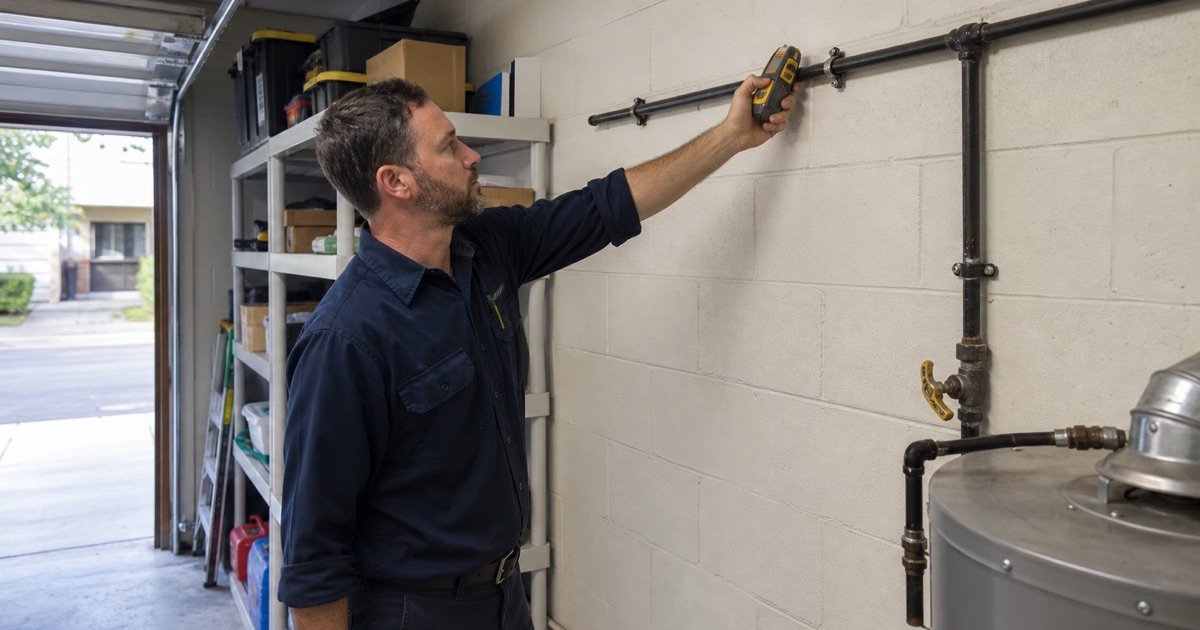
The SoCalGas service delivery point is the boundary. Upstream of it — the service, the meter set assembly, the regulator supplied with it — is the utility’s. Downstream is houseline, and it is yours, including the riser going into the wall and every foot of pipe behind it.
We establish which side a fault sits on before quoting rather than after. It is a five-minute question at the walkthrough and it prevents the far more awkward conversation that follows a job which could never have solved the problem. Nobody enjoys explaining after the fact that the work was correct and irrelevant.
What the Meter Can Actually Deliver
A meter is sized for an expected load, and it has a capacity. A property that has gained appliances since the meter was set can arrive at a total demand the meter cannot pass, and at that point the houseline is irrelevant — the constraint is upstream and the fix is a utility one. That is not a worse outcome, but it is a different job with a different timeline.
We total the connected load and read it against a pipe sizing table, then compare that figure to what the existing meter set is rated to carry. Where the meter is the limit we say so plainly rather than selling piping work that will not fix anything. It is a shorter conversation than the alternative and a considerably better one.
Asking the Utility for More
Where a service or meter upgrade is needed, that is a request to the gas company with its own process and its own timeline, and it does not run at the speed of a plumbing job. The SoCalGas Natural Gas Service Guidebook sets out what is involved.
We make sure the customer knows that timeline before committing to anything that depends on it. Nobody wants to discover that the new equipment cannot be commissioned for weeks because a utility step nobody mentioned is sitting in a queue. We would rather set that expectation at the quote than deliver it as news later.
Looking for gas line closer to Laguna Woods? See Gas Line Services in Laguna Woods.
Sizing the Houseline Correctly
The Calculation That Decides Everything
Sizing is a calculation rather than a judgment. Total the connected load in BTU, measure the developed length of each run including an allowance for its fittings, then read both against a pipe sizing table. Everything else on the job follows from those two numbers.
We do it in that order every time. Where a previous installation was clearly sized by eye — and on an older system it frequently was — the calculation is what turns a suspicion into something we can put in a quote and defend. An old system sized by eye is not necessarily wrong; it simply has never been checked.
Where the Original Design Ran Out
La Palma’s housing is largely from a single planned period, which means the original gas design was consistent and was correct for the day. It was not designed for a tankless unit, a fire feature and an outdoor kitchen arriving forty years later.
The system does not fail when that happens. It simply stops having any margin, and the next addition is the one that pushes it over. We would rather establish where the margin actually is than discover it on somebody’s behalf, halfway through installing the appliance that used it up.
Two Ways to Buy the Same Capacity
Where more capacity is needed, the choice is usually between upsizing the existing run and carrying gas at a higher pressure to be regulated down nearer the load. The first is simpler; the second moves less earth and less drywall. Higher pressure loses proportionally less over distance, which is why a smaller pipe can do the same work when it is regulated down near the load.
Neither is universally right. We price the one that suits the property and explain the other rather than presenting a single option as the only option. La Palma is a small city in northern Orange County whose population has barely moved between the last two censuses, so most work here is on existing systems rather than new build, and on original design assumptions that are now several decades old.
Meters, Tags and Getting the Gas Back On
Red Tags and Yellow Tags
When the gas company finds a condition it is not prepared to leave in service, the meter is tagged. The distinction matters: one condition means the appliance or system is unsafe and gas stays off, another means it needs attention but is not immediately dangerous.
We read the tag, address exactly what it names, and do not use it as an opening to sell unrelated work. A tag is a specific finding about a specific thing, and treating it as one is faster and cheaper for the customer, and it keeps the focus on getting the gas back on.
Getting the Meter Turned Back On
A property with the gas off is not a scheduling problem, it is a household without heat or hot water. We respond the same day when a meter has been shut off or a leak is suspected, because the interval before somebody arrives is the part that actually hurts.
Once the work passes, we arrange the re-light appointment with the gas company rather than leaving the customer to chase it. That final step is the one most commonly abandoned halfway, and it is the one standing between a completed repair and a working house.
Seismic Valves and What They Do
California Health and Safety Code Section 19180 covers seismic gas shutoff valves, and ASCE 25-97 is the standard describing what an earthquake-actuated valve has to do. These are motion-sensitive devices, distinct from a non-motion-sensitive excess flow valve, and they are frequently confused.
Where one is required or wanted we fit it correctly and explain how to reset it. A valve nobody knows how to reset is a valve that will have somebody without gas after a tremor that did no damage at all. We show the customer the reset before we leave rather than assuming they will find it.
Testing, Permits and the Record
Proving the System
Every job is tested and the result written down. We use a pressure test gauge rated to no more than twice the test pressure and graduated in increments of a tenth of a psi, and we hold the test long enough for the reading to mean something.
Where a leak is suspected rather than confirmed we survey with an electronic combustible gas detector and confirm at the joint with a soap bubble test. Two methods that fail in different ways are worth considerably more than one method used twice.
Permits and Inspection
We pull the permit and meet the inspector rather than handing that to the customer as a task. Fuel gas piping falls under Chapter 12 of the California Plumbing Code, Title 24 Part 5, and the work is carried out under a CSLB C-36 plumbing classification.
Where the work is part of a remodel, the piping test is taken after lath or gypsum board is in place, which catches damage done by other trades after the pipe passed its first test. Sequencing that correctly saves opening a finished wall.
What Is Handed Over
A written pressure test result goes to the customer at the end of every job whether or not an inspector asked for one, and it stays useful long after we have gone. The next contractor, an insurer or a buyer’s inspector will all eventually want evidence rather than assurance.
The people who quoted the work are the people who did it, and they are the ones who answer the phone afterwards. We do not subcontract, so nothing about the job has to be reconstructed from a file by somebody who was never there.
- Licensed & Insured
- Same-Day Leak Response
- Free Written Quotes









