
Santa Ana Gas Line installs, repairs and replaces gas piping throughout Irvine, California. We handle leak detection, appliance and amenity connections, buried runs to pool heaters and generators, capacity upgrades, meter work and the permits, inspections and pressure testing that go with them. Irvine is the newest housing stock in this ring by a wide margin, and that changes what goes wrong.
The short version is that corrosion is rarely the story here. Threaded steel failing from the inside out is the defining problem across most of this region, and on newer construction it simply is not the first thing to look for. What we find instead falls into three groups: bonding and installation details on flexible tubing, terminations, and capacity that was correct on the day and has since been outgrown.
That distinction matters commercially as well as technically. A contractor who arrives at a newer house with a repipe in mind is selling the wrong job. We test first and tell you when a system is sound, including when saying so costs us the larger piece of work. That is easier to promise than to do, and the pressure test is what makes it verifiable rather than a claim.
Newer Construction, Different Findings
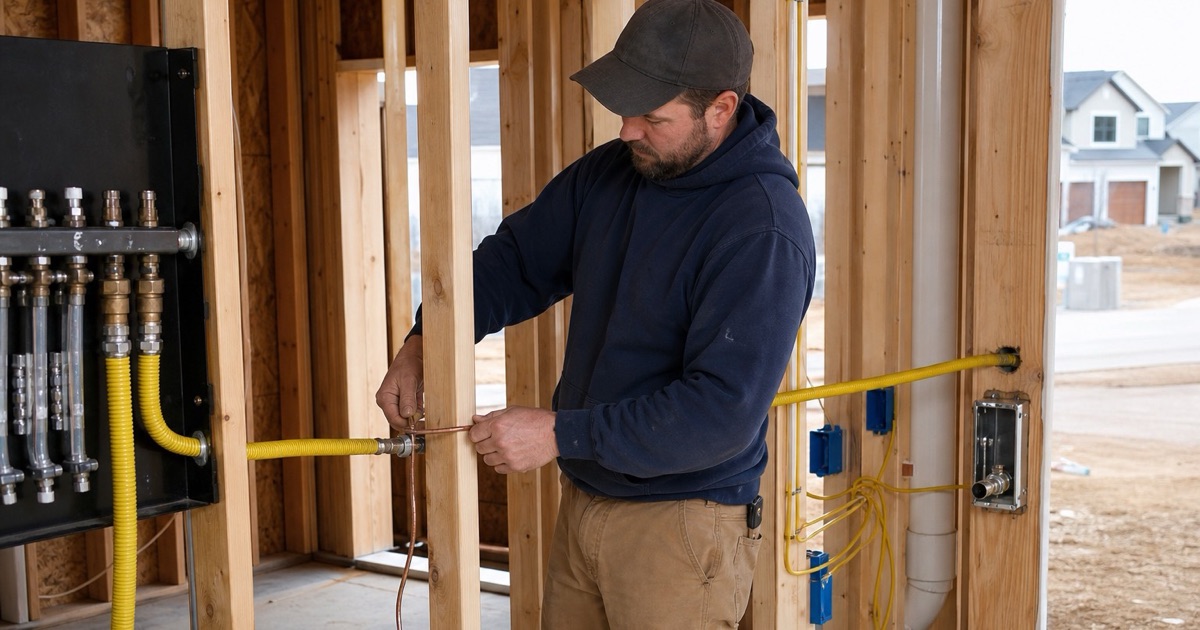
Bonding on Flexible Tubing
Corrugated stainless steel tubing listed to ANSI LC-1 and CSA 6.26 is the material of choice in construction of this era because it routes through framing far faster than rigid pipe. It carries a requirement rigid pipe does not: a 6 AWG copper bonding conductor, sized and installed to manage the lightning-induced currents that a thin wall cannot take.
This is the single most commonly missed item we find on newer systems, and it is missed because it sits in the gap between two trades. It reads as electrical work to a plumber and as plumbing to an electrician, and a system with no leak and no corrosion looks entirely healthy to anybody checking only for those. Checking it takes minutes once you know to look, and the consequence of a missing bond is not something that announces itself gradually.
Regulator Vent Piping
A line pressure regulator needs its vent piping run correctly, and corrugated stainless steel tubing is not permitted in that application even though it is permitted almost everywhere else on the same system. That exception catches people out precisely because the material is otherwise ubiquitous in this type of build.
We check vent runs specifically rather than assuming that a system built recently was built correctly throughout. Where a vent limiter is fitted in place of a run, we confirm it is the right one for the regulator rather than a generic part that happened to fit.
Terminations and Accessibility
Newer construction is generally tidy, and the failures we see are in the details: an appliance shutoff that has been built behind a cabinet run and can no longer be reached, a sediment trap omitted where the appliance called for one, or a connector routed so the appliance crushes it when pushed back into place.
None of these is dramatic and all of them matter at exactly the wrong moment. An isolation point that cannot be reached is worth precisely nothing during the event it was installed for. We check that every isolation point actually operates and can be reached without dismantling joinery, because a shutoff you cannot get to is not an isolation point at all.
Looking for gas line closer to Stanton? See Stanton Gas Line.
Capacity That Has Been Outgrown
The System Was Sized for the Original Schedule
A house built to a specification is piped for the appliances in that specification. Everything added since — a tankless water heater, a second cooktop, a pool or spa heater, an outdoor kitchen, a standby generator — draws on a system nobody has recalculated. The pipe does not stretch.
The failure is quiet rather than obvious. A branch at its limit does not leak; it simply starves everything on it whenever two appliances fire together, which presents as pilots dropping out and a water heater going cold when the furnace runs.
Doing the Arithmetic
Before an appliance goes onto an existing line we total what that line already feeds, measure the developed length of the run including fittings, and read both against a sizing table for the material and delivered pressure. Where you have told us something further is planned, that load goes into the calculation now.
Reading the delivered pressure at each appliance with a manometer while it is actually firing settles the question in minutes. It is also the measurement that stops perfectly good appliances being replaced for a fault that was never theirs.
Tankless, Pool Heaters and Generators
These three are behind most capacity work here. A tankless unit fires at several times the input of the tank it replaces. A pool heater is one of the largest single loads on a residential property. A standby generator has to deliver full output simultaneously with everything else in the building.
We calculate the total before equipment is ordered, so whether you need a larger line, a larger meter, or both is a planning decision rather than an installation-day surprise. Irvine had a population of 318,683 at the 2020 census, much of it in housing where at least one of these has been added since construction. The pipe that served the original specification is frequently still exactly as it was on handover.
Planned Communities and Process
Working Within HOA Constraints
Much of this housing sits within master-planned communities with rules about exterior work, equipment placement, screening and access. Those rules do not change what the code requires, but they absolutely affect where equipment can sit and how a run gets from the meter to it.
We identify any constraint at the survey rather than discovering it partway through. Where an association approval is needed, that runs on its own timetable and is far better started early than treated as a formality at the end. We have seen otherwise straightforward installations wait weeks on a submission nobody thought to make.
Permits and Inspection
Installing, extending, altering or replacing gas piping is permitted work, and we pull the permit and schedule the inspection ourselves rather than handing you a form and a phone number. The fee appears on the quote rather than arriving afterwards as an extra.
Where the work forms part of a remodel, the piping test is taken after lath or gypsum board is in place, which catches damage from the drywall screws themselves. That sequencing has to be planned with the other trades so nobody closes a wall ahead of the stage that must be witnessed.
Testing and Documentation
Every altered system is isolated, charged to test pressure and held while the gauge is watched, on an instrument whose range is no more than twice the test pressure and graduated in tenths of a psi. A coarser gauge reads a slow loss as no loss at all, which is how a leaking system passes.
You keep the written result on every job, along with photographs of the route and depth of anything buried. On newer property that documentation tends to be the first entry in a record that will run for decades, and starting it properly is worth more than it appears at the time.
Outdoor and Amenity Supply
Outdoor Kitchens and Fire Features
Newer housing here is frequently built with the outdoor space finished at the same time as the interior, which means the gas provision was either designed in or deliberately omitted. Where it was omitted, adding a built-in barbecue island, a linear fire table or a fire bowl later means routing a supply through completed hardscape rather than open ground.
That is a planning problem more than a technical one. We survey the existing route, identify where a stub can be brought up with the least disruption to finished surfaces, and coordinate with whoever is building the feature so the pipe arrives before the cladding rather than after it.
Pool and Spa Heaters
A pool or spa heater is among the largest single gas loads a residential property carries, and it typically sits at the far end of the longest run on the site. Those two facts together are what produce an undersized supply, and the symptom is a heater that never quite reaches temperature rather than one that fails outright.
We size the line for the heater’s rated input over the real developed distance to the equipment pad rather than the straight-line distance on a plan. A unit short-cycling on inadequate pressure is a supply problem, and it is diagnosed with a manometer rather than solved by replacing the heater.
Quick-Disconnects and Patio Heaters
A quick-disconnect outlet lets a portable grill or a patio heater be connected and taken away again without a cylinder, which suits a climate that supports outdoor use for most of the year. A gas lantern is a fixed low-load run by comparison, and both need weather-rated terminations.
The detail that matters is the shutoff position. It has to be reachable without leaning past the flame, and it has to still operate years later, which means specifying a valve for the exposure rather than the cheapest one that fits.
- Licensed & Insured
- Same-Day Leak Response
- Free Written Quotes









