
Santa Ana Gas Line installs, repairs and replaces gas piping throughout Huntington Beach, California. We handle leak detection, repipes, buried yard lines, outdoor kitchen and fire feature supplies, appliance connections, and the permits, inspections and pressure testing that go with them. Coastal property makes a particular demand on gas systems, and it is one that inland work never has to think about.
That demand is corrosion, and it acts on the parts of a system that are exposed rather than the parts that are concealed. Salt-laden air attacks the meter set, the riser, exterior runs, supports, and the terminations at outdoor appliances. Interior piping in a coastal house ages much like interior piping anywhere; everything outside ages considerably faster.
The result is a different inspection priority. Inland, the first question on an older system is usually what the concealed steel is doing. Here, a meaningful share of what we find is on the outside of the building, visible to anybody who knows to look, and often overlooked precisely because it is in plain sight.
Coastal Exposure and Corrosion
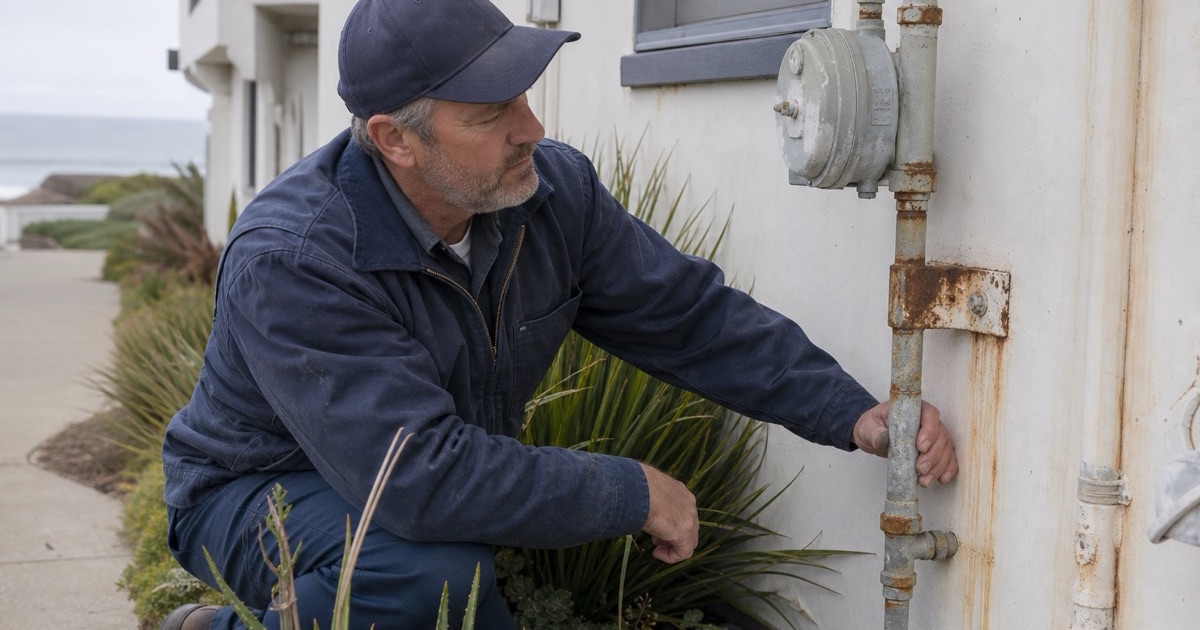
What Salt Air Does to a Meter Set
The meter set assembly and the riser serving it sit permanently outdoors, frequently on the seaward elevation, and they take the full load of the marine environment. Corrosion here shows first at fittings, at supports, and at any point where a coating has been damaged or a dissimilar metal is in contact. It is progressive rather than sudden, which is why it goes unremarked for years. By the time it is obvious from the street it has usually been advancing for a decade.
The meter itself belongs to the utility, but everything downstream of it is customer-owned, and that boundary runs straight through the most exposed part of the system. We identify which side of it a corrosion problem sits on before anybody is billed for anything.
Exterior Runs and Supports
Any gas piping running on the outside of a building — up a wall, along a side yard, out to a pool heater or an outdoor kitchen — is exposed to the same conditions. Supports fail before pipe does, and a run that has lost its supports puts load on its fittings, which is where a leak eventually appears. Protective coatings degrade faster here than the manufacturer’s general guidance assumes.
We survey exterior runs specifically rather than treating them as an afterthought to the interior system. On coastal property that is frequently where the finding is, and it is usually correctable long before it becomes a leak. Replacing a support or restoring a coating is a fraction of the cost of replacing the run it was holding up.
Outdoor Terminations
Quick-disconnect outlets, shutoffs at outdoor appliances, and the terminations serving fire features and patio heaters all sit outside permanently. A shutoff that has corroded to the point where it no longer operates is worse than useless, because the one time it is needed is the one time it will not turn. These are inexpensive components that fail quietly. Nobody discovers a seized shutoff at a convenient moment, because the only reason to reach for one is that something has already gone wrong.
We check that every outdoor termination actually operates rather than assuming it does, and replace what has seized. On a system with several exterior appliances that check takes minutes and is the difference between having an isolation point and believing you have one.
Looking for gas line closer to Irvine? See Gas Line Services in Irvine.
Outdoor Living and Amenity Load
Year-Round Outdoor Supply
Southern California outdoor living runs most of the year, and coastal property tends to lean into it harder than inland property does. Built-in barbecue islands, linear fire tables, fire bowls, patio heaters, gas lanterns and pool heaters all draw on a permanent supply rather than a cylinder, and each needs the branch checked for capacity before anything is connected.
We size the supply for the burners, bring it up in materials rated for exterior use in this environment, and terminate at a shutoff clear of the flame and reachable without leaning past it. Where hardscape is being built, the stub goes in before the stone or stucco rather than being chased in afterwards.
Pool and Spa Heaters
A pool or spa heater is one of the largest single gas loads on a residential property, and it usually sits at the far end of the longest run — the combination that produces an undersized supply. Add a coastal environment and the equipment pad is also the most corrosive location on the property.
We size the line for the heater’s rated input over the real developed distance to the pad, and specify the run and its terminations for the exposure. A heater that short-cycles on inadequate pressure is a sizing failure, not an equipment failure, and it is diagnosed with a manometer rather than replaced. We have seen perfectly good heaters condemned twice over before anybody measured the supply feeding them.
Coordinating With Hardscape
Fire features and outdoor kitchens are built by other trades, and the gas has to arrive before the finish does. Planning the stub position while the hardscape is still on paper costs nothing; chasing pipe through finished cladding afterwards is expensive and never looks right.
We coordinate with whoever is constructing the island or the seat wall so the trench and the stub happen at the correct point in the sequence. That is a scheduling conversation more than a technical one, and it is worth having early. The trades that follow us are the ones who pay for it when it happens late.
Testing, Permits and Handover
Surveying the Whole System
An electronic combustible gas detector sweep covers the interior system, and the exterior survey covers what the salt air has been working on. Together they produce a picture of a coastal system that neither on its own would give. Huntington Beach had a population of 193,151 at the 2020 census, across a housing stock spanning several decades, so the age of the interior piping varies considerably from street to street.
We isolate sections under test pressure to confirm any loss rather than inferring it, and give you the finding in writing with a fixed price against each option. That written finding is what lets you compare our recommendation against anybody else’s on the same evidence.
Permits and Inspection
Installing, extending, altering or replacing gas piping is permitted work, and we pull the permit and schedule the inspection ourselves rather than handing over a form. The fee appears on the quote rather than afterwards. Where work forms part of a remodel, the piping test is taken after lath or gypsum board is in place.
That sequencing has to be planned with the other trades so nobody closes a wall ahead of the stage that has to be witnessed, which on a project involving several contractors is the step most often missed.
What You Keep
Every finished system is isolated, charged to test pressure and held while the gauge is watched, on an instrument whose range is no more than twice the test pressure and graduated in tenths of a psi. A coarser gauge reads a slow loss as no loss at all. You keep that written result on every job.
Where we have buried a run, you also get photographs of the route and the depth taken before it was covered. In an environment that is actively working on everything exposed, a documented baseline is worth more than it would be inland.
Buried Runs Near the Coast
What the Ground Does to Steel
Buried steel corrodes in wet ground everywhere, and proximity to the coast does not improve matters. Original underground runs on older property here are among the most likely sections to have failed, and they are also the least likely to have been examined, because nothing about them is visible from the surface.
We isolate the underground portion and test it on its own, which establishes whether a loss is above or below ground before anybody excavates. That single measurement regularly changes the scope of a job in the customer’s favor, and it is the one most often skipped.
The Meter Position Question
Where a meter sits at the curb rather than against the building, the entire run from the sidewalk back to the house is customer-owned pipe rather than the utility’s. It is frequently the longest and oldest section of the whole system, and most owners assume it belongs to the gas company.
Establishing which side of that boundary a fault sits on is part of the survey rather than an afterthought. It decides who does the work and who pays for it, and getting it right early avoids both paying for the utility’s pipe and waiting on a utility that was never coming.
Replacing an Underground Section
New buried work is polyethylene laid at depth on proper bedding, with tracer wire above it so the line can be located again, transitioning to steel at an anodeless riser where it surfaces. Polyethylene does not corrode the way the steel it replaces did, which is the entire point of using it.
We backfill and compact in layers so the trench does not settle over the following winter, and put hardscape, turf and planting back the way we found them. Sandy ground settles differently from clay, and compaction is what stops a trench line appearing across a lawn six months later.
- Licensed & Insured
- Same-Day Leak Response
- Free Written Quotes









