
Santa Ana Gas Line has repaired gas piping in Santa Ana, California for over 20 years, and works throughout the surrounding cities including Garden Grove, Westminster, Fountain Valley, Tustin and Orange. We repair leaking joints, corroded sections, damaged yard lines and failed appliance connections, and we handle the permit, the inspection and the utility re-light that go with the work. What you get at the end is a system that has been retested and a written result that says so.
A gas line repair is a decision as much as a task, and the decision is the part most often skipped. The same leak can be a one-hour fitting replacement or the first visible sign that a system has reached the end of its service life, and nothing about the leak itself tells you which. A contractor who simply fixes what is in front of him is not being dishonest, but he is answering a smaller question than the one you are paying to have answered. We tell you which of the two you are looking at, in writing, before any work is priced.
That judgment carries more weight on this city’s housing stock than it would in a newer market. Threaded black steel corrodes from the inside out and gives way at joints and low points, which means faults arrive in groups rather than singly and the second one is usually already forming when the first is found. A second leak within a year of the first is a pattern, not bad luck. Much of the owner-occupied housing here dates from the 1950s through the 1970s, so this is the common case rather than the exception.
What We Repair
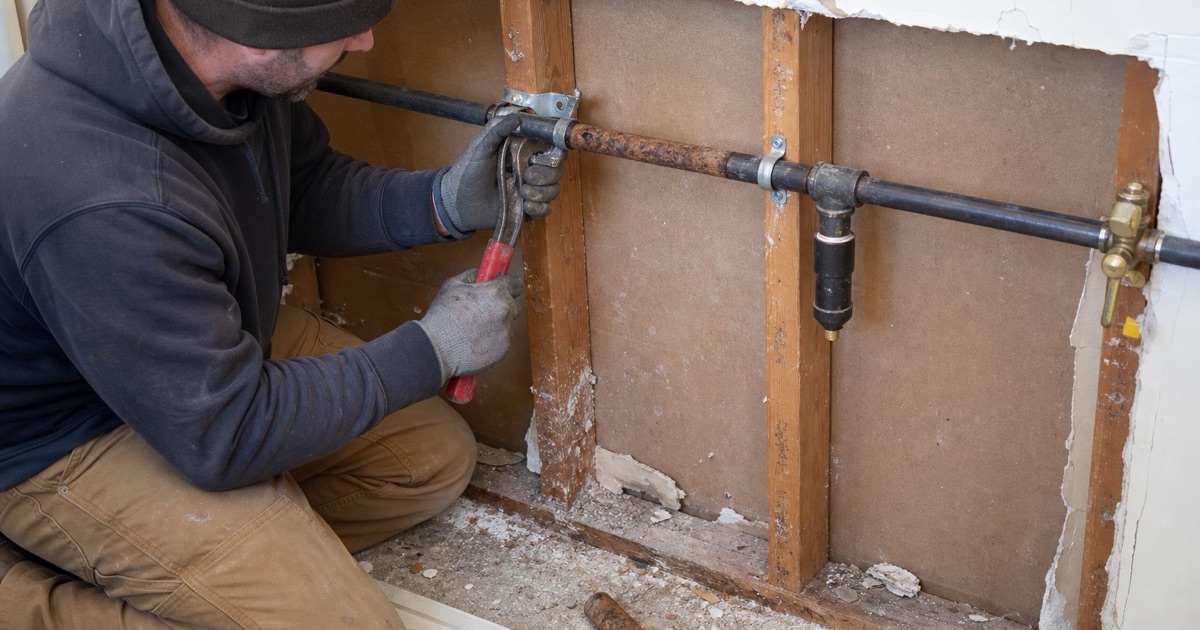
Leaking Joints and Corroded Sections
Most interior repairs come down to a threaded joint that has corroded through or a length of pipe that has thinned where moisture has sat against it for years. We cut back to sound pipe on both sides rather than patching at the point of failure, because the corrosion that produced one hole has been working on the surrounding metal for exactly as long. Replacing only the visible failure is how a repair comes back within the year. The replaced section is then pressure tested along with the rest of the branch, not on its own.
Damaged and Failed Yard Lines
Buried lines fail from corrosion, from ground movement, and from being struck — most often by somebody digging who had no way of knowing where the pipe ran, because the customer-owned yard line is not marked on an 811 ticket. We locate the run first, expose only the failed section, and replace it in the correct material for below grade. Tracer wire goes in above the new pipe so the next person to dig can find it, which is a small cost now against a repeat of the same accident later.
Appliance Connections and Shutoffs
A high proportion of what gets reported as a gas line problem turns out to be at the appliance end. A flexible connector reused past its life when an appliance was pulled out and put back, a shutoff valve that no longer seats properly, a missing sediment trap letting debris reach the burner orifices — all of these present exactly like a pipe fault to the person living with them. These are quick, inexpensive repairs, and they are the ones most often done badly, precisely because they look trivial enough to do without thinking.
Repairs That Clear a Red Tag
When the gas company finds an unsafe condition it tags the meter and shuts off the supply, and that visit condemns the system without repairing it. Clearing the tag means correcting whatever was flagged, having the work signed off, and getting the utility back out to restore service. We take these as same-day calls where we can, because a tagged meter usually means a household with no hot water and no cooking, and the clock on that is measured in hours rather than days.
Repair or Replace
When a Repair Is the Right Answer
A single failure on an otherwise sound system is a repair, and so is almost anything at the appliance end. Impact damage to a buried line is a repair too — the pipe did not fail, something hit it. If the rest of the system tests clean under pressure and the pipe has service life left in it, replacing more than the failed section is spending money for no gain. We will say so plainly, including when saying so costs us the larger job, because the alternative is selling work the evidence does not support.
When It Is Not
The answer changes when the same line has been repaired before, when the failure is corrosion at a threaded joint rather than impact damage, or when the pipe is original to a house of this era and the fault is one of several the survey turned up. At that point each repair buys a few months and the next call is already on its way. Repiping a system in that condition is not an upsell; it is the cheaper of the two paths once you count the second and third visits that are otherwise coming.
How We Put the Choice to You
You get both options in writing, with a fixed price against each and the survey finding that led us to recommend one over the other. The number agreed at the walkthrough is the number on the invoice. If you would rather repair a system we think is finished, we will do it and note the reasoning on the paperwork — it is your property and your call. What we will not do is carry out that repair without telling you what we found.
Our Step-by-Step Gas Line Repair Process
Locate and Prove the Fault
We survey the system with an electronic combustible gas detector, isolate the affected section, and hold it under test pressure to confirm the loss and measure its rate before anything is opened up. That gives us the location and the severity, and it tells us whether there is more than one fault on the system.
Quote in Writing
You get a fixed written price with the repair-or-replace finding set out alongside it, before any work starts. Where a permit is required we pull it, and the fee appears on the quote rather than arriving afterwards as an extra. Repair of gas piping and permit issuance are both published line items on the city’s fee schedule.
Repair and Retest
The failed section is cut back to sound pipe and replaced in the correct material for its location, then the system is recharged and held under test pressure again. You keep the written result. Where we have opened drywall or hardscape, it is made good and the trench backfilled and compacted in layers rather than simply refilled.
Inspection and Re-light
Where the work is permitted, we meet the inspector rather than asking you to be there. If the meter was shut off or tagged, we arrange the utility’s re-light appointment and check every appliance back into service, verifying the pressure each one receives and checking for spillage at the draft hood before we leave.
- Licensed & Insured
- Same-Day Leak Response
- Free Written Quotes