
Santa Ana Gas Line has installed new gas piping in Santa Ana, California for more than 20 years, and works across the surrounding cities including Costa Mesa, Fountain Valley, Westminster, Stanton and Orange. We run new lines for ranges and cooktops, tankless water heaters, pool and spa heaters, outdoor kitchens, fire features and standby generators, and we size, permit, test and document every one of them.
The part of an installation that decides whether it works is the arithmetic, not the pipe. A line is sized by adding up the BTU demand of everything it will feed, then reading that load against the run length and the allowable pressure drop on a sizing table. Skip that and you get a system that appears to work until two appliances run at once, at which point everything on the branch is quietly starved.
The second decision is the route, and it is the one you will live with. A run has to reach the appliance, stay accessible where the code requires it, terminate at a shutoff somebody can actually reach, and get there without opening more of a finished house than necessary. We walk that route with you before quoting, because the cheapest path through a building and the one you want in your home are not always the same line.
Sizing and Planning the Installation
Calculating the Load Properly
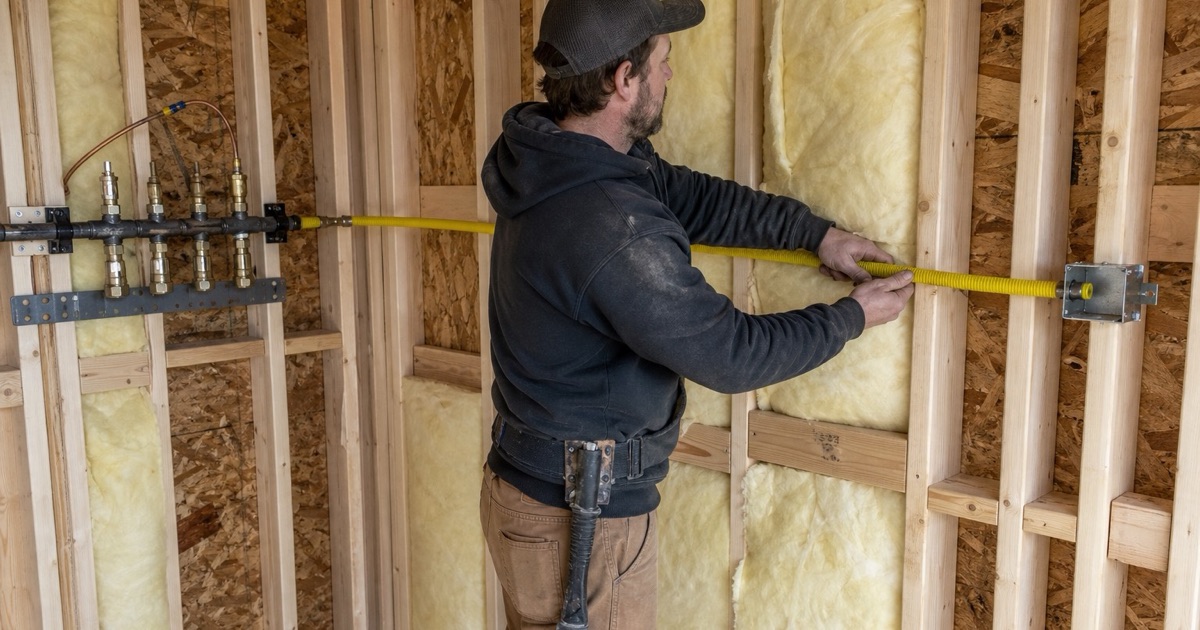
Every appliance has a rated input in BTU per hour, and the line has to carry the total of everything on it running together, not the largest one on its own. We add the connected load, measure the developed length of the run including fittings, and read both against a sizing table for the pipe material and the delivered pressure. Where you have told us an appliance is coming later — a generator, a pool heater, a second cooktop — that load goes into the calculation now, because upsizing a trunk after the walls are closed is a different job entirely.
Choosing the Material for the Run
Schedule 40 black steel to ASTM A53 is rigid, durable and slow to thread through a finished building. Corrugated stainless steel tubing listed to ANSI LC-1 and CSA 6.26 routes through framing far faster and needs a 6 AWG copper bonding conductor, and it is not permitted in regulator vent piping. Below grade the material is polyethylene in PE 2708 or PE 4710, which cannot come above ground and transitions to steel at an anodeless riser. Which one we use is decided by the route and the code, not by preference.
Planning the Route and the Terminations
The route determines the cost, the disruption and how the system serves you afterwards. We plan where the pipe runs, where it stays accessible, where it is supported, and where each appliance shutoff sits so it can be reached without moving the appliance. Sediment traps go in ahead of appliances that need them, to catch debris before it reaches burner orifices. Getting the terminations right at planning stage is what stops a perfectly good installation being annoying to live with.
Common Installations
Ranges, Cooktops and Kitchen Conversions
Putting gas into a kitchen that has only ever been electric means a new branch, a shutoff behind the appliance, a sediment trap and a flexible appliance connector rated for the duty. The pipe is rarely the difficulty; getting a route into a finished kitchen without opening more wall than necessary is, and it usually decides where the line comes from. We work that out before the quote so the number reflects the real job rather than an optimistic one.
Tankless Water Heaters and High-Input Appliances
A tankless unit fires at several times the input of the tank it replaces, and the branch that fed the old heater almost never carries it. This is the single most common reason a tankless installation stalls on the day of the swap, with the appliance on the driveway and the pipe two sizes short. We size and run the new supply ahead of the changeover so the pipe and the appliance arrive at the same standard, and the installer is not improvising.
Outdoor Kitchens, Fire Features and Heaters
Southern California outdoor living runs most of the year, which makes a permanent outdoor supply worth more here than in a cold-winter market. A built-in barbecue island, a linear fire table, a fire bowl, a patio heater or a gas lantern each need the supply sized for the load, brought up in a material rated for exterior use, and terminated at a shutoff clear of the flame. We coordinate with whoever is building the hardscape so the stub comes up in the right place before the stone or stucco goes on.
Pool Heaters and Standby Generators
These are the two heaviest loads on a typical residential property, and both usually sit at the far end of the longest run — the combination that produces an undersized supply. A standby generator has to deliver full output at the same time as everything else in the house, which frequently exceeds the existing line and sometimes the meter itself. We calculate the total before quoting and tell you plainly whether the answer is a larger line, a larger meter, or both.
Work That Has to Stay Accessible
Not every part of a gas system may be buried in a wall or a slab. Joints, valves and certain fittings have to remain accessible for inspection and future service, and where a run passes through a concealed space the rules on protection and support tighten. Planning for that at the routing stage is straightforward; discovering it after the drywall is hung is not. We flag anything that has to stay reachable before the framing trades close up behind us.
Permits, Testing and Handover
The Permit and the Inspection
Installing or extending gas piping in Santa Ana is permitted work through the city’s Planning and Building Agency, under the California Plumbing Code as the city adopts it in Municipal Code Section 8-290. Permit issuance is $70.06 and a new gas system of one to four outlets is $56.64, so a residential permit comes to $126.70. We pull it, show the fee on the quote, and meet the inspector ourselves rather than asking you to take the day.
Testing Before It Is Closed Up
A new system is proved by isolating it, charging it to test pressure and holding it while the gauge is watched — read in inches of water column for low-pressure work and in psi above that. The gauge range has to be no more than twice the test pressure and graduated in tenths of a psi, because a coarse instrument will pass a line that is losing slowly. In this city the piping test is taken after lath or gypsum board is in place, which catches damage from the drywall screws themselves.
What You Get at Handover
You keep the written pressure test result, the permit paperwork and photographs of the route and depth taken before anything was covered. That last item costs us nothing and repeatedly saves the next trade — or you — from finding a buried line the hard way. Where we trenched, the ground is backfilled and compacted in layers and the hardscape, turf and planting go back as we found them rather than as a patch.
- Licensed & Insured
- Same-Day Leak Response
- Free Written Quotes