
Santa Ana Gas Line inspects and pressure tests gas piping across Santa Ana, California, for property sales, rental compliance, insurance requirements and permit sign-off. An inspection here means the whole system is surveyed and tested, and you are handed a written result rather than a verbal opinion.
People arrive at this service from one of two directions. Either something has forced the issue — an escrow, a rental inspection, an insurer, or a red tag — or somebody has bought a house of this era and wants to know what is actually in the walls before they spend money elsewhere. Both are good reasons, and the second is much cheaper than the first.
What makes an inspection worth having in this city is the housing stock. A large share of the owner-occupied housing was built between 1950 and 1979, and the original Schedule 40 black steel in those buildings corrodes from the inside. A system can look sound and still be losing pressure, which is exactly what a test finds and a visual walk-through does not.
What an Inspection Covers
The Pressure Test
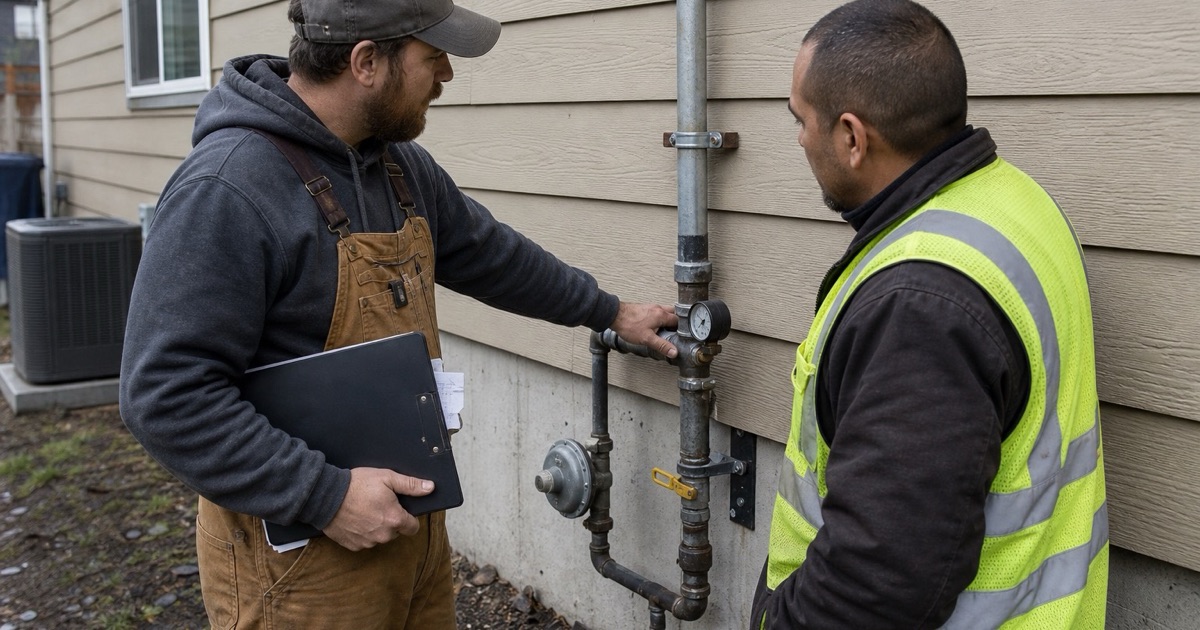
The core of the inspection is isolating the system, charging it to test pressure, and holding it while the gauge is watched. The instrument matters: its range must be no more than twice the test pressure and graduated in tenths of a psi, because a coarser gauge reads a slow loss as no loss. This is the part that produces a fact rather than an impression, and it is the number that goes on the report.
The Visual Survey
Alongside the test we survey what can be seen: pipe condition and support, corrosion at joints and low points, appliance shutoffs, sediment traps where they are required, flexible connectors that have been reused past their life, and any alteration that looks like it was never permitted. Each of these is a common finding on older systems and each is something an inspector or a buyer’s surveyor will pick up.
Pressure Delivered at Each Appliance
We also read the pressure each appliance actually receives while it is running, on a manometer. A system can hold pressure perfectly and still be undersized for what has been connected to it, which shows up as pilots dropping out and appliances underperforming when two run together. That is a capacity finding rather than a leak finding, and it is invisible to a test that only looks for loss.
Inspections With a Deadline
Sales, Escrow and Buyer Requests
A gas finding during escrow is a negotiation with a clock on it. Having the system tested and documented before listing removes it as a lever and gives you the option of correcting anything cheaply, on your own schedule. For a buyer, an inspection of a house of this age is one of the more useful things to spend a few hundred dollars on before committing.
Rental Property
Most of the housing in this city is rented, which puts gas piping in front of an inspection regime that owner-occupied property never faces. An inspector looks for unpermitted alterations, missing shutoffs, unsupported or corroded pipe and reused connectors. We survey ahead of that visit and tell you what will be flagged, so it is corrected on your timeline rather than under a correction notice with a date on it.
Unpermitted Work Discovered Late
Work that was never permitted usually surfaces at a sale, a refinance or a claim, and by then it has a deadline attached. The route through is an inspection of what is actually there, correction of anything that fails code, and a permit that closes properly. We survey first and give you the scope in writing before you commit to anything.
What You Receive
The Written Report
You get a written report covering what was tested, what the test showed, what the visual survey found, and the delivered pressure at each appliance — including the sections that came back clean. That last part matters more than people expect, because a report that only lists problems cannot be used to demonstrate that anything is sound.
Findings and Fixed Prices
Where the inspection turns something up, you get the finding and a fixed written price to correct it, with no obligation to have us do the work. An inspection that automatically becomes a sales pitch is not an inspection, and a report you cannot take to another contractor is not worth much.
Permits and the Paperwork Trail
Why Permit History Matters
An inspection increasingly turns into a paperwork question rather than a pipe question. Buyers, insurers and rental inspectors all want evidence that alterations were permitted, and the absence of a record is treated as a finding in its own right even where the workmanship is sound. We tell you what the physical evidence suggests about the system’s history, and where a legalizing permit is the cleanest route we set out what that involves before you commit to it.
Closing Out Work Somebody Else Left Open
A surprising number of properties carry a permit that was opened and never signed off, which reads on a search exactly like unpermitted work. Getting it closed means demonstrating that what was installed meets the code in force, and in this city the piping test is taken after lath or gypsum board is in place, so the sequencing has to be planned. We handle that process rather than handing you a phone number for the counter.
- Licensed & Insured
- Same-Day Leak Response
- Free Written Quotes