
Santa Ana Gas Line has provided gas leak detection across Santa Ana, California for more than 20 years, serving surrounding cities including Orange, Tustin, Fountain Valley, Costa Mesa and Garden Grove. We find leaks on appliance connections, on concealed interior piping and on buried yard runs, and we respond the same day when the smell of gas is what prompted the call. The survey covers the whole system rather than the one spot that prompted it, because a house that has produced one leak has usually been working on the next.
Detection is a survey, not a guess, and the distinction decides how much of your house gets opened up. A soap bubble test confirms a leak at a fitting you have already identified and reached, which is genuinely useful as a last step. It cannot tell you whether a building has one fault or four, it cannot reach pipe inside a wall or below a slab, and it cannot survey a run you cannot see. We sweep the system with an electronic combustible gas detector, isolate by section, and only then confirm at the fitting.
The reason this matters here is the age of the piping. Much of the owner-occupied housing in Santa Ana was built between 1950 and 1979, and the original Schedule 40 black steel in those houses corrodes from the inside and gives way at threaded joints and low points rather than in the middle of a run. That means the leak is rarely where the smell is strongest, and it means faults tend to arrive in groups. Surveying the whole system on an older house is not thoroughness for its own sake; it is the only way to know what you are actually dealing with.
How We Find a Gas Leak
Electronic Detection Across the Whole System
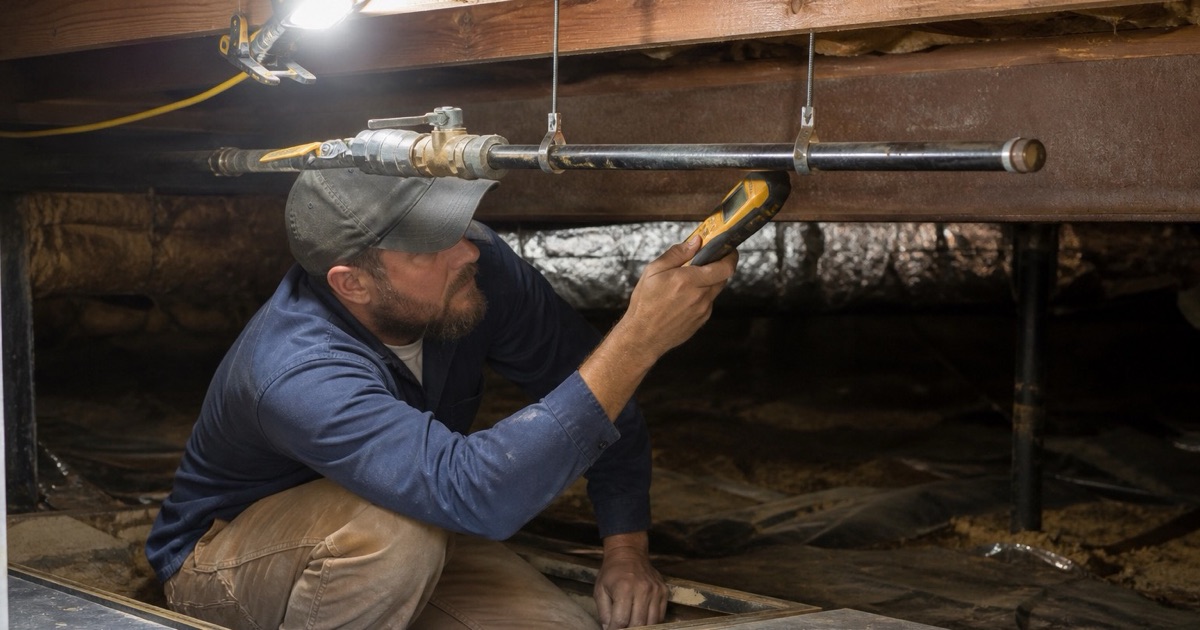
An electronic combustible gas detector registers concentrations far below the level a nose can pick up, which is what makes a survey possible rather than a search. We walk the full run — meter, riser, trunk, branches and every appliance connection — logging each point where the instrument responds rather than stopping at the first. What comes out of that is a map of the system rather than a single answer. On a house still on its original piping it frequently shows more than one fault, and knowing that before any repair is priced is what stops you paying twice.
Pressure Isolation to Prove the Loss
Once the instrument has flagged an area, we isolate that section and hold it under test pressure to prove the loss is real and to measure how fast it is going. The gauge matters as much as the test: its range has to be no more than twice the test pressure and graduated in tenths of a psi, because a coarser instrument reads a slow drop as no drop at all. A line that fails slowly is still a line that fails. This step is also what distinguishes a genuine leak from a smell that has another explanation entirely, such as a spilling flue.
Confirmation at the Fitting
The last step is the oldest one, and doing it last is the whole point. With the section isolated and the area narrowed to a few feet, a soap solution at the joint gives visible, unambiguous confirmation of exactly which fitting is failing. There is no instrument reading to interpret and no ambiguity about which side of a coupling has gone. Running this test first, across a whole house, is how people end up opening four walls to find one fault — and it still misses anything buried.
Leaks on Buried and Concealed Runs
Underground Yard Lines
A buried run cannot be surveyed by walking past it, so we work by elimination instead. We isolate the underground section at both ends, confirm it is the part losing pressure, then trace the route itself — polyethylene is followed on the tracer wire laid above it, and steel can be located directly. Only then does a shovel come out. Narrowing a fault to a short section before excavation starts is the difference between a repair and a landscaping project, and on a lot with mature planting that difference is most of the cost.
Piping Inside Walls and Under Slabs
Concealed interior piping is found the same way — isolate, prove, then narrow — but the access decision carries more weight, because every opening is drywall to make good afterwards. We establish which branch is losing before anything is cut, and we cut once. Where a concealed run in an older house has failed and the surrounding pipe is the same age, we will tell you plainly if the sensible answer is to abandon that run and reroute rather than repair in place. Chasing successive failures through finished walls costs more than the reroute would have.
Where the Leak Is Not Yours
Not every leak on a property is the property owner’s to fix, and finding that out early is worth real money. SoCalGas maintains its piping up to and including the meter, so a fault on the utility side is its responsibility and its cost. Establishing which side of the service delivery point the loss sits on is part of the survey rather than an afterthought. This matters on the older lots in this city, where the meter often sits at the curb — which makes the entire run back to the house customer-owned pipe, not the gas company’s.
What the Survey Tells You
One Fault or a Failing System
The most useful output of a whole-system survey is not the location of today’s leak; it is whether today’s leak is an event or a symptom. A single failure from an impact is one thing. Multiple responses along an original steel system, at threaded joints, in a house of this era is another, and it changes the right answer from repair to replacement. We put that finding in writing with the evidence behind it, so the decision is yours to make on facts rather than on a recommendation you have to take on trust.
Pressure at the Appliance
While the system is open to us we read the delivered pressure at each appliance with a manometer, because a leak is not the only way a line fails a household. An appliance running on inadequate pressure burns incompletely, which is a carbon monoxide question rather than a gas leak question, and it is also the real reason behind most pilot lights that will not stay lit. Finding a starved branch during a leak survey costs nothing extra and regularly explains a complaint the customer had stopped connecting to the gas at all.
The Written Record
Everything the survey finds goes into a written report, including the sections that tested clean. That record is what an inspector, an insurer, a buyer’s agent or the next contractor will ask for, and it is the reason a documented survey holds its value long after the repair is done. Where we have repaired, the retest result goes on the same document. You should not have to take a contractor’s word for the condition of something you cannot see.
After the Leak Is Found
Repair, Test and Document
Finding the leak is half the job. We repair or replace the failed section, recharge the system and hold it under test pressure again, and hand over the written result. Where the work altered piping and therefore required a permit, we pull it and meet the inspector rather than leaving either with you. A repair that is not retested is an assumption, and a repair that is not documented is one you will have to prove again later.
Getting the Gas Back On
If the meter was shut off or tagged, the supply does not simply come back on when the pipe is sound. Every appliance in the building has to be relit and checked in turn, and the utility has to attend. We arrange that appointment once the work has passed, then verify each appliance is receiving the pressure it should and check for spillage at the draft hood before we leave. A house handed back with three of four appliances working is not a finished job.
- Licensed & Insured
- Same-Day Leak Response
- Free Written Quotes