
Santa Ana Gas Line installs, repairs and replaces gas piping throughout Fullerton, California, for homeowners, landlords, property managers and tenants. We cover leak detection, repipes, buried yard runs, appliance connections, meter work, and the permits, inspections and pressure testing that go with them. Fullerton has one of the widest build-era spreads in this ring, and that is the thing that shapes the work.
Pre-war housing, post-war tract construction and much newer infill all sit within a short distance of each other here, and each fails differently. Corrosion on original threaded steel is the story on the older stock. On newer construction it is bonding, terminations and capacity that has been outgrown. Treating one as the other wastes money in both directions.
There is a second factor. A substantial share of housing here is rented rather than owner-occupied, which introduces a second decision-maker and an inspection regime that owner-occupied property never meets. On most jobs the first question is not technical at all — it is who owns the fault and whose deadline the work is running against.
A Wide Spread of Build Eras
Older Stock and Original Steel
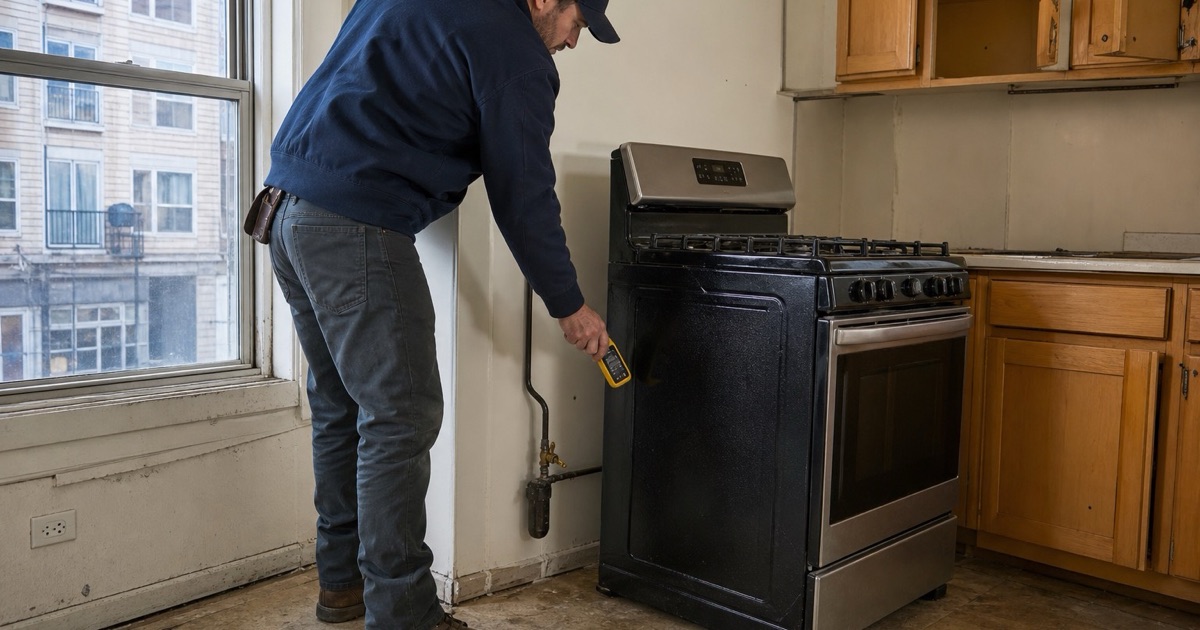
On the older housing the pattern is corrosion. Schedule 40 black steel to ASTM A53 corrodes from the inside out and gives way at threaded joints and low points, which means faults arrive in groups rather than singly across decades. A second leak within a year of the first is a pattern rather than bad luck.
We survey the whole system with an electronic combustible gas detector and isolate sections under test pressure, then give the finding in writing with a fixed price against repair and against replacement. On housing that has been altered repeatedly, that survey frequently turns up more than one response. It also identifies runs that were capped rather than removed when an appliance came out, which are the reason a pressure test will not hold for a cause nobody can locate.
Newer Construction and Different Findings
Newer houses rarely have corroded pipe, and their findings sit elsewhere. Corrugated stainless steel tubing listed to ANSI LC-1 and CSA 6.26 requires a 6 AWG copper bonding conductor and is not permitted in regulator vent piping, and the bonding in particular is the item most commonly missed.
It is missed because it falls between two trades — it reads as electrical work to a plumber and as plumbing to an electrician. A system with no leak and no corrosion looks entirely healthy to anybody checking only for those two things. Checking the bond takes minutes once you know to look for it, and the consequence of its absence is not something that announces itself gradually.
Establishing Which You Have
The first thing we do is work out which system is actually in front of us, because it determines everything after. That means a pressure test, a look at the material and the terminations, and a delivered pressure reading at each appliance while it is running.
It takes about an hour and it is what separates an accurate quote from an optimistic one. It also protects you from being sold a repipe on a system that tests clean, which on the newer stock here would be an expensive and unnecessary job. We would rather spend an hour establishing which situation you are actually in than arrive with a recommendation already decided by the year on the title.
Looking for gas line closer to Anaheim? See Gas Line Services in Anaheim.
Rental Property and Inspection Exposure
What an Inspector Looks For
Gas piping in rental housing meets a level of scrutiny that owner-occupied property does not, and the findings are predictable enough to prepare for: unpermitted alterations, missing or inaccessible appliance shutoffs, unsupported or corroded pipe, and flexible connectors reused past their service life.
We survey ahead of a visit and give the findings in writing with a fixed price against each item. Because the list an inspector works from is largely predictable, that survey is unusually accurate as a forecast of what a visit will produce. Correcting them on your own schedule costs materially less than correcting them under a notice with a date attached, and it avoids displacing a tenant over something avoidable.
Unpermitted Work Inherited With the Building
Rental property changes hands, and alterations made by a previous owner arrive with it. Work that was never permitted usually surfaces at a sale, a refinance, an insurance claim or an inspection, and by then it has a deadline and very little negotiating room attached to it.
The route through is an inspection of what is actually there, correction of anything that fails current code, and a permit that closes properly. On a good number of these the physical work is modest and the missing paperwork is the real job. Knowing which of the two you face changes the budget considerably, and it changes whether you deal with it now or when somebody forces the question.
Turnover as the Window
The hardest constraint on rental gas work is access to an occupied unit. A vacancy between tenancies is the one period when a system can be surveyed, tested and corrected without coordinating around somebody’s life, and that window is usually short and already busy.
We schedule around turnover where a landlord prefers to work that way, and we can survey and quote in a single visit so the decision can be made quickly. Where a whole building needs attention, phasing it across successive vacancies is often more practical than attempting it at once. That is a planning conversation rather than a technical one, and it is much easier to have before a tenant has already given notice.
Added Load and Capacity
Appliances Added to an Older Branch
Across both the owner-occupied and rental stock, the most common defect is a new appliance teed off a branch that had no capacity left. Adding an outlet to a line already at its limit does not fail visibly; the furnace and the water heater simply run short whenever the range is on.
We total the connected load, measure the developed length including fittings, and read both against a sizing table before agreeing that any existing pipe can carry more. Where the numbers do not work, upsizing the trunk is the fix rather than replacing appliance parts. That finding comes with the measurement behind it, so an owner can see why the recommendation is what it is rather than taking it on trust.
Tankless and High-Input Swaps
A tankless unit fires at several times the input of the tank it replaces, and the branch that fed the old heater almost never carries it. In a rental context that also means a unit out of service for longer than anybody budgeted when the swap stalls on the day.
We size and run the supply ahead of the changeover so the pipe and the appliance meet the same standard. Where the trunk needs upsizing as well, that is far better established before equipment is ordered. A tankless unit sitting in a garage waiting for pipework is a cost nobody quoted for and everybody remembers.
Measuring Rather Than Guessing
Reading the delivered pressure at each appliance with a manometer while it is actually firing settles most of these questions in minutes. A starved branch looks entirely healthy under no load and shows itself immediately under two.
That measurement is the one most often skipped, because replacing a part is quicker than investigating why the old one kept failing. We would rather spend the time and tell you the pipe is the problem.
Permits, Testing and Handover
Permits and Inspection
Installing, extending, altering or replacing gas piping is permitted work, and we pull the permit and meet the inspector rather than leaving either with an owner or a tenant. The fee appears on the quote rather than arriving afterwards as an extra.
Where the work forms part of a remodel, the piping test is taken after lath or gypsum board is in place, which catches damage from the drywall screws themselves. That has to be planned with the other trades so nobody closes a wall ahead of the stage that must be witnessed.
Buried Runs and Meter Position
Where a meter sits at the curb rather than against the building, the whole run back to the house is customer-owned pipe rather than the utility’s, and on older lots it is usually the oldest section nobody has examined.
We isolate the underground portion and test it separately before anybody excavates, and every dig is preceded by a private locate, because the utility marks only as far as the meter and the customer-owned yard line is on nobody’s ticket.
Testing and Documentation
Anything we alter gets sectioned off, brought to test pressure and held under observation on a gauge chosen for the job — range within twice the test pressure, graduated in tenths of a psi. Use something broader and a slow loss simply does not register.
You keep the written result on every job, along with photographs of the route and depth of anything buried. For rental property that documentation does a second job entirely — it is what an inspector, an insurer or a prospective buyer asks to see.
- Licensed & Insured
- Same-Day Leak Response
- Free Written Quotes









