
Santa Ana Gas Line installs, repairs and replaces gas line systems throughout Fountain Valley, California. We handle leak detection, whole-house repipes, buried yard runs, appliance and amenity connections, and the permits, inspections and pressure testing that go with all of it.
Fountain Valley presents a pattern we see nowhere else in this ring quite so clearly. A large share of the city was built out inside a relatively narrow window, which means the gas piping across whole neighborhoods went into the ground within a few years of each other and is now reaching the end of its service life on roughly the same schedule.
That has a practical consequence worth knowing before you call anybody. If your neighbors have started having gas work done, that is not a coincidence and it is not a sales pattern — it is a housing stock arriving at the same point together.
A City That Was Built All at Once
Why Uniform Build-Out Changes the Diagnosis
When a neighborhood goes in over a few years, the piping shares a material, an installation standard and a set of routing decisions. Threaded Schedule 40 black steel corrodes from the inside out and fails at joints and low points, and where the conditions are shared across a tract, the failures tend to appear across it in the same order.
That makes diagnosis here unusually informative. What we have found on one house on a street is genuinely predictive of what is behind the walls two doors down, in a way it simply is not in a city with a mixed build history. It shortens the survey and it makes the repair-or-replace conversation more honest. It also means we can often tell you what to expect before we arrive, which is not something worth claiming in a city with a mixed build history.
Reading the Pattern Rather Than the Leak
The single most useful question on this stock is not where the leak is but whether it is the first one. One failure on a system that otherwise tests clean is a repair. A second within a year, at a threaded joint rather than from an impact, is the system telling you what the rest of it is doing.
We survey the whole run with an electronic combustible gas detector and isolate sections under test pressure, so that judgment is made against measurements rather than against the one fault that prompted the call. You get the finding in writing with a fixed price against both options. If the evidence points to a repair we will say so, including when the larger job would have been easier to sell.
Timing a Repipe Rather Than Reacting to One
Because the stock ages together, a repipe here is one of the few gas jobs that can genuinely be planned rather than forced. A system that is testing marginal but holding gives you the option of scheduling the work around a remodel, a kitchen, or simply a month that suits you.
Doing it on your own timeline is materially cheaper than doing it the week the meter gets tagged. It also lets the work be staged so the household is not without hot water overnight, which is the part people care about most once the price is settled. That staging takes more planning and occasionally an extra day on site, and it is worth asking any contractor how they intend to handle it before you sign anything.
Looking for gas line closer to Costa Mesa? See Gas Line in Costa Mesa.
Fifty Years of Added Load
The Appliances the Original Pipe Never Anticipated
The population was 57,047 at the 2020 census, in housing largely specified for the appliance schedule of the era it was built in. Since then the same systems have picked up tankless water heaters, second cooktops, pool and spa heaters, outdoor kitchens and in some cases standby generators.
None of that was in the original sizing calculation, and pipe does not stretch. The load went up in increments, each one small enough to seem harmless on its own. A branch at its limit does not fail visibly — it simply starves everything on it whenever two appliances fire together, which presents as pilots dropping out and a water heater going cold when the furnace runs.
Doing the Arithmetic Before Adding Anything
Before an appliance goes onto an existing line we total what that line already feeds, measure the developed length of the run including fittings, and read both against a sizing table for the material and the delivered pressure. Where you have told us something else is coming later, that load goes in now.
Upsizing a trunk while a route is still open is ordinary work. Doing it after the walls are closed and the appliance is installed is a different job at a different price, and it is entirely avoidable with an hour of measurement beforehand.
Tankless Conversions in Particular
A tankless unit fires at several times the input of the tank it replaces, and the branch that fed the old heater almost never carries it. This is the most frequent reason a tankless installation stops on the day of the swap, with the unit on the driveway and the pipe one or two sizes short.
We size and run the new supply ahead of the changeover so the pipe and the appliance arrive at the same standard. Where the trunk also needs upsizing, that is much better established before you have committed to the equipment than after.
Buried Runs and the Yard
The Underground Section Nobody Has Looked At
Suburban lots of this vintage frequently carry a buried run to a heater, a detached garage or the house itself, installed at the same time as everything else and never inspected since. Buried steel in wet ground corrodes on a different schedule from interior pipe, and it is the section least likely to have been thought about.
We isolate the underground portion and test it on its own, which tells you whether a loss is above or below ground before anybody excavates. That single measurement regularly changes the scope of a job in the customer’s favor. It is also the measurement most often skipped, because it takes longer than assuming the loss is wherever the smell is strongest.
Locating Before Anyone Digs
Every excavation is preceded by a locate, and it goes further than an 811 ticket does. The utility marks only as far as the meter, so the customer-owned yard line — often the one running directly across where you intend to dig — is not on that ticket and is not marked by anybody unless a private locate is arranged.
We do that locate ourselves with our own equipment. On a tract lot with a pool, a patio and mature planting, knowing where the pipe runs before a shovel goes in is the difference between a repair and a landscaping project. It is also the difference between a routine job and a struck gas line, which is an emergency for the whole street rather than an inconvenience for one household.
Putting the Ground Back
New buried work is polyethylene at depth, bedded properly, with tracer wire laid above it so the line can be located again, transitioning to steel at an anodeless riser where it surfaces. What people actually remember afterwards is the yard rather than the pipe.
We backfill and compact in layers so the trench does not settle into a visible depression over the following winter, and hardscape, turf and planting go back the way we found them rather than as a strip of loose soil and a promise. On a uniform tract where every front yard is visible from the street, that finish is the part the neighbors judge the work by.
Permits, Testing and What You Keep
The Permit and the Inspection
Installing, extending, altering or replacing gas piping is permitted work, and we pull the permit and schedule the inspection ourselves rather than handing you a form and a counter phone number. The fee is shown on the quote rather than arriving afterwards.
Where piping is altered as part of a wider remodel, the piping test is taken after lath or gypsum board is in place rather than before, which catches damage from the drywall screws themselves. That sequencing has to be planned with the other trades so nobody closes a wall ahead of the stage that has to be witnessed.
Testing and the Written Result
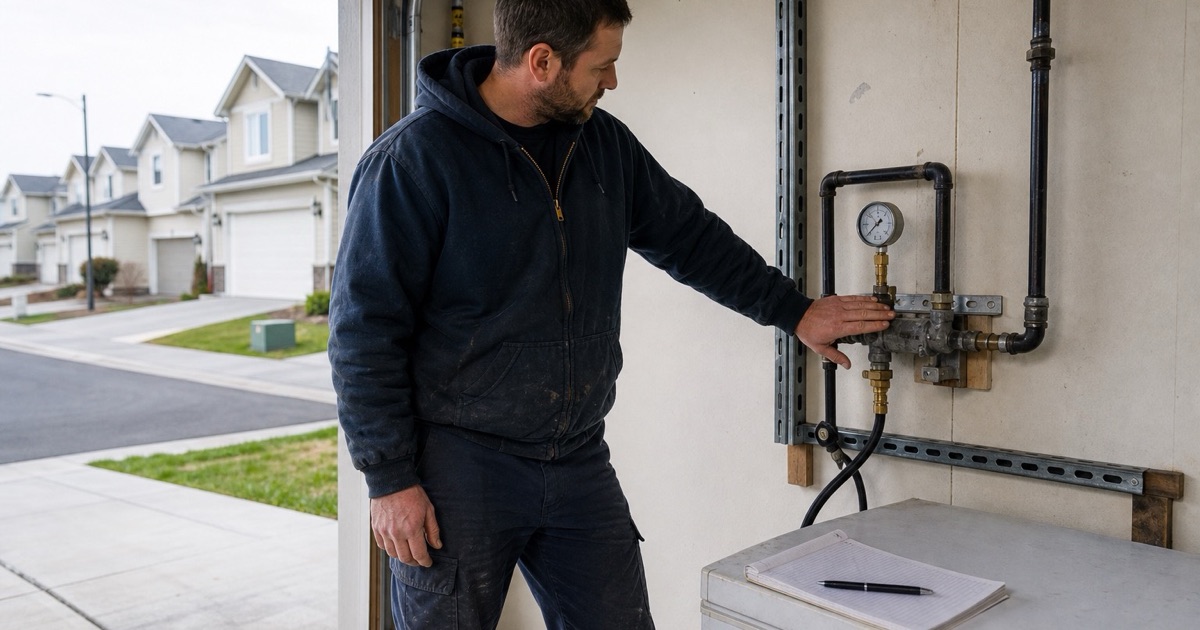
A finished system is isolated, charged to test pressure and held while the gauge is watched, on an instrument whose range is no more than twice the test pressure and graduated in tenths of a psi. A coarser gauge reads a slow loss as no loss at all, which is how a leaking system passes.
You keep that written result on every job, whether or not an inspector asked for it, along with photographs of the route and depth of anything we buried. On a street where the neighbors will be having the same work done, that documentation is worth having. More than once it has been the thing that told the house next door what to expect and what a fair price for it looked like.
- Licensed & Insured
- Same-Day Leak Response
- Free Written Quotes









