
Santa Ana Gas Line installs, repairs and replaces gas piping throughout Cypress, California. The job that comes up most often here is not a failing line at all — it is a working line being asked to carry something it was never sized for, because the house has gained appliances since it was built.
The stock is largely 1960s and 1970s, and it was piped for what a house of that period ran: a furnace, a water heater, a range, perhaps a dryer. Since then the same branch has picked up a tankless unit, an outdoor grill, a fire feature or a second dryer, each added on the reasonable assumption that one more appliance is a small thing.
Individually it usually is. Collectively it is not, and the point at which a system stops coping is rarely dramatic. Nothing fails. Things simply start performing slightly below what they should, all at once, on the coldest evening of the year — and that is the fault we are most often called to look at here.
Adding Load to an Existing Branch
Totaling What the House Already Draws
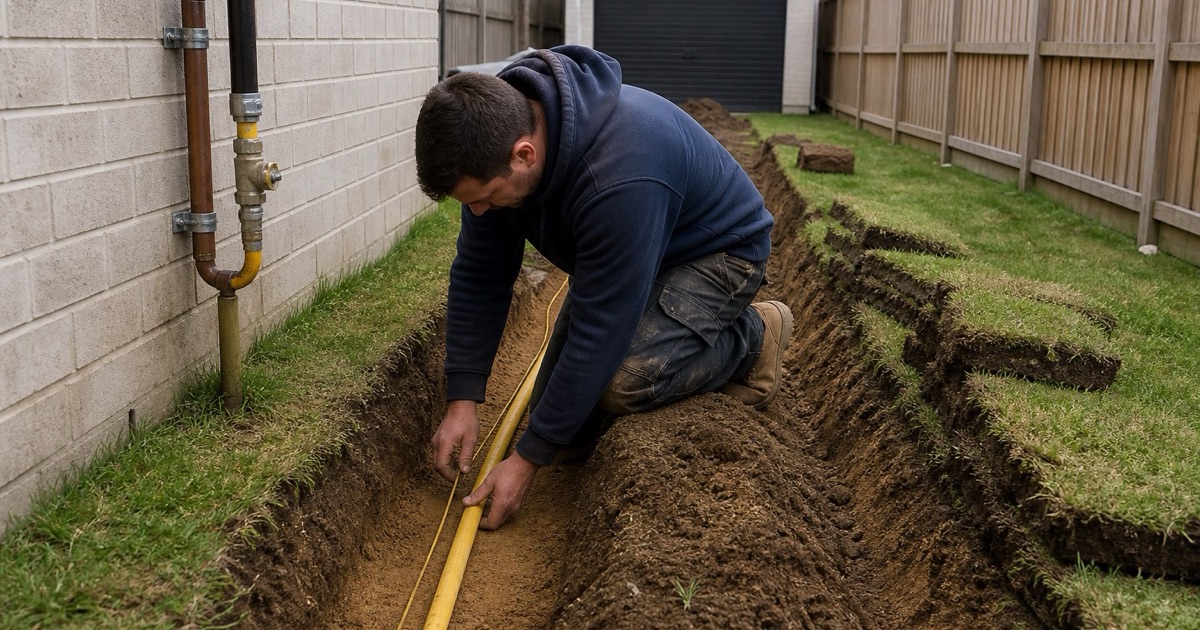
Before anything new goes on a line, the honest question is what the line is already carrying. We total the connected load of every appliance on it from the data plates rather than from a list of what the house is assumed to have, because the assumed list and the actual list diverge in a house that has been added to over fifty years. Somebody’s garage heater from 1988 counts even though nobody remembers it.
That total is then read against a pipe sizing table alongside the developed length of the run. Two houses on the same street with the same original pipe can arrive at completely different answers, purely because of what previous owners connected and where they connected it. The pipe in the wall is identical; what has been hung off it is not.
Conversions That Change the Arithmetic
A tankless water heater is the conversion that catches people out most reliably. It fires at several times the input of the tank it replaces, and it does so intermittently rather than steadily, so the branch that comfortably fed the old unit is frequently nowhere near adequate for the new one.
The unit itself will be installed correctly and will still underperform, which sends everybody looking at the appliance. We check the supply before the swap rather than afterwards, because the cost of upsizing a run is far lower while the decision is still open. Once the unit is mounted and the old tank is gone, the cheap options have gone with it.
Where the New Appliance Actually Connects
The convenient tie-in point is not always the correct one. Connecting a new load at the far end of a branch that is already near its limit loads the whole run, where taking it from a point nearer the meter may cost more pipe and solve the problem outright.
We look at where a new appliance can be fed from rather than where it is easiest to reach. On a single-story tract house with the meter on one elevation and the addition on the other, that decision is worth making deliberately rather than defaulting to the nearest available tee.
Looking for gas line closer to Fullerton? See Gas Line in Fullerton.
What Distance Adds to the Problem
Developed Length, Not Route Length
Sizing depends on developed length, which is the run plus an allowance for every fitting on it converted into equivalent pipe. A route with several changes of direction behaves like a considerably longer straight run, and tract houses tend to have plenty of direction changes, because the pipe was routed around framing rather than through open space.
We measure the actual route rather than estimating from a floor plan. It is the step most often skipped, and on a borderline system it is the difference between a calculation that says yes and one that says no, and guessing in the generous direction is how an underperforming system gets signed off.
The Appliance at the End of the Line
Pressure falls along a run, so the last appliance on it is always the one that shows a shortfall first. That produces the familiar complaint of a unit that works perfectly alone and poorly when the furnace comes on, which is a supply symptom rather than an appliance fault.
We put a manometer on the system under genuine load rather than at rest. A reading taken on a quiet system describes a state the appliance never actually operates in, and it is how a real supply problem gets signed off as fine. We take the reading with the furnace calling and the water heater firing, which is the condition the complaint actually describes.
Upsizing Versus Reworking
Sometimes the answer is a larger main run; sometimes it is a separate branch to the new load; occasionally it is neither and the meter itself is the limit. Those are three different jobs at three different prices, and the calculation decides which one applies.
We give a fixed-price written quote before anything is opened up, and the number agreed at the walkthrough is the number on the invoice. Cypress is a city in northwestern Orange County with a population of just over fifty thousand, and the housing here is consistent enough that we can usually say early which of the three is likely.
Traps, Shutoffs and Connectors
The Sediment Trap
Every appliance wants a sediment trap, sometimes called a drip leg, dropping below the tee ahead of it. On an older system that has been altered several times, traps are among the most commonly missing components, because each alteration was done quickly and the trap was the easy thing to leave out. Nobody notices a missing trap until something downstream of it stops behaving.
We fit them where they belong and add them where they were skipped. Debris in a line moves toward whatever is drawing, and the appliance that ends up with it is usually the newest and most sensitive one on the system.
A Shutoff Within Reach
Every appliance also needs its own shutoff, positioned where somebody could actually reach it in a hurry rather than behind the appliance it isolates. In garages that have gained storage over the decades, that requirement is quietly defeated more often than not, by shelving, a freezer or twenty years of accumulated storage.
We place them so a single appliance can be isolated without shutting off the house. It costs very little at installation and it is the difference between a small problem and an evening without heat or hot water.
Connectors and What They Are Rated For
A flexible appliance connector is the right component in the right place and the wrong one when it is used to make up distance, run through a wall or serve as permanent piping. Replacing an old connector during an appliance swap is routine, and it is worth doing rather than reusing.
Outdoors, a quick-disconnect gas outlet is the correct answer for anything that moves — a grill on a patio does not want to be hard-piped. We fit the right component rather than the one already at hand.
Testing, Permits and Handover
Proving the Altered System
Any alteration means the system gets tested, not merely the new section. A house that has been added to repeatedly can have an existing defect that only becomes visible when somebody finally puts the whole run under test pressure.
We use a gauge rated to no more than twice the test pressure, graduated in increments of a tenth of a psi, and we hold the test properly. Where a leak is indicated we survey with an electronic combustible gas detector and confirm at the joint with a soap bubble test.
Who Deals With the Paperwork
We pull the permit and schedule the inspection rather than handing either to the customer. Fuel gas piping falls under Chapter 12 of the California Plumbing Code, Title 24 Part 5, and the work is carried out under a CSLB C-36 plumbing classification.
Where a meter has been shut off, we arrange the re-light appointment with the gas company once the work passes rather than leaving the customer to chase it. That single step is the one most often left undone by others.
What You Are Left With
A written pressure test result is handed over at the end of every job whether or not an inspector asked to see one. On a system that will almost certainly be added to again, that document is the new baseline for whoever works on it next.
The people who quoted the work are the people who ran the pipe, and they are the same people who answer the phone if it needs attention later. We do not subcontract crews, which on repeat work in the same neighborhoods matters more than it sounds.
- Licensed & Insured
- Same-Day Leak Response
- Free Written Quotes









