
Santa Ana Gas Line installs, repairs and replaces gas piping throughout Costa Mesa, California, on both commercial and residential property. That covers restaurant and commercial kitchen gas, tenant improvement work, process and heating load in light manufacturing, and the full range of domestic work from leak detection to whole-house repipes.
Costa Mesa is the most genuinely mixed market in this ring, and the mix is the thing that shapes the work. Retail, commerce and light manufacturing sit alongside a substantial residential market, and a gas contractor here moves between the two within the same week.
For a gas contractor that means two different trades running side by side, with different codes of practice, different inspection expectations, different timelines, and very different consequences when something is not ready on the day.
Commercial Kitchen and Restaurant Gas
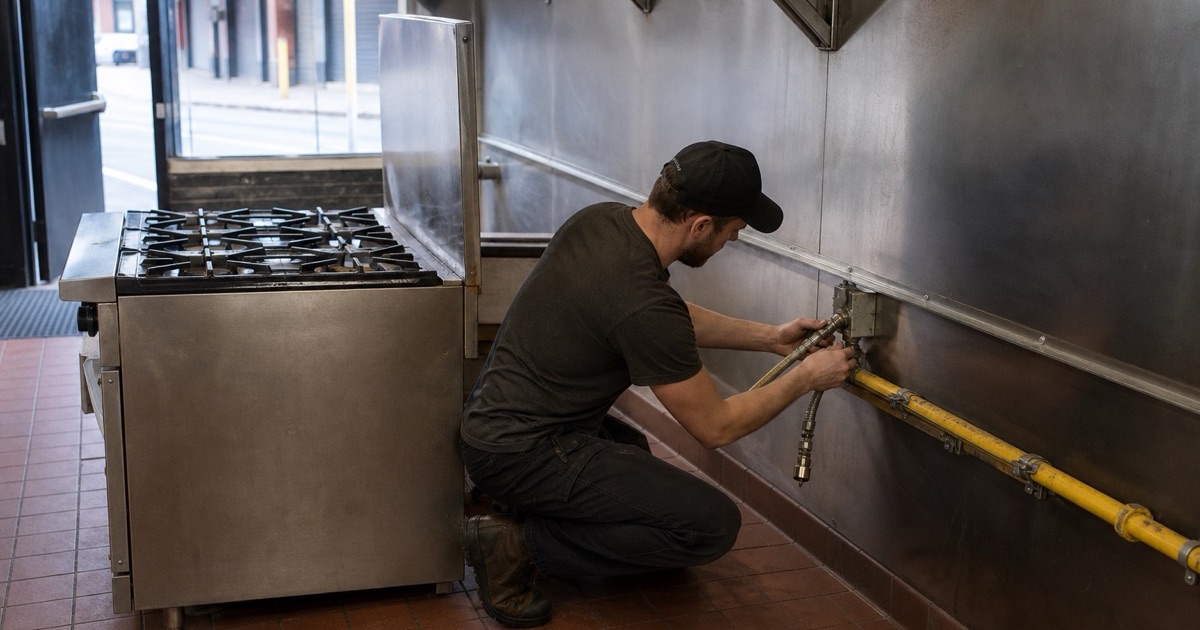
Sizing for a Commercial Appliance Schedule
A commercial kitchen concentrates more gas load into a smaller footprint than anything in residential work. Ranges, fryers, griddles, char broilers, ovens, steamers and a water heater can all be expected to run simultaneously, which means the line has to be sized for the total connected load rather than a diversified estimate.
We total the input of every appliance on the schedule, measure the developed length including fittings, and read both against a sizing table for the material and delivered pressure. Undersizing here does not present as a fault — it presents as equipment that never quite performs, which a kitchen will blame on the equipment for years. By the time somebody measures the delivered pressure, two perfectly good fryers have usually been replaced.
Tenant Improvements and Turnover
Restaurant space turns over, and each new operator brings an appliance schedule that has nothing to do with the last one. Gas piping left by the previous tenant is frequently the wrong size, in the wrong place, or capped where the new layout needs an outlet.
We survey what is actually there before the layout is finalized rather than after, because the position of the existing trunk often decides where the cook line can economically sit. Bringing us in at the drawing stage costs nothing and regularly saves a change order. It also means the permit application reflects what will actually be built, rather than being amended halfway through the fit-out.
Working to an Opening Date
Commercial gas work almost always sits on a critical path with a fixed date at the end of it, and the constraint is rarely the pipe. It is the permit, the inspection and the utility, each of which runs on its own schedule and none of which moves for an opening.
We plan the sequence backwards from the date, pull the permit early, and coordinate the inspection and any utility involvement so those steps are not discovered late. Where the timeline genuinely does not work, we say so at the quote rather than at the deadline. An operator who knows in week one that the inspection will not clear before the planned opening can move the date; one who finds out in the final week cannot.
Looking for gas line closer to Garden Grove? See Gas Line Services in Garden Grove.
Light Manufacturing and Commercial Buildings
Process and Heating Load
Light manufacturing uses gas for process heat as well as for space heating and water, and the two have different characteristics. Process equipment often demands a steady, well-regulated supply at a specific pressure, and a system sized only for the building’s heating load will not deliver it.
We establish what the equipment actually requires from its data plate rather than from an assumption, and size and regulate accordingly. A line pressure regulator and its vent piping are part of that design, and corrugated stainless steel tubing is not permitted in regulator vent piping. That restriction catches people out precisely because the tubing is permitted almost everywhere else on the same system.
Roof-Mounted and Exterior Equipment
Commercial buildings put a good deal of gas-fired equipment outside, on roofs and in yards, where exposure and access both matter. Exterior runs need materials and supports rated for the location, terminations that can be reached for service, and protection where anything crosses a traffic route.
We plan those runs for the people who will maintain them rather than only for the installation. A shutoff that requires a lift to reach is technically compliant and practically useless at two in the morning when something needs isolating. We would rather add a valve at a sensible height during installation than explain that limitation to a maintenance contractor later.
Shutdowns and Occupied Buildings
Work on an occupied commercial building is scheduled around the tenant, which frequently means evenings, weekends or phased isolation so only part of the system is down at a time. That takes planning and it takes the isolation points existing in the first place.
Where a building’s gas system has no sensible way to be sectioned, we will say so and quote the valves that would fix it. It is a small cost during other work and it is what makes every subsequent job on that building cheaper.
Residential Work in Costa Mesa
Older Housing and Original Steel
The city grew from a semi-rural farming community of 16,840 after its incorporation in 1953 into an urban area taking in part of the South Coast Plaza and John Wayne Airport edge city, one of the region’s largest commercial clusters. Alongside that commercial market there is a substantial residential one, and the older parts of it carry the same original threaded steel piping found across this region. It corrodes from the inside out and fails at joints and low points, and the diagnostic question is whether a leak is the first or the second.
We survey the whole system rather than the reported fault and give you the finding with a fixed price against repair and against replacement. The population was 111,918 at the 2020 census, and a good share of that housing is old enough for this to be the live question. The answer is rarely obvious from the outside, which is why we test rather than estimate from the build year alone.
Appliance and Amenity Connections
Domestic work here runs the usual range: ranges and cooktops, dryers, tankless water heaters, fireplace conversions, and outdoor kitchens and fire features for a climate that supports them most of the year. Each needs the branch checked for capacity before anything is connected to it.
Adding an outlet to a line already at its limit does not fail visibly. It means the furnace and the water heater run short whenever the range is on, which gets blamed on the appliances rather than on the pipe feeding them. Reading the delivered pressure at each appliance while it is actually firing settles that argument in a few minutes.
Permits, Testing and Handover
Residential and commercial gas work are both permitted, and we pull the permit and meet the inspector rather than leaving that with the owner or the tenant. The fee appears on the quote rather than afterwards.
Every finished system is isolated, charged to test pressure and held while the gauge is watched, and you keep the written result. Where the supply was interrupted we arrange the utility’s re-light and check every appliance back into service, verifying the pressure each one receives while it is firing.
Where Commercial and Residential Meet
Mixed-Use Buildings and Shared Systems
Costa Mesa carries a good deal of property where a commercial ground floor sits under residential above, or where a converted building serves both purposes. Gas systems in those buildings frequently grew by addition rather than by design, and the boundaries between what serves whom are not always obvious from the pipe.
Establishing which meter feeds which tenancy, and where the isolation points actually are, is the first thing we do on a building like that. It decides who authorizes the work, who is billed for it, and whose supply has to be interrupted to carry it out, and getting it wrong is expensive in a way that has nothing to do with pipework.
Landlords, Tenants and Who Owns the Fault
The split between landlord and tenant responsibility for gas piping is a recurring source of delay, particularly on restaurant space where the tenant installed the appliances and the landlord owns the building. A fault on the house side and a fault on the tenant’s side are the same repair and a completely different conversation about who pays.
We identify where the fault sits and put it in writing before any work is agreed, so the discussion happens with a fact in front of it. That document is frequently more useful to the parties than the repair itself, and it takes no longer to produce.
Work Scheduled Around a Business
Gas work in an occupied commercial building is scheduled around trading hours, which usually means evenings, early mornings or a phased shutdown that keeps part of the system live. What makes that possible is having sensible isolation points, and older buildings often do not.
Where a system cannot be sectioned without shutting the whole building down, we will say so and quote the valves that would fix it. It is a small addition during work that is happening anyway, and it is what makes every future job on that building cheaper and less disruptive.
- Licensed & Insured
- Same-Day Leak Response
- Free Written Quotes









