
Santa Ana Gas Line installs, repairs and replaces gas piping throughout Commerce, California. Nearly all of it is plant-scale work — process burners, large-diameter headers, high-pressure service and the regulation that steps it down — rather than the residential piping that fills our schedule elsewhere.
Commerce was laid out around industry rather than housing, and the gas systems follow from that. A plant can draw in an hour what a house draws in a season, and it draws it at a pressure a house never sees. This is not residential work made larger. The design problem is a different one.
That changes where the time goes. The pipe itself is often the quickest part of the job. Reading the equipment’s real requirement, sizing a header that several machines draw from at once, and planning an isolation that does not stop production are what a quote here is actually made of.
What Plant-Scale Load Actually Changes
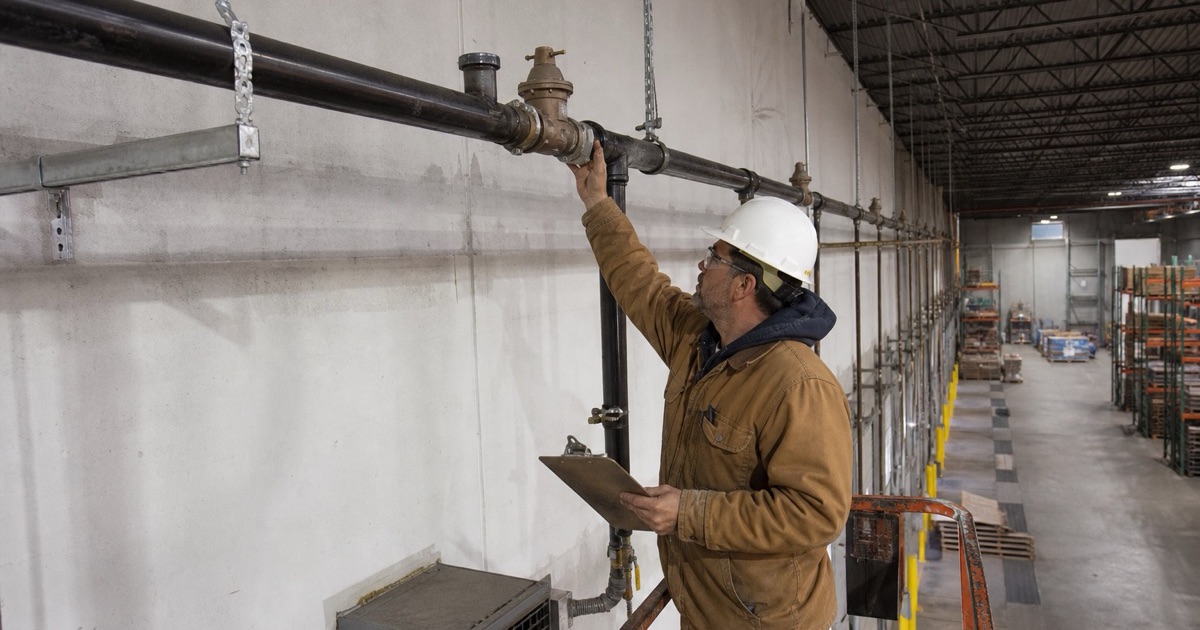
Reading the Requirement Off the Equipment
Process equipment asks for a defined pressure at a defined flow, not simply enough gas to light. A system sized around space heating and hot water will not hold that under load, and the shortfall shows up as inconsistent output rather than as anything anyone files as a gas fault. By the time someone thinks to measure the supply, the equipment itself has usually been serviced twice and cleared both times.
We take the figure from the data plate and the manufacturer’s installation sheet rather than from a rule of thumb, then run a BTU load calculation against a pipe sizing table across the whole connected load. That number is what the rest of the design has to answer to, and it is the one figure we will not take on trust from a previous installer.
Sizing a Header Rather Than a Branch
A house has branches off a small main. A plant has a header that several pieces of equipment pull from, sometimes together and sometimes not, and the real sizing question is which of those cases the system has to survive rather than which one is easiest to calculate. Shift patterns answer that question far better than a schedule of equipment does, so we ask about them.
We size against a realistic worst case instead of the sum of every nameplate, because a header built for a coincidence that never occurs costs money and ceiling space for nothing. Where the duty is genuinely uncertain we say so in the quote rather than burying it in a margin.
Where the Pressure Is Stepped Down
Industrial service frequently arrives above what the equipment can accept, which makes regulation part of the design rather than an accessory bolted on at the end. A Maxitrol 325 series line pressure regulator, its vent limiter and its vent piping all need to sit where they can be reached and serviced. A regulator installed somewhere nobody can get to is a regulator nobody will ever check.
Corrugated stainless steel tubing is not permitted in regulator vent piping, and that catches people out because the same material is allowed almost everywhere else on the system. We check vent runs specifically rather than assuming a recent installation got it right.
Looking for gas line closer to South El Monte? See South El Monte Gas Line.
Carrying Steel at Industrial Diameters
Support Spacing and Strut Channel
Schedule 40 black steel to ASTM A53 gets heavy quickly once the diameter grows, and spacing that is generous under a half-inch branch is nowhere near adequate under four inches of charged header. Strut channel, anchored into structure, is what actually carries it. The weight of the gas is negligible; the weight of the steel is not, and it is carried for the life of the building.
We set supports to the span the diameter requires and fix them to the building rather than to cladding or to another trade’s services. A header hung off something never intended to carry it is the kind of defect that passes an inspection and then fails quietly years later.
Movement, Expansion and Seismic Restraint
A long run inside an unconditioned building moves with temperature, and a building in Southern California moves for reasons of its own. Both have to be allowed for at the supports rather than left for the threaded joints to absorb. A joint is the least suitable part of a system to use as an expansion allowance, and it is the part that will tell you so.
California Health and Safety Code Section 19180 covers seismic gas shutoff valves, and ASCE 25-97 sets out what an earthquake-actuated valve has to do. Where one belongs on a system we fit it and prove it works rather than treating it as a line on a checklist.
Isolation Without Stopping the Plant
Most industrial work here happens on a live system with production running around it. The valuable part of the plan is the isolation — which section comes out, what stays fed while it does, and how long the window genuinely needs to be. Getting that wrong in either direction is expensive, and the expensive direction is usually optimism.
We walk that with whoever runs the operation before we price anything, so the shutdown we schedule is the one that suits the plant. An hour agreed in advance is worth considerably more than a day discovered halfway through.
Testing and Proving a Large System
Test Pressure Across a Large Volume
A big header holds a big volume, and volume changes how a test behaves. Temperature moving along a long run will shift the gauge on its own, so a reading has to be held long enough to separate a genuine loss from the afternoon warming the steel. A test abandoned early because the needle moved is as unhelpful as one nobody watched at all.
We use a pressure test gauge rated to no more than twice the test pressure and graduated finely enough to show a real change, in increments of a tenth of a psi. Inches of water column and psi are both in play on an industrial system, and mixing the two scales is a common way to misread a result.
Proving It Section by Section
On a system of any size, testing the whole thing at once tells you only that something is wrong somewhere. Breaking it into sections and proving each in turn tells you where, and it means a fault found late does not put the entire job back to the start. On a header feeding a dozen machines that difference can be a day rather than a week.
Where a leak is suspected rather than confirmed we survey with an electronic combustible gas detector and confirm at the joint with a soap bubble test. Two methods that fail differently are worth more than one used twice.
The Written Result
Every job ends with a written pressure test result handed over, whether or not an inspector has asked to see one. On an industrial site that record tends to matter more than it does on a house, because the next contractor, the insurer and the plant’s own maintenance file all eventually come looking for it.
The people who ran the pipe are the people who sign that sheet. We do not subcontract crews, so the person who quoted the work is the person who tested it and the person who answers the phone if it needs attention later.
Permits and the Utility Boundary
Who Pulls It
We pull the permit and book the inspection ourselves rather than handing either to the customer as a task to chase. On a working plant the inspection has to be fitted around production, which is far easier to arrange when the person scheduling it is the person doing the work. Handing that to a plant manager as a to-do is how a finished job sits uninspected for a month.
Fuel gas piping falls under Chapter 12 of the California Plumbing Code, Title 24 Part 5, and the work is carried out under a CSLB C-36 plumbing classification. Commerce sits in southeast Los Angeles County, and the county’s adoption is what the inspection is measured against.
Where the Utility Stops
Everything downstream of the meter is houseline, and it belongs to the site rather than to the gas company. On an industrial parcel that can mean hundreds of feet of steel and a dozen pieces of equipment. The SoCalGas service delivery point is the line between their responsibility and ours.
Where the meter set assembly itself is the constraint rather than the piping behind it, we say so early instead of discovering it after a header is in. The city is served by the Long Beach and Santa Ana freeways and by Metrolink at the Commerce station, and on a large delivery the route in matters nearly as much as the date.
Locating What Is Already Buried
Industrial parcels accumulate services, and the drawings rarely keep pace. Before any trenching we locate and mark what is already there, including the customer-owned runs an 811 DigAlert ticket does not cover, because the utility marks only as far as its own asset.
We photograph the route and the depth before a line is covered and hand those images over, so the next trade on site knows what is under the slab. Trenches are backfilled and compacted, and hardscape is put back the way we found it.
- Licensed & Insured
- Same-Day Leak Response
- Free Written Quotes









