
Santa Ana Gas Line installs, repairs and replaces gas piping throughout Artesia, California, on residential and commercial property alike. That covers leak detection, repipes on original steel, buried yard runs and appliance connections on the domestic side, and restaurant and commercial kitchen gas, tenant improvements and building systems on the commercial side.
The commercial half of this city is concentrated rather than dispersed. A dense main street of restaurants and food businesses puts a great deal of connected gas load into modest premises, and those buildings have usually served a succession of operators, each leaving piping shaped around an appliance schedule that no longer exists.
The residential half is compact older housing where the familiar pattern applies. Threaded Schedule 40 black steel corrodes from the inside out and gives way at joints and at low points, so faults arrive in groups rather than singly. A second leak within a year of the first is a pattern rather than misfortune, and it is the point at which the conversation ought to change.
Restaurant and Commercial Kitchen Gas
Sizing for the Real Simultaneous Load
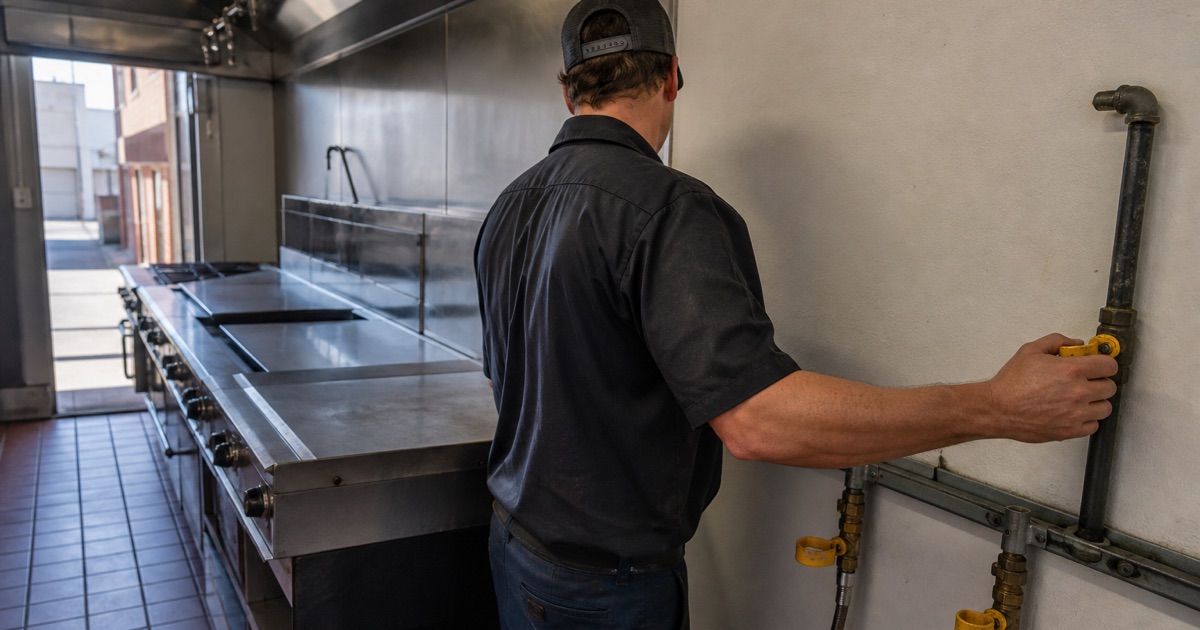
A commercial kitchen expects ranges, fryers, griddles, char broilers, tandoors, ovens and water heating to run at the same time rather than in turn. The supply has to be sized for that genuine simultaneous total, not a diversified estimate that assumes some of it is idle. Undersizing does not present as a failure; it presents as equipment that never quite performs.
We total the input of every appliance on the schedule, measure the developed length of the run including its fittings, and read both against a sizing table. By the time somebody finally puts a manometer on the line, two perfectly good fryers have usually been replaced already. That is an avoidable expense and it is entirely a supply problem rather than an equipment one.
Piping Left by Previous Operators
Premises on an established restaurant street have usually served several businesses, each leaving gas piping shaped around its own equipment. What arrives with a new tenancy is frequently the wrong size, in the wrong position, or capped exactly where the new layout needs an outlet.
We survey what is actually in the space before the drawings are finalized, because the position of the existing trunk often decides where a cook line can economically sit. Being involved at that stage costs nothing and regularly saves a change order, and it means the permit reflects what will genuinely be built. Amending a permit halfway through a fit-out delays every trade queued behind it, not only the gas work.
Working Around a Trading Business
Gas work in an occupied restaurant is scheduled around service rather than around the contractor, which usually means late evenings, early mornings or a phased shutdown keeping part of the system live. What makes phasing possible is isolation valves in sensible positions, and older buildings frequently lack them.
Where a system cannot be sectioned we say so and quote the valves that would fix it. A restaurant that can keep trading during a repair is worth the valve several times over, and it changes the economics of every future job in that building. Owners who have added proper isolation once do not go back to closing an entire premises for a single repair.
Looking for gas line closer to Santa Fe Springs? See Santa Fe Springs Gas Line.
Compact Residential Stock
Surveying Rather Than Chasing
On a small house it is tempting to treat the reported leak as the whole job, and on housing of this age that is usually a mistake. We sweep the full system with an electronic combustible gas detector and isolate sections under test pressure, because the fault that prompted the call is frequently not the only one. That survey takes about an hour and changes the right recommendation often enough to be worth doing every time.
The survey also identifies runs capped rather than removed when an appliance came out, which is common on housing altered repeatedly. Those abandoned sections are why a pressure test will not hold for a cause nobody can locate, and resolving them is better done before a remodel than during one.
Repair or Replace, in Writing
One failure on a system that otherwise tests clean is a repair, and impact damage to a buried line is a repair regardless of age. The answer changes when the same line has been repaired before, when the failure is corrosion at a threaded joint, or when the survey found several faults on one original run.
You get both options with a fixed price against each and the finding that produced the recommendation. If you would rather repair a system we believe is finished, we will do it and note the reasoning on the paperwork. It is your property and your decision to make. What we will not do is carry out that repair without first telling you plainly what the survey found.
Routing in a Small House
Compact properties leave very little room for a gas run to take an easy path, and there is rarely a route that avoids finished surfaces entirely. Corrugated stainless steel tubing listed to ANSI LC-1 and CSA 6.26 threads through existing framing far more readily than rigid pipe, which reduces the openings needed.
It requires a 6 AWG copper bonding conductor and is not permitted in regulator vent piping, and Schedule 40 black steel remains correct where a rigid exposed run is practical. We set out which material goes where on the quote so the reasoning is visible. A run that mixes materials deliberately is a better installation than one that forces a single product everywhere.
Buried Runs and the Meter
The Underground Section
Lots of this vintage frequently carry a buried run to a heater, a detached garage or the building itself, laid when everything else was and never examined since. Buried steel in wet ground corrodes on a different schedule from interior pipe, and nothing about it is visible from the surface.
We isolate the underground portion and test it separately, which establishes whether a loss is above or below ground before anybody excavates. That measurement regularly reduces the scope of a job rather than expanding it. Knowing the loss is above ground turns a trenching quote into an afternoon’s work indoors.
Where the Meter Sits
Where a meter sits at the curb rather than against the building, the entire run from the sidewalk back is customer-owned pipe rather than the utility’s. On older lots that section is frequently original, and most owners assume the gas company owns it.
Establishing which side of the service delivery point a fault sits on is part of the survey rather than an afterthought. It decides who does the work and who pays for it, and it avoids waiting on a utility that was never coming.
Locating on a Dense Street
Every excavation is preceded by a locate that goes further than an 811 ticket, because the utility marks only as far as the meter and the customer-owned yard line appears on nobody’s ticket unless a private locate is arranged.
On a dense commercial street with buried services sharing a narrow strip of ground, that locate is the single most valuable hour of the job. Striking a live gas line on a restaurant row is not a delay; it is an evacuation.
Permits, Testing and Handover
Permits and Inspection
Residential and commercial gas work are both permitted, and we pull the permit and meet the inspector rather than leaving that with an owner, a tenant or a general contractor. The fee appears on the quote rather than afterwards as an extra.
Where piping is altered as part of a fit-out or remodel, the piping test is taken after lath or gypsum board is in place, which catches damage from the drywall screws themselves. On a job running several trades in parallel that is the step most often missed.
Proving the Finished System
A finished system is isolated, charged to test pressure and held while the gauge is watched, read in inches of water column for low-pressure work and psi above that. The gauge range must be no more than twice the test pressure and graduated in tenths of a psi.
A coarser instrument reads a slow loss as no loss at all, which is exactly how a leaking system passes a test. You keep the written result on every job, and on commercial premises it is also what a landlord and an insurer will want to see.
Getting Everything Back On
Where the supply was interrupted, every appliance has to be relit and checked in turn and the lines purged of air. We verify the delivered pressure at each while it is actually firing and check for spillage at the draft hood on anything that vents.
In a commercial kitchen that final pass matters more than anywhere else, because a line that tests perfectly can still hand back an appliance that is underperforming. We would rather find that before the kitchen does. A second call during service is considerably more expensive for an operator than an extra hour on the first visit.
- Licensed & Insured
- Same-Day Leak Response
- Free Written Quotes









