
Santa Ana Gas Line runs and connects appliance gas lines across Santa Ana, California — ranges and cooktops, dryers, tankless and tank water heaters, wall and central heaters, and gas fireplace inserts. Whether it is a new branch into a kitchen or a connection at an appliance that already has a line waiting, the work is sized, permitted where required, and tested.
Appliance connections are where most gas work goes wrong, and it is because they look simple. A flexible connector, a shutoff and a fitting is a ten-minute job to look at, which is exactly why it gets done without checking whether the branch behind it can carry the appliance being hung on it.
The two questions worth asking before anything is connected are whether the line has the capacity and whether the termination is right. Neither is visible from the appliance. Both are answered before we quote.
Kitchen Appliances
Ranges and Cooktops
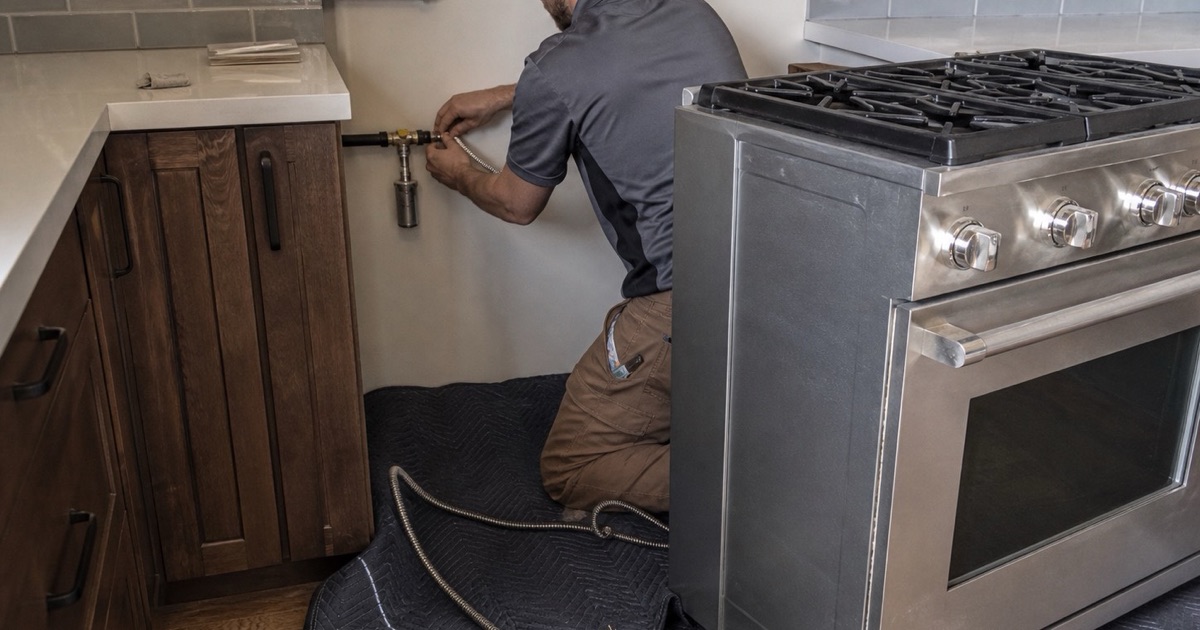
Putting a gas range where an electric one stood means a new branch to the kitchen, a shutoff behind the appliance that can be reached, a sediment trap to catch debris before it reaches the burner orifices, and a flexible appliance connector rated for the duty. The pipe is rarely the difficult part. Getting a route into a finished kitchen without opening more wall than necessary is, and it usually decides where the branch comes from and what the job costs.
Why the Connector and Shutoff Matter
A flexible connector has a service life and is not meant to be reused when an appliance is pulled out and put back — which is exactly what happens during most kitchen work. A shutoff that no longer seats properly is equally common and equally quiet. These are inexpensive parts that fail in ways that present as a mysterious gas smell, and they are worth replacing whenever an appliance is disturbed.
Dryers and Laundry Connections
A gas dryer needs its own connection, a shutoff and enough clearance behind the appliance that the connector is not crushed against the wall when the dryer is pushed back. That last point sounds trivial and is the most common defect we find on laundry connections. Where a laundry is being moved or added, the branch is sized alongside whatever else is on that run.
Water Heaters and Heating Appliances
Tank Water Heaters
Replacing a tank heater like for like is usually straightforward, but it is worth checking the delivered pressure and the condition of the connector and shutoff while the old unit is out, because that access does not come round often. A sediment trap where the installation calls for one costs very little at that moment and prevents debris reaching the control valve.
Tankless Water Heaters
A tankless unit fires at several times the input of the tank it replaces, and the branch that fed the old heater almost never carries it. This is the single most common reason a tankless installation stops on the day, with the appliance on the driveway and the pipe one or two sizes short. We size and run the supply ahead of the swap so the pipe and the appliance meet the same standard.
Wall Heaters, Furnaces and Fireplace Inserts
Wall heaters are common in housing of this era and are often the appliance furthest from the meter, which makes them the first to suffer on a marginal line. Fireplace inserts and log sets need a line to the hearth terminating at a shutoff the code requires you be able to reach. Converting a wood-burning firebox to gas is a frequent retrofit here, where the masonry is sound but nobody wants to burn wood.
Sizing, Permits and Testing
Checking the Branch Has Capacity
Before an appliance goes on an existing line we add up what that line already feeds and compare it against the developed length and the delivered pressure. Adding an outlet to a branch with no headroom does not fail visibly — it just means the furnace and the water heater run short whenever the range is on. Where the numbers do not work, the answer is upsizing the trunk rather than hoping.
Permit and Inspection
Adding an outlet or altering piping is permitted work through the City of Santa Ana’s Planning and Building Agency. Permit issuance is $70.06 and an additional gas outlet is $8.99, while extending or altering a system is $83.45. We pull the permit where the work requires one, show the fee on the quote, and meet the inspector rather than leaving that with you.
Testing and Handover
Any altered piping is recharged and held under test pressure before it is signed off, and you keep the written result. We then run the appliance, verify the pressure it actually receives while it is firing, and check for spillage at the draft hood on anything that vents. An appliance that lights is not the same as an appliance that is right.
- Licensed & Insured
- Same-Day Leak Response
- Free Written Quotes